How to Build a Backyard Quinzhee

A what? A quinzhee.

Life is Good in a Quinzhee, Photo © Liesl Clark

Life is Good in a Quinzhee, Photo © Liesl Clark

Quinzhee is an Athabaskan word for snow shelter and when there’s enough snow about, our resident mountaineer can’t help but make one with the kids. Mountaineers learn how to build them as an emergency refuge from the ravages of winter storms in the mountains. It’s more fun when you have one just 5 feet from your back door.

How do you build a quinzhee? It’s easy. And you don’t need a lot of snow on the ground to pull it off. We built this one with only about 8 inches of snow on the ground.

First make a huge pile of the white stuff, packing it with shovels and skis if you have them, without walking on the pile. Get it as tall as you can and make it cone-shaped, adding a good volume of snow to the back end. Really pack it down. Let it sit as long as you can, to settle the snow and let the snow crystals sinter. Sinter? Yes, sinter. Sintering is bonding of the snow crystals and this happens when snow crystals come in contact with each other. Packing it really helps.

We let ours sit over night. But you might not be so lucky. In the event you are stuck out in a storm in your backyard because you forgot your house key, you can let it sit for an hour.

It Might Look Like a Pile of Snow. But In No Time It'll Be Home.

It Might Look Like a Pile of Snow. But In No Time It’ll Be Home.

Next, you’ll want to cut a small entrance close to the ground. You’re essentially cutting a flat slab-like face on the surface of the quinzhee. Then, you can start digging into it.

Digging Out the Tunnel, Photo © Liesl Clark

Digging Out the Tunnel, Photo © Liesl Clark

Dig a small tunnel to start, only large enough to allow your body to slither in. Dig in about a body-length. Then you can start to enlarge the room.

Excavating Snow From the Quinzhee, Photo © Liesl Clark

Excavating Snow From the Quinzhee, Photo © Liesl Clark

Dig an oval-shaped room, complete with sleeping platforms on either side of the tunnel and inside the void. You want to elevate the sleeping platforms off the ground if you have enough space because the cold sinks to the bottom and the small entrance-way will keep the heat from escaping out the entrance because your entrance is low to the ground. But if you just want it to be a fun playspace, forget about the sleeping platforms. Who’s going to camp in this thing unless they absolutely have to?

Quinzhees are actually warm at night.

Quinzhees are actually warm at night.

When the snow falls, isn’t it fascinating how we come to use it for our pleasure and benefit? Some of us like to slide on it, others strap skis on to travel over it, my husband and I like to think about how the snow can be turned into a resource for our family. This quinzhee has been a true hit.

Inside the Quinzhee, Photo © Liesl Clark

Inside the Cozy Quinzhee, Photo © Liesl Clark

Next time the snow falls, don’t just shovel the snow off your sidewalk or driveway randomly. Throw it into a big pile and you’ll have a fodder for a quinzhee in no time for the whole neighborhood to enjoy.

How (and Why) I Kicked the Paper Towel Habit

A few good rags,

A few good rags in a basket = alternative to paper towels. Photo © Liesl Clark

A few good rags in a basket = alternative to paper towels. Photo © Liesl Clark

a washing machine,

2-3 weeks-worth of cloth rags in line for laundering = sustainable replacement for paper towels. Photo © Liesl Clark

2-3 weeks-worth of cloth rags in line for laundering = sustainable replacement for paper towels. Photo © Liesl Clark

and an empty drawer

"Wiping Towel Drawer," under the counter right next to the dinner table, ready for wipe-ups. Photo © Liesl Clark

“Wiping Towel Drawer,” under the counter, right next to the dinner table, ready for wipe-ups. Photo © Liesl Clark

are all it took to convert my family from paper towels to cloth towels.

Rosie would be proud of these cloth towels. They’re definitely “the quicker picker upper” vs. Bounty, her paper equivalent.

And there’s another reason to skip paper towels altogether: Bisphenol A, a chemical linked with cancer among other things. Sadly, according to a study published in Environmental Science & Technology, our recycled paper products are now laced with this endocrine disruptor because thermal receipts that have high amounts of BPA have been recycled into most of our post-consumer paper products. Therefore, recycled content paper towels, newspapers, business cards, printer paper, even toilet paper have BPA and BPS in them. Returning to virgin pulp paper products might the healthier route to take! But the environmental impact of using virgin paper (a.k.a. loss of trees and the dioxins released in the atmosphere during the process of bleaching conventional toilet paper), according to the Huffington Post, far outweighs the small amounts of BPS found in our recycled paper toilet paper.

Oh, and BPA has also been detected in our currency.

Hazardous waste? Photo © Liesl Clark

Hazardous waste? Photo © Liesl Clark

I think this whole situation might be the perfect example of a bass ackwards trash backwards absolutely hazardous mess only humans can create. Somehow, we’ve managed to contaminate our own paper recycling streams with such toxic chemicals that post-consumer recycled paper itself is no longer a green option. Strategists say that if we stop recycling our thermal receipts or any recycled paper that has BPA in it, we may return to BPA-free papers. The problem is that according to some estimates, 8 million tons of BPA are produced each year and it’s been detected on every beach ever tested for the chemical.

The dilemma appears to fit perfectly with Urban Dictionary‘s definition of bass ackwards:

bass ackwards
Ass backwards. The state of doing (or having done) something the wrong way.
No no dude, you’ve got the cables plugged in all bass ackwards.

Before we recycle our papers into new papers and disseminate them all over the planet, into our gray water (in the case of toilet paper) and onto our countertops (paper towels) let’s find out what’s in them and exclude the papers that have toxic chemicals in them.

The bad guys: Thermal receipts have more BPA (that transfers into your skin upon contact) than any other paper, can, or plastic. Photo © Liesl Clark

The bad guys: Thermal receipts have more BPA (that transfers into your skin upon contact) than any other paper, can, or plastic. Photo © Liesl Clark

What can you do to help prevent BPA and its alternative BPS from spreading further into our watersheds? Stop buying paper towels, refuse receipts at stores, and don’t put them in your compost, your recycling, or even in your fireplace. Seems the toxic culprits need to be collected and bagged up so their chemicals can never leach into our groundwater. Think male frogs with female genitalia and you’ll get the picture. I’m considering taking the ones I collect to our household hazardous waste facility.

cloth towels instead of paper

Now, what to do with those paper towel holders? We use ours in a closet to hold rolls of string and masking, duct, electrical tape.

New Year’s Reduce, Reuse, Recycle (Re)Solutions

New Year's Reduce, Reuse, Recycle Re(Solutions) Bring Simplicity and Joy. Photo © Liesl Clark

New Year’s Reduce, Reuse, Recycle (Re)Solutions Bring Simplicity and Joy. Photo © Liesl Clark

In the New Year, I believe many of us have dreams of simplicity, homes de-cluttered and made minimal yet functional. Can this be achieved in a sustainable manner? Yes!

Sustainably reducing our junk brings a sense of freedom and joy, and I can tell you from experience that it’s entirely attainable, without trashing the environment. The key is to take simple steps toward offloading your excess items. As a byproduct, you’ll find real pleasure in seeing the value in your things and the joy they can bring others, rather than just tossing them into the landfill.

Here are 9 of our favorite New Year’s (Re)Solutions to help you reduce the stuff weighing you down:

I suggest you take a week to truly de-clutter and reduce.

STEP ONE: Each day of the week choose one room to focus on, so you don’t wear yourself out on day one. Do a decluttering pass through the room, carrying a box which will hold the items you’re ready to offload.

STEP TWO: Can any of your unwanted stuff be reused? Join your local Buy Nothing group, a gift economy where people share what they have with their neighbors. Keeping our stuff in our local materials economy is one of the greatest gifts you can give your own community, connecting you to the people around you and helping us all to reduce our consumption. See if there’s a group near you or ask the founders team to start a group in your area if you’re willing to be a local admin.

You can then post each of your items in your group. Don’t be shy! Your stuff is another person’s treasure. People give cement blocks away in our group, sticks, even used bubble wrap, extra pans of homemade lasagna, chicken feed, and unwanted jewelry. There’s no such thing as “trash” in our groups as you may find an artist who could use your discarded item or a small business owner who needs bubble wrap for packaging their items for shipping. If you don’t have a Buy Nothing group in our area, then move on to step 3.

STEP THREE: Have a few spare boxes ready to hold your leftover unwanted and unused items in your garage, basement, attic or spare room where you can then separate the pile into distinct categories:

1) Stuff to Donate to an Animal Shelter: Do you have old blankets, towels, or extra pens and pencils hanging about? You’d be surprised to learn what items most animal shelters could use. Here’s a typical wish list for a local shelter.

To find an animal shelter near you, click to The Humane Society‘s website where they have links to the best resources for locating local animal shelters. All you need to do is input your zip code to find a local shelter. Most have a wish list online, but you can call to find out their specific needs.

2) Stuff to Donate to a Charity That Will Come and Pick Things Up: There’s nothing better than people who come to you and take away your unwanted stuff. Donationtown has a website where you can input your zip code a find a charity that will come to your home and pick reusable household items up. But if you have a local charity, like GoodWill where you can drop off your items, that’s another great option.

Are you seeing the forest through the trees? Ridding of your excess stuff sustainably isn't so hard. Photo © Liesl Clark

Are you seeing the forest through the trees? Ridding of your excess stuff, sustainably, isn’t so hard. Photo © Liesl Clark

3) Electronics Recycling: Take stock of your e-waste — your electronics that no longer work or that you haven’t used in a year or 2, and take them to Best Buy! Best Buy is one of North America’s top e-waste recyclers and you can easily find one near you. This task is a simple one: load up a cart with your old TV, computers, vacuum cleaner, and wheel it through the front door and there will be a place by the front door to leave your electronics for recycling. Done.

You Can Recycle 3 Electronic Items Per Visit to Best Buy

You Can Recycle 3 Electronic Items Per Visit to Best Buy

4) Metals can go to a nearby scrap metal facility: We save our metals in a special box to be taken periodically to our scrap metal bin found at the local transfer station. Metals of all types have value and can be repurposed into new items made of metal. Saving things that are primarily made of metal can benefit your scrap metal facility greatly and keep those precious materials out of the landfill and in our materials economy for years to come.

5) Do you have a cupboard filled with plastic containers? Reduce it by half and you probably won’t miss what you’ve removed. Save your favorite ones for storing dry goods in and then go through your jars and do the same thing. If you have extra lids, recycle them. Or if you’re missing lids, recycle the jars or containers themselves. The new year is a time to take stock and simplify! I reduced my jars by half and passed the good ones with lids on to our local senior center that collects them for projects. Check with your senior center to see if they can use them or post your jars on your Buy Nothing group. Someone will have a use for them.

6) If you’re trying to reduce old stockpiled boxes of random stuff, make a pledge to go through one box at a time. Give yourself time to go through it and separate the items into recyclable items and those that can be given away and reused. I try to remind myself that we’re stewards of our stuff on this planet and our job is to, at the end of your stuff’s usefulness to you, dispense with it responsibly.

Stockpiled Boxes in the Attic: Emptying Them Out One Per Week is Do-able.

Stockpiled Boxes in the Attic: Emptying Them Out One at a Time, Even One a Day Makes the Task Do-able.

7) If you have old family photos you want to reduce, you can always check with family members to see if they want them. By scanning them digitally, you can save them on a small thumb drive and then you have the photo paper waste to think of. There are some great ideas out there for photo reuse, like turning them into tile coasters or donating them to a scrap art store. Remember, your old family photos do have potential value, especially for your family’s future generations.

8) Books: If there were ever an easy item to help you get rid of, it’s books! Most libraries want your books as do many non-profits worldwide.  We have a local “Books and Beer” get-together every few months in our Buy Nothing group where we can meet neighbors and share our books.

9) Make a promise to yourself to be mindful of what you acquire. Promise that all new things going into your home this year will be used and loved extensively, not squirreled away in yet another box to be offloaded at the end of the year. If you don’t take my advice, you might want to listen to a slightly different perspective on reducing. It all results in the same thing, however, less waste and less unnecessary clutter in your life for stepping out into a new year.

There is an elegance to beginnings and endings of years. Make yours a stuff-free one by following our simple steps. Photo © Liesl Clark

There is an elegance to beginnings and endings of years. Make yours a stuff-free one by following our simple steps. Photo© Liesl Clark

Mapping Plastic: First Days of Our Journey

Even Point White Pier ain’t plastic-free. We found Chapstick tubes lodged in the cracks. Photo © Liesl Clark

Our journey started on a windy day. Circumnavigating Bainbridge Island to map the plastic on its shores has started off like any other beach walk where we tease plastic detritus from tall grasses, seaweed, and huge boulders. Our friends, Rebecca Rockefeller, David Dale Campbell, and their daughters met us at Pleasant Beach, aka Lynwood Center Beach, and we headed south at the day’s lowest tide in hopes of reaching Point White Pier by dark. But we hit a snag.

Rich Passage is a narrow waterway providing access between Seattle and Bremerton for ferries, submarines and naval boats from the nearby seaports. Strong tidal conditions prevail and a winter shoreline walk along the Bainbridge side of the passage is impossible. Lined entirely with bulkheads, houses built right up to the coast, Rich Passage isn’t actually passable on foot. Our map here shows the section, right at Point White, that we had to skip, but we’ll return at a minus tide in the spring to complete as much of it as possible and collect whatever plastics are plastered to the human-made coast.

Legs 1 and 2 of the Bainbridge Island Plastic Mapping Project. Our Track is in Blue.

It’s a 53-mile circumnavigation we’re undertaking and we’ve done about 2. Beginnings are all about logistics, so the fact that we managed to track our progress by GPS and map it for you here is a huge feat.

Rebecca Rockefeller Inspecting “The Armored Coast,” Photo © Liesl Clark

We resumed our route on the west side of Point White 2 days later and cleaned the armored coast of plastic to Point White Pier, a landmark on Bainbridge where the fishing is good and summer swimmers hurl themselves into Puget Sound’s frigid waters.

According to the U.S. Geological Survey, “One of the largest estuaries in the United States, Puget Sound has roughly 2,500 miles of sheltered coastline, about one-third of which is armored. An increasing regional population and rising sea level will likely increase the pressure for additional shoreline armoring. Bulkheads, seawalls, and other armoring structures protect shoreline properties from damage and loss due to erosion, but armoring can also affect the nearshore habitat that is so important to restoring and preserving the health of Puget Sound.”

The man-made basalt armor of Crystal Springs. Plastics are jammed around the boulders. Photo © Liesl Clark

We see the daily affect of the sea upon the armored coastlines we walk and know climate change and sea level rise will ultimately win out. And studies are proving that armored coasts cause increased erosion on neighboring shorelines and adversely affect wildlife habitats. For us plastic pluckers, the armored coastlines mean there’s little plastic to be procured as there’s no true high tide line. Those plastics will have to deposit themselves somewhere else.

Rope Is Easily Caught in Man-Made Boulder-Strewn Coastline, Photo © Liesl Clark

Marine rope and fishing line is easily found behind and around boulders placed along Puget Sound’s shorelines, a barrier between sea and land but a catchment sieve for ropes and lines. We approach these coastlines with steely knives, our tools to free plastic filament ropes so we can remove them permanently in an effort to prevent future entanglement of marine species. The ropes placed by people to moor or tie down their boats, of course, are left alone. Most ropes we free, we’re able to simply pull from the rocks or pick up from the high tide line.

Some marine rope is reused by our researchers. Photo © Liesl Clark

Every beach walk brings surprises, sometimes in the form of items our intrepid children would like to keep — gifts from the sea — or bizarre relics in plastic that have no purpose on a beach. The new-looking basketball was a surprise, until we found a second one and realized they can’t be uncommon. Then the plastic spongy pig thing brought shouts of joy.

A Pig on the Beach? Photo © Liesl Clark

What the? Photo © Liesl Clark

But it was the white plastic replica sculpture of “The Last Supper” that won first prize this time.

“The Last Supper” on the Beach. Photo © Liesl Clark

What weird stuff have you found on the beach?

Our beach plastics survey would be remiss if we didn’t highlight the usual suspects, like balloons. This is one of the hundreds we’ve picked up in the last year alone.

Balloon and Pool Noodle Washed Up On Bainbridge Island. Photo © Liesl Clark

If you haven’t noticed, balloons blow, and when they have a ribbon attached to them that ribbon gets wrapped up in seaweed or around the necks of curious seals. We’ve seen countless images of seals entangled in plastic. Balloons and their attendant ribbons contribute to this problem. Please consider alternatives to balloons for your next birthday party to help prevent their inevitable migration to the sea. We don’t buy gift ribbon anymore, now that we’ve seen how much of it lines our shores.

Inner Plastic Lining of a Mylar Balloon, Washed Ashore. Photo © Liesl Clark

The Tally So Far:
We’re inventorying our island plastics by item. And so far, the most populous plastics are plastic bottle caps, styrofoam chunks, earplugs, construction zone tape (37 feet), fireworks, pvc piping, snack food bags & wrappers, plastic drink bottles, styrofoam food trays, tape, and 209 feet of marine rope. We’ve recycled the plastic bottles along with any glass bottles and aluminum cans we pick up along the way — just putting what’s plucked from the sea back into our materials economy.

Items of Note?
Three plastic wreath frames presented themselves on a high shoreline bank. In an upcoming post we’ll expose what ecologists say about the affects of throwing your yard clippings and organic waste into the sea. Grass clippings are not good for our oceans, yet we’re finding that Bainbridge Island residents are piling their yard waste and organics along their sea walls so they can be pulled out to sea with high tides and storm events. Hence the wreath frames, nursery tape, plastic plant pots, and those plastic tags that tell you what kind of plant you’ve bought are found all over Puget Sound. If we find things that can be reused, we put them back into circulation. So, we’re proud to note that the two of the plastic wreath frames were shared on our local Buy Nothing group and an island neighbor will use them for upcoming holiday wreath-making. I was inspired by her enthusiasm and reused one for a wreath I made of rosemary clippings from one of our plants. We’re also collecting all golf balls, tennis balls, and beach toys to be reused by local friends.

On a lighter side, we found a very old and rusty plastic lighter from The Derby lounge in Ketchican, Alaska!

Want to join us, physically or virtually, in our adventure around Bainbridge Island on our Plastic Mapping expedition? No need for us to do this alone! Drop us a line in the comments and we’ll arrange a date.

Post-Holiday Zero Waste Living

Carefree Holiday Fun in Zero Waste Style

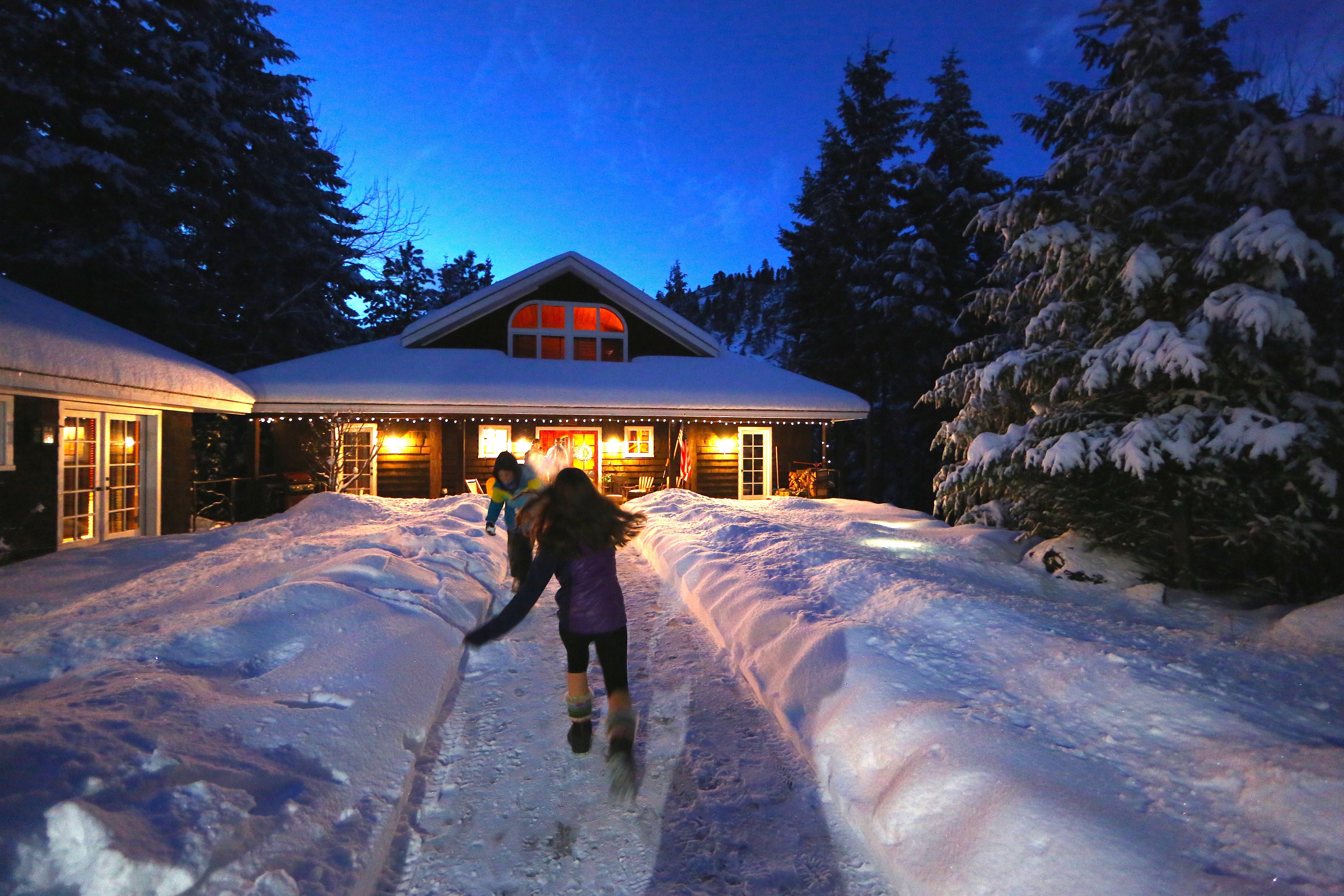
Carefree Holiday Snowball Fun in Zero Waste Style © Liesl Clark

Some reliable sources say Americans produce 25% more waste over the year-end holidays than we do the rest of the year. I’m not surprised, given the household waste-management we’re undergoing this time of year. Our consumption, through gift giving/receiving and party-throwing, is at an all-time high.

Trimming the Tree, Photo © Liesl Clark

What steps can we take to make this year a game-changer, reducing our impact at years’ end? Here are some easy zero-waste practices that should make you feel good:

  1. Recycle Your Live-Cut Christmas Tree: Most communities have tree recycling options available. Boy Scouts in some communities conduct drives to collect trees and chip them up into compost, for example. Other communities will allow you to put your tree in your yard waste bins.
  2. Reuse Your Live Christmas Tree: We throw ours in our brush pile and then cut it up for kindling once the wood has cured. But we’ve created a list of 15 reuses for your Christmas tree if you’re interested.
  3. Take a moment to turn off your power, enjoy a few hours of power disconnection with family for introspection and connection. We do this for an entire day and the appreciation for each other, and the magic of slowing down comes back  into our lives.

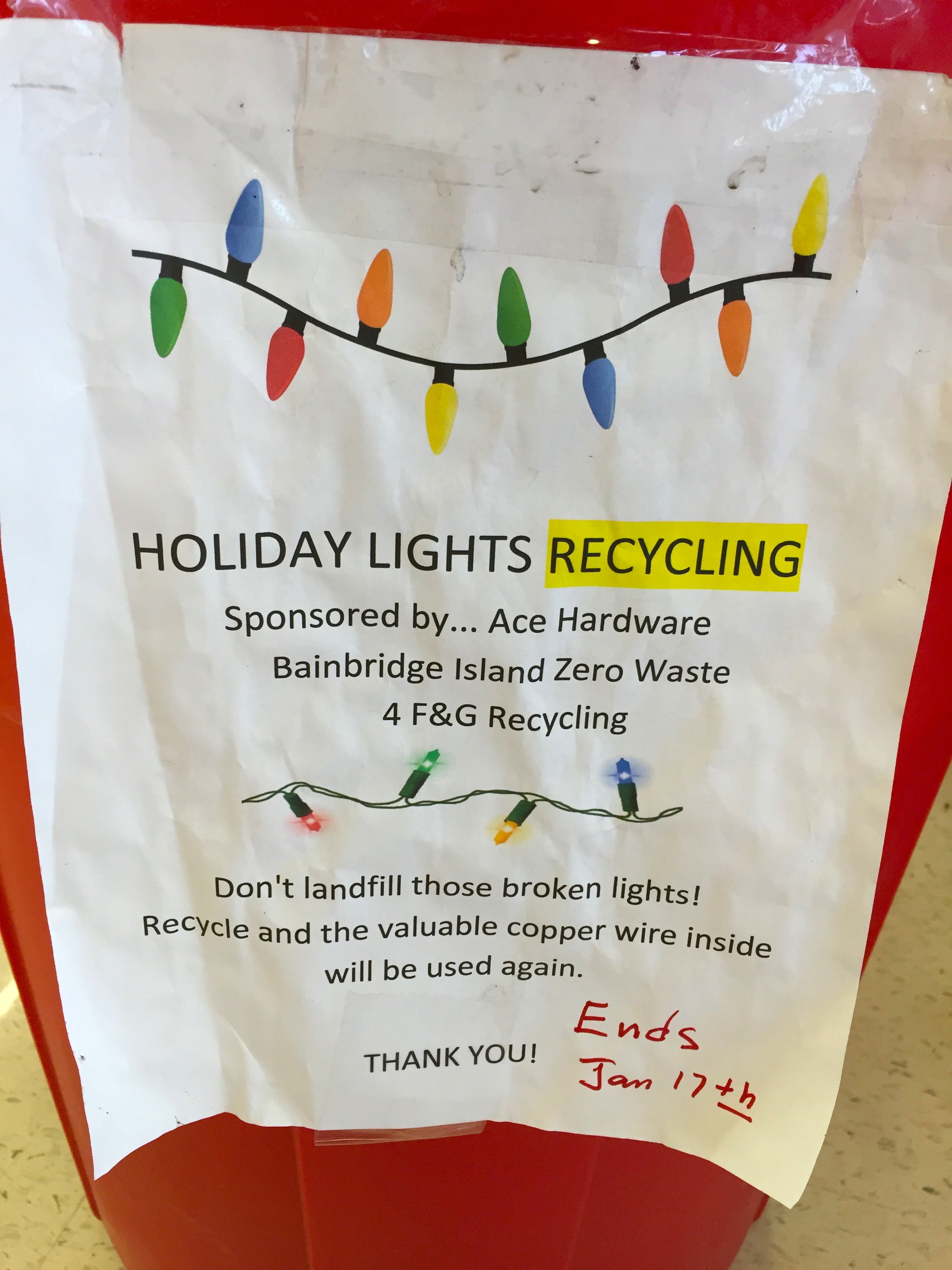
    Ace Hardware is Doing Good Things in Our Hometown © Liesl Clark

    Ace Hardware is Doing Good Things in Our Hometown © Liesl Clark

  4. Recycle your broken holiday/tree lights: When your lights stop working (and, sadly, these things are so poorly made their working life is not very long), don’t throw them away. Most communities have a local option for recycling string lights. Ace Hardware, for example, is our local drop point on our island. But if you can’t find a local venue, you can send your lights to Light Source, in Texas, where they sell used string lights for recycling and give the proceeds back to charity. Or, better yet, collect a few from friends and neighbors and send the tangled mess in a larger box so you know you’ve diverted more than your own from your waste stream. The Refining Company in Medford, OR also recycles holiday lights. Recycling string lights is a booming business in China and although the practices aren’t the most environmentally-sound, thousands of tons of string lights are kept out of our landfills. The Atlantic has a must-read article about the recycling of our string lights in China to mine out the copper wiring inside. After reading the article, I swore we’d never buy string lights again. We receive thousands of unwanted string lights at our local summer community auction, so our family retrieves a few of the unwanted strings from there each summer and use them until they stop working, which, sadly, isn’t very long. IMG_0769 copy
  5. Stockpile your styrofoam and recycle or reuse: Styrofoam is the single most prolific plastic material found on our beaches. In some communities, it has been banned. If you received styrofoam as part of a gift this holiday season, consider yourself the future steward of this highly toxic material. Finding your local recycling option for year-round styrofoam stewardship is the single best thing you could do for the environment this season. In the Seattle area, for example, a free drop-off location in Kent is the place. In the meantime, ask your local zero waste group if there’s a nearby store, like Bay Hay and Feed on Bainbridge Island, that conducts drives to collect the stuff so it doesn’t end up in our waters.
  6. Save your Christmas cards for repurposing: You can always recycle the cards you get from friends in your paper recycling bin. But a fun activity is to cut off the side with the writing and save the card with its attractive artwork for future homemade gift tags. Some people use them to create wreaths for next year, too. And I found a pretty bunting idea for displaying them on your hearth.
  7. Save all ribbon for reuse: Ribbons are made of plastic and survive in our oceans unscathed for years. We’re always surprised to find ribbon from birthday balloons wrapped up in seaweed (they are also known to entangle baby seals, sea otters and sea turtles) and once we break them free from the wrack line debris, the ribbon is as good as new. Save the ribbon you receive on gifts and give the gift of life to our marine creatures by not buying more of it. If you reuse what you have, and receive in the future, you’ll never need to buy more ribbon again. Giving and receiving is cyclical like that.
  8. Find a spot to store re-usable tape: This is a true insider’s tip. There’s plenty of tape and stickers that will peel right off a bag or shiny package and it, too, can be reused. The trick is to have a convenient spot in your home where you keep it. My friend Rebecca puts hers on the side of the fridge for the kids to access easily (kids go through gobs of tape.) We put our reclaimed tape on the inside of a closet door where office supplies are kept. Family members know that’s the community tape dispenser. We haven’t bought new tape in months.
  9. Save what wrapping paper you can for reuse: You don’t need an explanation for this. It’s yet another way to see how reuse can save you money. Most wrapping paper can’t be recycled because of the materials used to make it. Composting or burning it, too, isn’t recommended because of the toxins involved. Because we are committed to not buying new wrapping paper, what do we use? We make beautiful cloth gift bags and give them to friends and family for reuse. We recycle our children’s art as wrapping paper. We use pretty cloth as wrapping paper in the Japanese style of wrapping. We keep items in their shipping boxes and decorate the boxes with ribbon we’ve found on our beaches or plastic marine debris we’ve recovered as a reminder of our mission in the first place. These packages below are how our children creatively wrap their gifts in found items from our home or the beach:

10) Pass on your unwanted faux tree through The Buy Nothing Project or give to Goodwill: Thousands of plastic trees end up in the landfill after the holidays. These aren’t meant to be single-use items. If you need to get rid of yours, pass it on to Goodwill, sell it on Craigs List, or Buy Nothing it.

11) Don’t throw away your unwanted or broken items or toys: One of the single-most satisfying activities you can do with your family is create a workspace where you can repair the items you received over the holiday that were made to break within the first 6 months’ (or sometimes 6 hours) of use.

Send us your stories of what broke, and how you fixed it! We’re looking for inspiration from you, stories about how you defied the odds and came up with a smart solution to repair or repurpose an item so it could be diverted from a landfill and have a new life.

12) Thank your tree: And finally, a special thank you movie in tribute to the pesticide-free, sustainably grown US Forest Service tree we weeded from the dense thicket on the tree-laden slopes of the Olympic National Forest:

15 Reuses For Your Live Christmas Tree

Each year's Christmas tree is reused on our property. © Liesl Clark

Each year’s Christmas tree is reused on our property. © Liesl Clark

Before you send your live Christmas tree out on the curb for yard waste pickup or to the Boy Scouts for recycling, there may be another use that’s perfect for you and your tree.

  1. Kindling: Throw your live tree in your brush pile, let it cure, and then cut it up for kindling for next fall.
  2. Save Your Perennials from Freezing: Cover your perennial beds with your cut up pine boughs to either insulate them from future sub-zero weather, or for preserving the piled up snow that’s already on them. Repeated freeze-thaw cycles can kill your best perennials.
  3. Trivets and Coasters: Cut 1” disks from the trunk to make trivets or coasters. It’s a fun project for the kids
  4. Bird Feeder: Prop up your tree outside in the back yard and trim it with strings of popcorn and birdseed ornaments so your wild birds can have a winter feast.
  5. Do Something Really Cool With Your Tree: Fabien Cappello fashioned stools from abandoned Christmas trees on the streets of London.
  6. Plant Stakes: If you don’t have access to sticks in the woods near you, strip the branches of their needles and use them to stake your indoor plants that need some extra support.
  7. Pea Sticks: You can use the stripped branches as pea sticks later in the spring. Criss-cross them to make a trellis for your peas to grow up.
  8. Marshmallow Sticks: Those same pea sticks can then be used as marshmallow-roasting sticks in the summer.
  9. Garden Edging: Cut the trunk into disks to use as a garden border if you line them up on their sides and dig them 2” into the soil. These look really pretty on the garden’s edge.
  10. Fire Starter: We save some of our needles to use in our homemade fire starters.
  11. Potpourri: Use the needles for a homemade balsam potpourri.
  12. Garden Path: Use the disks cut from your tree trunk as flat stepping “stones” in your garden path. If you have a chipper, the wood chips from your tree can make nice garden path material, too.
  13. Erosion Barrier: We have used past trees along a slope on our property to help prevent a slope from slipping. This is our ongoing brush pile that is stabilizing the slope and holding up our lawn above it nicely.
  14. Habitat: If your tree ends up in your brush pile, or out in a spot on your property, it provides cover for birds and little rodents, making a safe habitat for plenty of critters. Some experts claim that throwing a tree into your pond can provide safe cover for your fish.
  15. Save the Blue Herons: In Illinois a special Christmas tree recycling program reuses the trees as nesting materials in a blue heron rookery.
    Our Elves © Liesl Clark

    Our Elves © Liesl Clark

    What do you do with your tree? Are there any other reuses that we didn’t include?

Easiest Prettiest Ornament You’ll Ever Make

As we’re just two days to Christmas, I’ll keep this brief. But suffice it to say, this is a great children’s activity in the days before Christmas.

Items Needed:

1 Plastic Lid

Non-stick cooking oil or spray

Glue

Leftover beads, sequins, glitter, sparkly stuff

We even used some beach glass and small shells from the beach

Piece of ribbon or yarn

All you need is to pull a plastic dairy tub lid out of the recycle bin, like a large yogurt container lid. The 4″ wide version works well but you can use a small one, too, for a smaller ornament. Spray or lightly oil with non-stick cooking oil. Then pour glue into the lid. Start placing your items in the glue spaced nicely around and don’t be shy just throw it all in there. Be sure to also stick a loop of yarn or ribbon at the top to act as your hanging ribbon. Wait for a couple of days for the glue to dry. If you place your lids in the sun or in a warm place the drying time goes faster. When it’s dry, just flex the lid around a bit and the ornament will come off easily! You end up with a pretty ornament that glows and sparkles with Christmas lights behind it. Easy!

Easy Peasy Pretty Ornament From a Plastic Lid Mold

Easy Peasy Pretty Ornament From a Plastic Lid Mold

Handmade Candles, Sharing Economy Style

Handmade Marbled Wax Scrap Candle

Handmade Marbled Wax Scrap Candle

I love making something from nothing, or at least something that costs us nothing. Our friends are kind enough to endure our yearly candlemaking and candlegiving tradition, and we boast about the fact that these candles are all made from the wax scraps friends and neighbors share with us.

Here’s how it’s done:

  1. We take old candles, or the lumps of wax left over after you’ve burned yours out, and turn them into new candles, recycling the wicks and all.
Scrap Wax From Gifted Scrap Candles © Liesl Clark

Scrap Wax From Gifted Scrap Candles © Liesl Clark

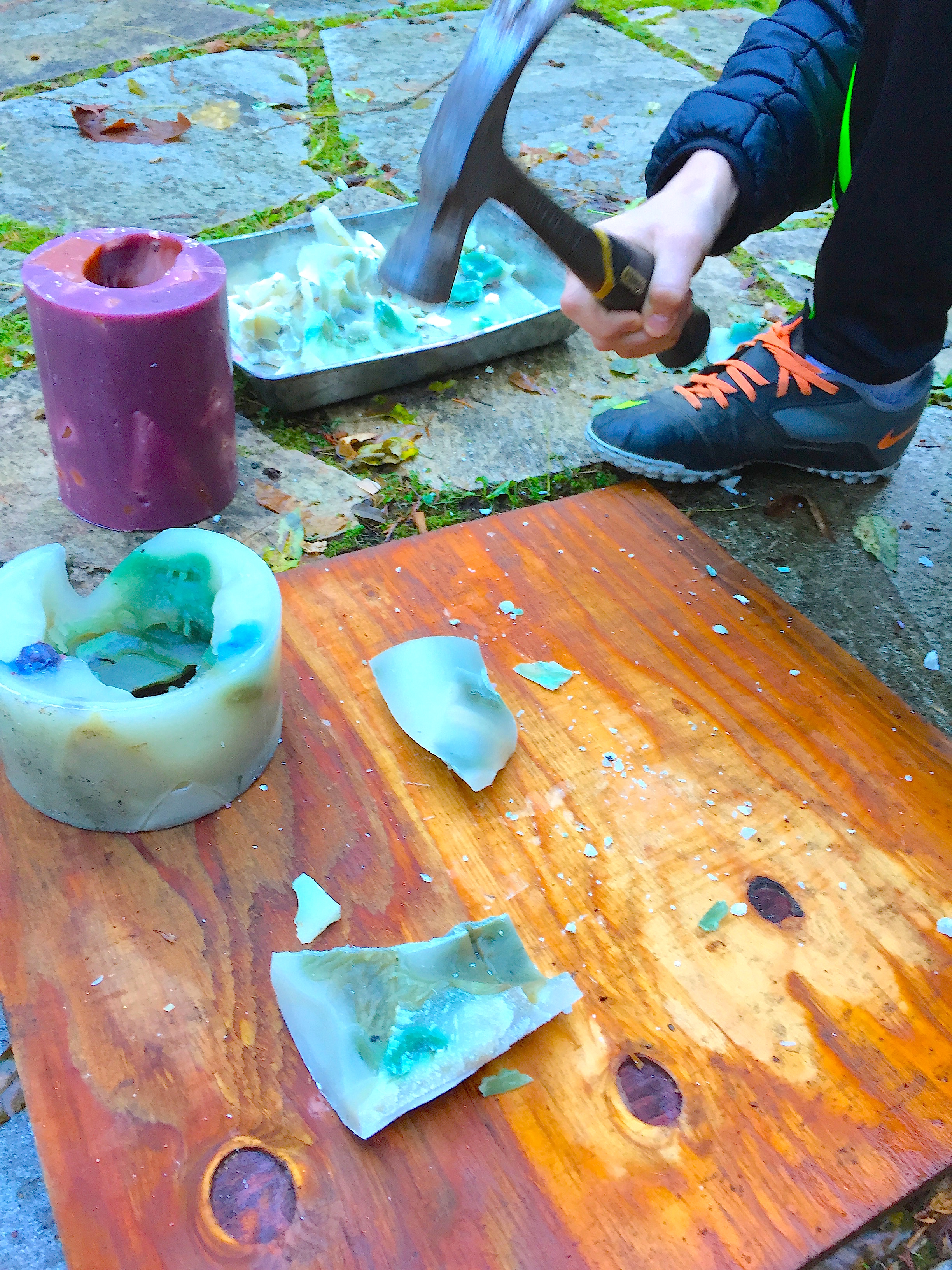
2) Using a hammer on a wooden board is our preferred method for chunking out candle wax, but we also create our own colors of melted wax, pour it into a brownie pan, let it dry and then hammer the 1-2 inch wax into pieces.

Hammering Out Wax Chunks From Used Candles © Liesl Clark

Hammering Out Wax Chunks From Used Candles © Liesl Clark

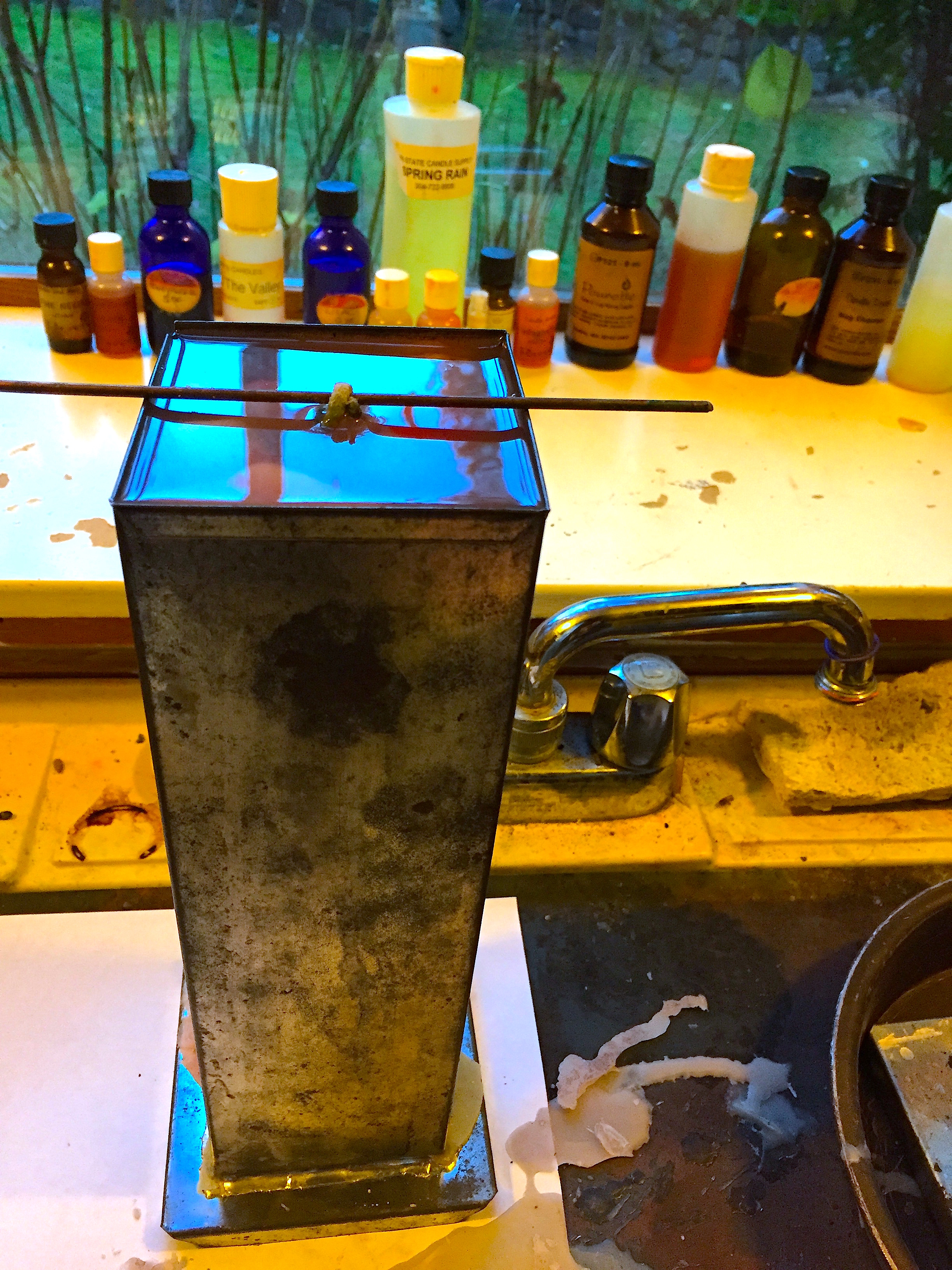
3) We have candle moulds in many shapes and fill them with chunks we create out of the used candles. Be sure to remove the wicks from the old candles and any burned parts.

Place your scrap wax inside your candle moulds.

Place your scrap wax inside your candle moulds.

4) We use wicks from old candles that we melt down and recycle them as wicks for our new candles and string the wicks into our moulds.

5) We then melt down a contrasting color of wax from saved old candles to pour into the moulds around the colored chunks. A drop or two of an essential oil can provide some aromatherapy for those in the room when your burn your new candle.

Pour Your Melted Wax Over the Chunk-Stuffed Mould. © Liesl Clark

Pour Your Melted Wax Over the Chunk-Stuffed Mould. © Liesl Clark

6) Let your mould sit overnight to solidify and cool. In the morning, pull your candle free from the mould.

IMG_0676 copy 2

Enjoy!

© Liesl Clark

© Liesl Clark

Doll Ornaments

Most of our ornaments are handmade or free finds we’ve rescued from the landfill. That’s not to say our tree looks like it’s decorated with junk. Quite the contrary. Each little piece has a story to it: where was it ‘recovered’ or who created it.

We love to find small dolls the children are finished playing with and turn them into ornaments. This one’s so easy it takes all of 30 seconds to make…er…once your glue gun is heated up.

Doll Ornaments, Photo © Liesl Clark

Doll Ornaments Look Like Angels, Photo © Liesl Clark

All you’ll need is:

An assortment of dolls

A glue gun

Scissors

Ribbon

All you need to make your dolly-ments, Photo © Liesl Clark

All you need to make your dolly-ments, Photo © Liesl Clark

Glue the ribbon together into a loop. Then glue the loop to the back of your doll. Ours have hats which make the gluing really easy. Now hang your dolly-ments onto the tree! Other toys lend themselves to ornamentdom if you’re so inclined. We’ve made lego ornaments, matchbox carnaments — you get the picture.

25 Uses for Silica Gel

The Many Uses of Silica Gel. Photo © Liesl Clark

The Many Uses of Silica Gel. Photo © Liesl Clark

Silica gel is one of those little-understood materials. Although the little silica gel packets say “Do Not Eat, Throw Away” that doesn’t mean you have to follow this misguided advice and think the little gels are poisonous. You’ve likely unknowingly put some in your mouth already or rubbed it all over your body as it’s used in some toothpastes and also exfoliants. They’re a non-toxic inert desiccant that will dry out anything they sit near. Their uses are many and hence it’s worth thinking twice about throwing them away. I collect them and share them in my local Buy Nothing group every 6-13 months with artists and others who praise their worthiness for reuse.

The Carolina Poison Center has this to say about silica gel:

“The gels are a form of silicic acid, which is similar to sand. Silica gel is non-toxic, meaning that it is not poisonous if eaten. The package says “DO NOT EAT” because (1) it is not food, and (2) it could be a choking hazard.”

The ASPCA also deems it nontoxic, usually producing only mild stomach upset, which typically resolves with minimal to no treatment for your pet.

So, now that we’ve determined it’s not a poison to be avoided, we’d like you to not throw it away because those little packets are useful! Silica gel can be reused over and over again and has some excellent applications in the home and office.

This list will go from the most obscure reuses to the most common:

1) If you have trouble keeping your car windshield from fogging due to moisture trapped in your car, place a couple of silica packets on the dashboard and they’ll go to work for you.

2) Put a silica gel packet inside your halloween pumpkin to stave off the mold.

3) Extend the life of your razor blades by placing silica gel packs in an airtight container with silica gel.

4) Throw in your ice skating bag to help keep the blades from oxidizing.

5) Store a few with your fishing gear, especially dry flies.

6) Fight mold! Stash silica packets in the damp corners of your home.

7) (My favorite.) Use silica gel packets as tiny throw pillows for your doll house. If you cover them with scrap fabric, all the better.

8) Use a little in your kitty litter. Your commercial kitty litter manufacturer does.


9) Put packets of silica gel in with your silverware. It slows down the tarnishing process.

10) Place them inside your camera cases, with lenses, to keep your equipment dry.

11) Put silica gel in with your boxes of stored photos and slides to preserve them longer.

12) Your down jackets and down sleeping bags will benefit from a few packets of silica gel to keep moisture out.

13) Put a few packets in with your garden seeds to keep them dry.

14) Stash a packet or 2 with your jewelry to prevent tarnishing

15) All keepsakes in the attic in boxes can benefit from a few silica packets nearby.

16) Keep a couple packs in the pockets of your luggage to keep your clothes and travel items dry.

17) Silica gel and dried flowers are excellent friends.

18) Store them with your electronics.

19) If you have video tapes, DVDs or old audio cassettes, silica gel would be welcome nearby.

20) If you think your silica gel has been exposed to a lot of moisture, you can put them in a 150 – 200 degree oven for a few minutes to dry them out and restore them to functionality again.

21) If you still have silica gel packets hanging about, pass them on to a receptive neighbor through your local Buy Nothing group. Share them, so no one ever has to actually buy them.

22) Use them with your kids to teach about volume. Here’s how one science teacher writes: “I use them in science class. The students love playing with the silica balls when they swell up with water. We measure how much water they can absorbe by measuring them when they are dry then measuring again after a few hours.”

23) When your cell phone falls in the dink, place several packets in a ziplock bag with your wet phone. Leave for 12-24 hours and check for signs of any remaining condensation on lenses, etc. You may just save your cell phone!

24) Another reader tells us that if you put your hearing aid in a ziploc bag overnight with silica gel it can help to keep the moisture out of the hearing aid.

25) Melita tells us they’re a huge help with dirty diapers: “I tape them to the top of the rubbish bin I put nappies in. It absorbs the smells. Every week I change them over. Works a treat!

Don’t stop at 25!

26) Put them in an airtight container with your leftover nori. It’ll keep your nori crisp, not gummy.

27) If you have trouble with dampness in our under-sink cabinet, causing all sorts of damage or the dishwasher powder box to get damp and clump up. Silica gel to the rescue! Throw some packets in with your dishwasher powder.

If you have more reuses for these little packets, please share them here.