DIY Plastic Bag Dryer

Here’s an admission: We wash and dry all of our used plastic bags and then reuse them. Since the polyethylene in our bags will still be here in 2516, it’s hard for me to think of these things as a single-use product. Since plastic bags will still be here, but in tiny micro-pieces out in our environment, in 500 years, why not use them as long as we can? With a little water and soap, they’re ridiculously easy to clean. The drying of plastic bags just takes some thought.

My mother uses her refrigerator magnets and then sticks her bags to her fridge for drying. I think it makes her fridge look like the bag monsters we see at environmental events. Other folks just stick them onto the water faucet for drying, or on a nearby plant (the bag serves to then water the plant, yo!)

Well, I like to have a little drying station right near the sink where the bags can be hung easily. To that end, my sister gave me a wooden Gaiam plastic bag dryer a few years ago and this thing is now an everyday-used staple in our kitchen.

Gaiam Bag Dryer, Photo © Liesl Clark

Gaiam Bag Dryer on My Sill © Liesl Clark

But here’s the thing: You can make your own from items you have in your house right now. Take a toothbrush holder (or if you don’t have one of those, just use a mason jar) and stuff some pebbles into it. Then poke chopsticks through the toothbrush holder holes and lodge them into the pebbles to set them firmly apart. If you’re using a mason jar, drill some chopstick-width holes into the top and insert chopsticks. Place your bag-holder by your sink and wash, hang, and reuse your plastic  bags with glee!

toothbrush-holder-bag-dryer

DIY Bag Dryer © Liesl Clark

I’ve used a pretty vase, too, for this purpose as well, making sure I have a method for firmly setting the chopsticks in place. If you have some pretty sticks to use, like curly willow, rather than chopsticks, you can make an artistic-looking bag dryer for your sink that looks beautiful at all times. Jewelry trees are also cool to use. Have fun with it, because the end game is to create a space for drying plastic bags, like Ziplocs, so you never have to buy them again. We haven’t bought any in about 10 years and although we mostly use glass these days, the reusable bags come in handy for all kinds of projects the kids have at school or at home for holding things.

I posted a link to this article on my Facebook page and, what do you know, so many of my friends are willing to admit they, too, wash their plastic bags and dry them. There were so many different ways of drying the bags, I had to share them here. Check this out:

Anahata: I use, wash, dry and reuse. To dry I just slip half of a clean dishtowel into the bag and fold the other half over the outside. Then, I roll it up and the majority of the surface moisture is absorbed in the towel.

David: Liesl, bit mundane – decline plastic bags when offered but stuff used bags into my back pocket for picking up dog shit later [not sure about the energy cost to me or the planet of washing and drying] the trash hereabouts is incinerated and turned into heat and, as far as I know, toxin-free compost.

Jake: We’ve been doing this for years – not a problem at all! Yes, our cleanliness police love to think it’s dangerous, but like you said, no different than washing and reusing a pan or a plate. We wash lightly – depending on what was in it – sometimes just a rinse, and then hang on a wooden drier like in your pic. We also reuse other bags from food items, so rarely if ever need to buy plastic bags, etc. Frighteningly, I still have a tube of Saran wrap in our drawer from college – it’s now become a bit of a pride point. Thanks for sharing and encouraging us all to be a bit more friendly to the planet, and to ourselves!…Such simple things that make a big difference if everyone does it!

Melissa: I have seen too much plastic in the ocean, during dives, to be able to stay unaware. I source food not packaged in plastic to the best of my ability and if we do end up with plastic packaging, it had to be reusable if not recyclable. Plastic zip bags of hemp hearts or wild rice, for example, get rinsed and just turned over atop of utensils in their drying basket beside the sink where the drip dry for reuse. They tend to hold up significantly better than the zip lock type bags that are made with the intention of being used once and then tossed (shudder).

Jeanne: I have always washed them out with sudsy water, rinse, then I hang upside down on a wooden spatula smile emoticon I was lucky to grow up with resourceful Scot father. We didn’t use paper towel much either, and when we did, it also hung on the wooden spatula! So I’ve been doing this my whole life. I applaud all you do and you inspire!!!

Lissa: I used to use clothespins to pin them to a thin curtain rod in my kitchen window, but there was never enough room for all of the bags. Now we use a baby bottle drying rack.

Of course I got the baby bottle drying rack from my Buy Nothing group.

Ann: I put a pair of tongs in them and put them on the dish drainer, facing up. They dry out nicely that way.

Robynn: We wash them and then air dry on a mitten rack. I found it yeears ago in some crazy catalog and thought is would be perfect for bags. It makes me crazy to have them dry on the cooking utensils since they always seem to be in the way. We can get 10 bags (or 5 pairs of mittens!) on the rack!

Caroline: I dry them on slotted spoons, single chopsticks of varius sizes (missing their mates), I loved drying them on a mitten wrack as Robynn mentined but said wrack is in use for drying doggie raincoats & such nowadays.

Robynn: I dry the doggie rain coats & dog towels on a quilt racks that seem to pop up at the Salvation Army iwth increasing frequency. Home carpenters made some great sturdy racks to hold those heavy handmade quilts – but now no one seems to put (have?) quilts on them any more! smile emoticon

Caroline: I also use a large glass vase I got from Value Village for 50 cents years ago. I use branches that fall from trees, ut them in the vase & use them to dry plastic bags.

Tammy: yup, turn inside out, wash and they stay up alone, drying on the counter. dont buy anything ,just turn inside out and wash” For soups and messy stuff, ziplock has some great containers

Sandie: I put mine over mason jars and let them dry out or use a large wooden spoon in a jar for the larger bags.

Deidra: I’ve been looking into the fabric/oil cloth type that are dishwasher safe. My boys tend to not save the plastic ones no matter how much I cringe.
Shanda: I reuse mine over and over. I rarely wash them, though. If it’s merely a little moisture from the produce, I just dry them on the fridge with magnets. I only wash if the produce goes bad, or if the bags contained meat.

Stephanie: We use our wine rack as a bag dryer.

Stephanie Browne's photo.


What does your bag-drying rig look like?

25 Reuses For Tea Leaves

The Many Uses for Tea Leaves. Photo © Liesl Clark

1) Tea: Reuse your tea leaves for….more tea! Just reinfuse.

2) Compost: Tea leaves are an excellent material for your compost, tea bags and all.

3) Worm Food: Worms love used tea leaves as much as coffee grounds.

4) Eye Compress: Place cool wet used tea bags (or loose tea even) over your eyes to remove the puffiness (eyes closed, please). Tea is an anti-inflammatory and it can also remove rings under your eyes. Pink eye and styes are also combatted by used tea bag compresses.

5) Sting or Itch Remover: Used wet tea is known to remove itchiness from rashes and stings. Try it!

6) Deodorizer: From removing odors from your fridge to your carpet and dog bed, dry used tea is a wonder stink remover.

7) Acne Prevention: Green tea leaves rubbed over your face helps prevent acne.

8) Incense: Add some tea leaves to your favorite incense and burn it. It adds a nice smell.

9) Foot Deodorizer: If you have bad smelling feet, soak them in a bowl or sink full of brewed used tea leaves.

10) Insect Repellant: Burn dried tea leaves outside if mosquitoes are a problem. They don’t like the odor.

11) Plant Water: Used tea leaves soaked in water for a day makes excellent plant water/fertilizer and mulch.

12) Fertilizer: Here’s a good article on using tea leaves as fertilizer.

13) Window Cleaner: Long-steeped used tea leaves make a great window washing liquid.

14) Make Chagra: Chagra is a used tea leaf product made in Japan that essentially is used in the household for many of the ideas above — deodorizers and fertilizers.

15) Floor and Furniture Shine: Mop floors and wipe down furniture with brewed used tea leaves. The tannins in the tea will add a shine to your wood.

16) Toilet Stain Remover: Try pouring your wet used tea leaves into the bottom of your toilet where you might have stains. Leave them there for a while and then flush ’em down the toilet. They might help remove your toilet stains.

17) Hair Dye: Dye your hair in black tea (save up your used tea bags for this) and see if you like the results. Tea will also add shine to your hair.

18) Soothe Burns and Sunburns: A teabag with wet leaves can help soothe your burns.

19) Rose Food: Roses love the tannins in tea.

20) Meat Tenderizer: Soak meat in a tea leaf infusion to tenderize.

21) Tea Dye Your Fabrics: For an antique look try dying your garment in tea.

22) Carpet Freshener: Sprinkling dried tea leaves over the carpet and vacuuming up removes odors and dust.

23) Raise Silk Worms: Silk worms love lea leaves. Start your own farm.

24) Wart Remover: Tea is reportedly an excellent wart remover. Apply wet leaves or used tea bag to warts and eventually they’ll disappear.

25) Divine Your Fortune: Reading tea leaves, or tasseography, is an ancient craft. Learn it.

Do you have more tea reuses to add?

DIY Dryer Lint Fire Starters

By Finn Clark

Finn's DIY Fire Starters

We live in the Northwest where the winters are long and wet. Like most 9-year-olds, I’m interested in (and learning about) fire and what my parents call “combustibles.”

I like to forage for wood with my wood-cutting tools.

Our home is heated almost entirely by wood and since we forage for our own wood in our forest, it’s often pretty wet. I decided it was time to make some fire starters for cold wet nights when nothing wants to burn. These things will definitely help start your wet wood burning, especially if you use 2-3 of them. Here’s how:

The things you'll need: Lint, egg cartons, wax scraps, string, shredded paper, matches.

Gather together:

Lint

Egg Cartons

Wax Scraps (we melt ours into pie tins for easy re-melting)

Wick String or Just Plain String,

Shredded Paper, Paper Scraps, and/or Sawdust

Matches

Melt your wax and dip the wick string in it to make a true wick.

Next, you’ll need to melt down your wax scraps. I place our previously-melted wax scraps in a pie tin with another pie tin underneath and place the double-layer pie tins over our pilot light on the stove. That’s enough to melt the wax in the tins and it’s safe for little hands like mine that could get burned by the wax. Dip your string in the melting wax to make a true candle wick. They burn more slowly and readily with the wax infusion.

Mix your lint and shredded paper (and saw dust if you have it) together in a big bowl.

While your wick is drying, mix all your lint with shredded paper and you can add sawdust and small wood chips if you have them.

Really really mix it well.

I think I like the mixing part the best.

Cut your wicking into little wicks.

Now that your wick is dry, you can cut it into small 2-3 inch wicks for each fire starter.

Stuff your dry ingredients (wick in the middle) into each egg carton cup.

Now you can stuff your lint mixture into the egg carton cups. We take a small handful, wrap it around a wick, and then jam it (with the wick standing up in the middle like a candle wick) into each cup.

Pour your melted wax over the whole mess. Lots of it.

We then pour our melted wax over the top of the paper/lint/wick-filled egg carton. I let my mom do it because even though we have 2 pie tins under the wax, it could spill and hurt me.

Another angle of Mom doing the pouring. It was cold in our house so she's wearing a down vest. That's why we needed fire starters -- to get the fire started.

Do you see little matches standing up in the back row there? That’s my secret ingredient. I like to use matches dipped in wax as my wicks. They’re actually home-made water-proof matches but that’s another post for a later time. They work really really well as wicks, too.

These are my fire starters.

When your wax has solidified and cooled, the fire starters are ready to be used. Simply rip off a single cup at a time and light your wick when you’ve placed your fire starter where you want it in your well-laid fire.

Lighting our fire starter is the best best part.

Now we get to enjoy a warm winter wet wood fire.

Our warm winter fire by home-made fire starters brings smiles.

DIY Kitchen Compost Pails

My new favorite kitchen thing is a thing I’m reusing for something else.

Romertopf oven turned kitchen counter compost container. © Liesl Clark

Ta da! My new swank kitchen countertop compost holder! It’s a Romertopf oven turned compost collector that actually looks nice on the kitchen counter and it has a lid, too.

Romertopf Oven/Compost Container with Lid. © Liesl Clark

This new beauty is a replacement for our last counter compost container that was made of plastic and do you know what it did? It cracked. No surprise, right?

What's in Our Compost? Paper scraps, hair, pet fur, wax paper, egg shells, cotton fabrics, string....

I was determined to find a non-plastic container and the terra cotta Romertopf is perfect for the job. Here’s other wonderful thing about this compost container:

Design your cupboard so you can hide the compost container. © Liesl Clark

It fits in a little spot we designed inside the trash/recycling cupboard where we can store our compost under the counter most of the time. It’s the perfect size for said slot.

Done.

No need to buy a compost container (I’m amazed to see that compost pails cost anywhere from $20 t0 $60!)

And, what’s with the charcoal filters the store bought compost holders have? If you just empty your compost pail into your compost every day, there’s no need for odor control, right? And, lining it with a plastic bag? Just. No. The whole point in having a compost pail is to tip the thing over in your compost, take it back into the kitchen and wipe/wash it out. Enough said.

Did you know that if you compost your food scraps (and the other things we know can go into a compost), you can reduce your waste by 60%? That’s a great reduction in your trash bill. Between our chickens, guinea pig, dog, and worms, our compost is reduced by 2/3 each day as these critters get first dibs on the kitchen scraps.

I looked around on the internet, and found a few other innovative reuses for a kitchen compost caddy. My favorites were a vintage ice bucket and a, get this, mason jar.

What do you hold your kitchen scraps in, destined for the compost bin?

30 Toothbrush Reuses Plus Options Plastic-Free

Brushing Your Teeth With Plastic:

OK, we’re not going to try to wean you from using toothbrushes…well…sort of. Although most toothbrushes of the world are made of plastic, we have to admit they’re very handy and, for the most part, do the trick. But once we started seeing a lot of toothbrushes lying on our favorite beaches, my children and I had to look into whether there are any environmentally-friendly alternatives. First, why are toothbrushes found on our beaches? Think, seeping sewage. Around our lovely little island, there are some old sewage pipes that are known to dump right into Puget Sound. And, you guessed it, people are flushing their plastics down the toilet. You can only imagine what other plastics we find, like tampon applicators and those single-use plastic floss applicator thingies.

Why are we concerned about brushing our teeth with plastic? Many toothbrushes are made with PVC and Bisphenol-A, known toxins that, frankly, should be banned from all toothbrushes. If you’re considering reducing your plastic footprint in the toothbrush department in the future, I found this great guide to BPA and PVC-free toothbrushes that might help you choose one less toxic. I also like to see what Beth Terry has to say on the subject, as she has put a lot of care into her research. Here are 4 less plastic alternatives that my family has tried:

1) We first got ourselves some bamboo toothbrushes and have enjoyed them immensely. Combined with our zero waste toothpaste, they’ve been getting our teeth and gums clean in a plastic-free way. When we’re done with the toothbrushes, they’ll be used as kindling for the fire or could even go into our compost!

2) My toothbrush before the bamboo one was a Radius toothbrush, made of recycled wood with a replaceable head. I love it, used it for years, replacing the head periodically until a crack developed where the head meets the handle. It was a good half-way alternative, but the large size did prove a bit cumbersome for travel. (However, on expeditions, just bringing the head was perfect for cutting down on weight)

3) Toothbrush before Radius, and a travel alternative that I used, was the Preserve toothbrush which I bought in a mail-back pouch that I promptly lost. Preserve takes back their toothbrushes when you’re done with them and recycles them along with other #5 plastics through their Gimme5 campaign. Many Wholefoods Markets have bins where you can drop off your toothbrush, along with dairy tubs like yogurt containers produced by Stonyfield Yogurt. These cradle-to-cradle practices are growing and we applaud Preserve, Wholefoods, and Stonyfield for making this a reality.

4) But (you knew I’d say that), plastic is plastic (it’s hard for me to imagine that there are zero health concerns about putting plastic in our mouths, now that I’ve been keeping up with the latest toxicology reports on plastics and the additives put in them.) And once you go down the plastic-free-living path, you start looking around for ALL your options and inevitably discover how people lived and kept their teeth clean long before plastic was invented. Which leads me to….”the traditional natural toothbrush”: Peelu miswaks.

Miswak Sticks are the New Toothbrush in Our Home

Now, these things are cool. And if you want to impress your next guests, rather than handing them a guest toothbrush to use, slip ’em a miswak stick and let ’em start chewing. Just as Native Americans once used bark for teeth cleaning, in Pakistan the peelu tree has for centuries been the traditional teeth cleaner of choice. I won’t pretend to be an expert, here, but after I read this fantastic article by Nourishing Treasures, I had to get me some miswak sticks.

The kids and I enjoyed them for many months. And it’s no wonder since they’re reportedly known to entice the companionship of angels, aid in digestion and even improve eyesight. These things leave my teeth feeling cleaner than they’ve ever been! And then I read this clinical study which proves that the use of the miswak outdistances toothbrushing in terms of removing plaque and overall gingival health. I quote, for you, the study’s conclusion:

“It is concluded that the miswak is more effective than toothbrushing for reducing plaque and gingivitis, when preceded by professional instruction in its correct application. The miswak appeared to be more effective than toothbrushing for removing plaque from the embrasures, thus enhancing interproximal health.”

Now to just get that “professional instruction” and we’ll be laughing all the way to the dentist. Any professionals out there, feel free to provide instruction in our comments section below. Yes, the miswak sticks are sealed in plastic, but for argument’s sake it’s less plastic than in a traditional toothbrush.

Reuse Your Toothbrushes

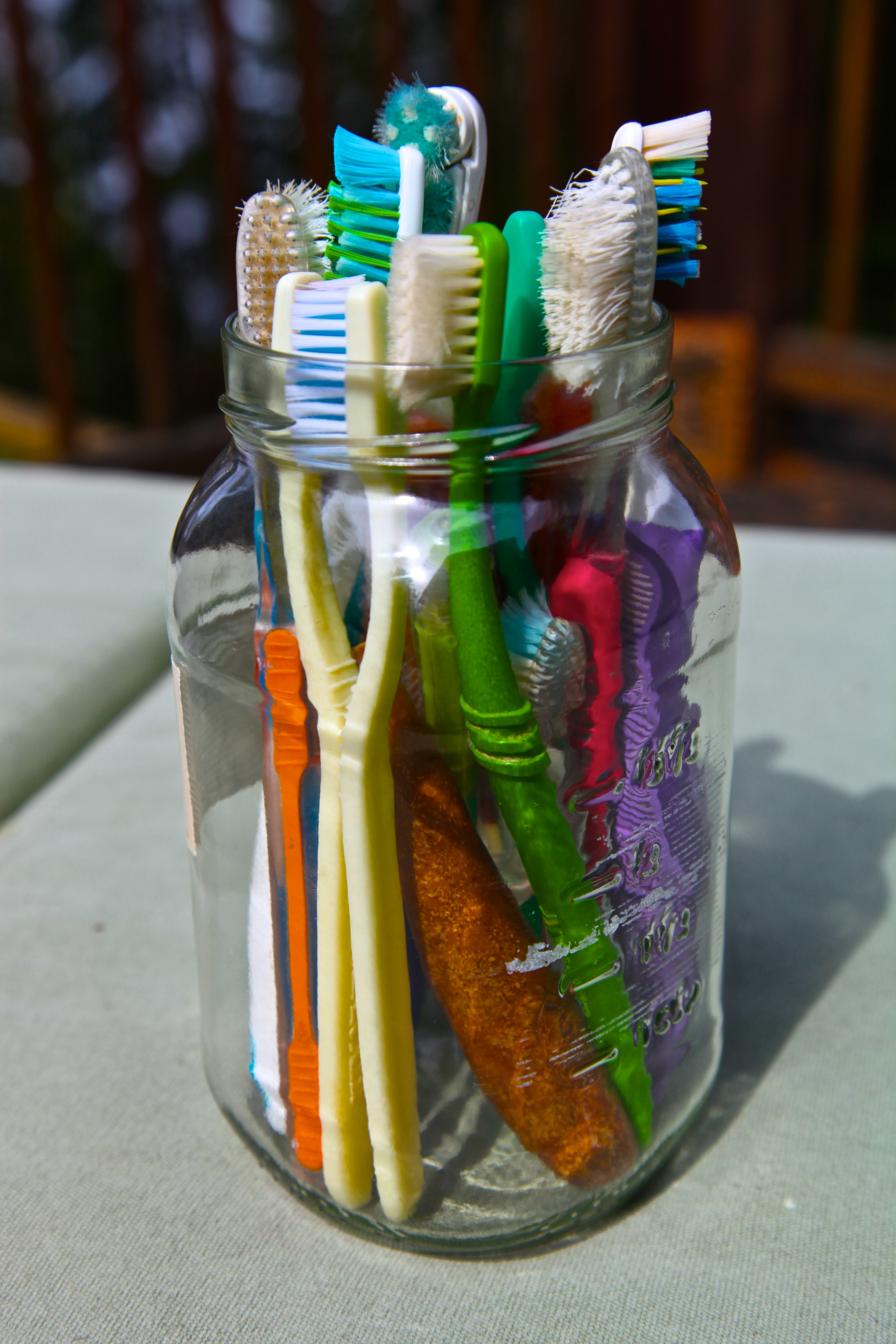
Unable to throw things out because of our zero waste lifestyle, we’ve accumulated quite a few plastic toothbrushes in our day. But it turns out old toothbrushes can come in handy. Here are 25 wonderful things that can be done with that little versatile brush (once you’ve retired it from use in your mouth):

1) Use it to clean hard-to-clean places.

2) Pass it on to your dog for brushing his/her teeth. (Yes, sanitize it first!)

3) Keep one with your craft supplies to be used as a special stiff paintbrush for art projects.

4) Clean corn.

5) Use as a grout scrubber.

6) Keep one under the sink for scrubbing around faucets and sink edges.

7) Label another one for use as a fingernail cleaner after gardening.

8) Keep one in the car glove box for emergency assistance like brushing off battery terminals.

9) Put one in your child’s “scientist backpack” for archaeology outings. A toothbrush is a critical artifact cleaning instrument. I can attest to the fact that my son’s spare brush packed in with his archaeological brushes has come in handy for our team of scientists in the excavations we’ve done in the Caves of Mustang.

10) Stash one in your foyer or mud room for cleaning mud from shoes. Keep one in your shoe shine kit for sprucing up drab shoes.

11) Keep one on your tool bench for assisting in cleaning tools.

12) Store one in your cleaning supplies bucket for spot cleaning carpets and furniture.

13) Save one for the laundry room for spot cleaning grease stains, etc.

14) Put one in with your makeup to brush away mascara clumps and to be used as an eyebrow brush.

15) Another one will be wanted on-hand as a back scratcher.

16) Use one for cleaning your bicycle chain.

17) Save one for cleaning jewelry or silverware.

18) Use one to clean out brushes and combs.

19) Some people swear by them as excellent fish tank algae cleaners to scrub algae off the glass.

20) Here’s a reuse idea from our favorite repurpose/reuse website:  “For all you fishermen, and women out there, cut the head off the toothbrush, and then drill a hole in either end, attach a swivel to one end and then the hook at the other end, make great spinning lures as they are often bright and multi coloured and the bodies make the perfect shape.”

21) Lift the lid and look at the hinges of your toilet seat. Pretty gross. Use an old toothbrush to make it look (and smell) as good as new.

22) Use as a bottle cleaner for those vintage bottles you collect.

23) Make a toothbrush bracelet.

24) Use your toothbrush as a tool to make a  rag rug.

25) For some serious fun, visit Evil Mad Scientist and learn how to make a bristle bot. Decapitate the toothbrush (off with its head!), and affix a teeny, tiny pager motor or (get this) battery-powered toothbrush motor (the sort that make your toothbrush vibrate), as well as a battery (and maybe some LEDs), and of course any googly-eyes you might have lying around and you’ve got yourself a buzzing little bot, bouncing around on bristles.

26) Use one to clean the grooves on your horizontally-sliding windows.

27) One reader wrote in to share that she uses four toothbrushes glued side by side to brush fleece sweaters and blankets after they are washed. It helps to make them look and feel like new.

28) Use one for a hair dye applicator.

29) Use your old toothbrushes to clean your dryer lint trap. Residues can build up and the brushing helps clean that off.

30) Dust and clean the crevices and ledges on hardwood molding with your old brush.

You’ll see the comments section is below. We’re hoping to find some further great ideas, links, instructions, even photos if you have ’em, for toothbrush reuse or waste-free alternatives to tooth-brushing.

25 Uses For Coffee Grounds

25 Wondrous Things to do With Your Coffee Grounds. Photo © Liesl Clark

25 Wondrous Things to do With Your Coffee Grounds. Photo © Liesl Clark

We all love our coffee here in the Northwest, but where I live, on Bainbridge Island, we love our coffee grounds perhaps even more. Nowhere else will you see farmers, home gardeners, landscapers, and vermiculturists fighting over the grounds produced by local cafes. Let’s face it, coffee grounds and plants go well together. I can assure you they’re all using them for #2 and #3 below as coffee grounds fertilizer and worm food, but the other 23 uses are also worth looking into. Some might even surprise you:

1) Turn Your Hydrangeas Blue: Hydrangeas can be blue or purple depending upon your soil Ph. Acidic soil begets blue hydrangeas. Coffee grounds, when brewed, are acidic. Use them as a top dressing on the soil around your hydrangeas, making sure to scratch the coffee grounds into the soil and you’ll enjoy blue bursts of color. I prefer purple, but my soil is acidic anyway, so we get blue.

2) Feed the Worms: We have a worm bin and those squirmies tend to thrive on 80% coffee grounds 10% eggshells and 10% dried leaves.

3) Coffee Grounds in Your Compost: Everyday, we use our coffee grounds as fertilizer. Most people put them in their compost along with their kitchen scraps. They’re a great source of nitrogen, potassium, calcium, magnesium, and sulfur.

4) Coffee Grounds Provide Shine to Your Hair: I haven’t tried it, but word is out that if you work some wet grounds into your hair they’ll help create a beautiful shine. They’ll also give you some great brunette highlights. Cover up the grays? Let us know.

5) Coffee Grounds Construction Play: This homeschooling family uses coffee grounds for play with small construction vehicles. The grounds are an interesting replacement for sand or dirt.

6) Coffee Grounds Abrasive Dish Scrub: Use grounds as your scrubbing agent for dirty dishes. I’m serious. When we ran out of scrubbies one day, I just used some grounds to get a scrambled egg pan all cleaned up. It’s like when you’re camping and use sand as your dish-cleaning abrasive.

7) Deodorizer: If your freezer or fridge are smelly and you can’t find the source, put a bowl or 2 of dried coffee grounds in there and the grounds will absorb the odors. Add vanilla for a different scent.

8) Facial Scrub: Just apply slightly wet coffee grounds to your face and exfoliate. Coffee grounds are found in some skin care products. I haven’t tried this yet, but I think my daughter and I will try it on our next natural spa day and post the results.

9) Furniture Scratch Remover: Cover up furniture scratches by rubbing them down with wet coffee grounds that match your furniture’s color. I’ve done this and it works!

10) Easter Egg Dye: Dye your eggs with coffee grounds for a pretty rust brown color. “But they’ll just look like our brown eggs,” you might say. Nope, this brown color is really pretty and looks great when you use it on eggs that have had crayon designs drawn on them.

11) Ant Repellant: Ants don’t like coffee grounds. Sprinkle them along their path. We do this under our deck where the ants live and it really bugs them. (See what I did there?)

12) Coffee Grounds Body Scrub: Scrub them over your body as a gentle exfoliant. But be sure to cover your drain with a mesh drain catcher or towel.

13) Drain Cleaner: If you dilute them and let them go down the drain every once in a while, they reportedly make an excellent drain cleaner.

14) Tool Cleaner: Coffee grounds can help clean up your tools as an abrasive rub and gunk remover. I love this one. While my husband is away, the kids and I are going to do some tool cleaning.

15) Coffee Ground Fossils: Here’s a great tutorial for making cool fossils or pretty imprints with the kiddos.

16) Ice Remover: Use grounds to “salt” your icy sidewalks. Then take your shoes off before treading on your fancy carpets.

17) Blueberry Food: Save your grounds in a bucket all winter long, then make a soup to cast the lot over your blueberries. They love coffee grounds! Spruce and evergreens do too.

18) Dust Buster: Another fave of mine — Sprinkle over your fireplace ashes when cleaning them out to dampen down the ashes.

19) Seed Spacer: Add dried coffee grounds to your tiny seeds like carrot seeds when sowing as they help spread out your seed dispersal when doing it by hand.

20) Slug Repellant: Some slugs are reportedly coffee ground haters. Not ours. But I don’t want to deter you from trying to put a ring around your favorite slug-devoured plants. You don’t likely have enormous slugs like we do that’ll slime their way through a fire pit filled with ashes. They don’t call them banana slugs for nothin’.

21) Mosquito Larvae Killer: I can’t verify this one either but some people say if you pour some grounds into your puddles it’ll kill mosquito larvae. Hmmmm….kill? Doubt it.

22) Vintage Wood Stain: Here’s a simple wood stain recipe using coffee grounds. Good luck.

23) Cockroach Trap: This Old House has an interesting-looking coffee-bait roach trap for you.

24) Treasure Map Paper: Dip some blank white paper into a bowl or sink-full of grounds and some water. Pull it out and let it dry. Then have fun with your map-making.

25) Cat Repellant: Cats apparently don’t like coffee grounds so you can put them around your spots (like your sand box?) where you don’t want cats to, um, do what they do in dirt.

Don’t stop at 25!

26) Meat Marinade: Add a teaspoon of coffee grounds to your steak marinade and impress your favorite coffee lover.

27) Secret Brownie Ingredient: If you’re the boss, add a few grounds to your brownies to give everyone (not for kids!) a boost at work.

Lastly but definitely our favorite, my friend Rebecca’s Grandma Inge’s best coffee grounds reuse tip is to put a bowl of grounds in the car to keep you (and the car) refreshed and perky throughout the day.

How do you use your grounds?

How to Build a Backyard Quinzhee

A what? A quinzhee.

Life is Good in a Quinzhee, Photo © Liesl Clark

Life is Good in a Quinzhee, Photo © Liesl Clark

Quinzhee is an Athabaskan word for snow shelter and when there’s enough snow about, our resident mountaineer can’t help but make one with the kids. Mountaineers learn how to build them as an emergency refuge from the ravages of winter storms in the mountains. It’s more fun when you have one just 5 feet from your back door.

How do you build a quinzhee? It’s easy. And you don’t need a lot of snow on the ground to pull it off. We built this one with only about 8 inches of snow on the ground.

First make a huge pile of the white stuff, packing it with shovels and skis if you have them, without walking on the pile. Get it as tall as you can and make it cone-shaped, adding a good volume of snow to the back end. Really pack it down. Let it sit as long as you can, to settle the snow and let the snow crystals sinter. Sinter? Yes, sinter. Sintering is bonding of the snow crystals and this happens when snow crystals come in contact with each other. Packing it really helps.

We let ours sit over night. But you might not be so lucky. In the event you are stuck out in a storm in your backyard because you forgot your house key, you can let it sit for an hour.

It Might Look Like a Pile of Snow. But In No Time It'll Be Home.

It Might Look Like a Pile of Snow. But In No Time It’ll Be Home.

Next, you’ll want to cut a small entrance close to the ground. You’re essentially cutting a flat slab-like face on the surface of the quinzhee. Then, you can start digging into it.

Digging Out the Tunnel, Photo © Liesl Clark

Digging Out the Tunnel, Photo © Liesl Clark

Dig a small tunnel to start, only large enough to allow your body to slither in. Dig in about a body-length. Then you can start to enlarge the room.

Excavating Snow From the Quinzhee, Photo © Liesl Clark

Excavating Snow From the Quinzhee, Photo © Liesl Clark

Dig an oval-shaped room, complete with sleeping platforms on either side of the tunnel and inside the void. You want to elevate the sleeping platforms off the ground if you have enough space because the cold sinks to the bottom and the small entrance-way will keep the heat from escaping out the entrance because your entrance is low to the ground. But if you just want it to be a fun playspace, forget about the sleeping platforms. Who’s going to camp in this thing unless they absolutely have to?

Quinzhees are actually warm at night.

Quinzhees are actually warm at night.

When the snow falls, isn’t it fascinating how we come to use it for our pleasure and benefit? Some of us like to slide on it, others strap skis on to travel over it, my husband and I like to think about how the snow can be turned into a resource for our family. This quinzhee has been a true hit.

Inside the Quinzhee, Photo © Liesl Clark

Inside the Cozy Quinzhee, Photo © Liesl Clark

Next time the snow falls, don’t just shovel the snow off your sidewalk or driveway randomly. Throw it into a big pile and you’ll have a fodder for a quinzhee in no time for the whole neighborhood to enjoy.

How (and Why) I Kicked the Paper Towel Habit

A few good rags,

A few good rags in a basket = alternative to paper towels. Photo © Liesl Clark

A few good rags in a basket = alternative to paper towels. Photo © Liesl Clark

a washing machine,

2-3 weeks-worth of cloth rags in line for laundering = sustainable replacement for paper towels. Photo © Liesl Clark

2-3 weeks-worth of cloth rags in line for laundering = sustainable replacement for paper towels. Photo © Liesl Clark

and an empty drawer

"Wiping Towel Drawer," under the counter right next to the dinner table, ready for wipe-ups. Photo © Liesl Clark

“Wiping Towel Drawer,” under the counter, right next to the dinner table, ready for wipe-ups. Photo © Liesl Clark

are all it took to convert my family from paper towels to cloth towels.

Rosie would be proud of these cloth towels. They’re definitely “the quicker picker upper” vs. Bounty, her paper equivalent.

And there’s another reason to skip paper towels altogether: Bisphenol A, a chemical linked with cancer among other things. Sadly, according to a study published in Environmental Science & Technology, our recycled paper products are now laced with this endocrine disruptor because thermal receipts that have high amounts of BPA have been recycled into most of our post-consumer paper products. Therefore, recycled content paper towels, newspapers, business cards, printer paper, even toilet paper have BPA and BPS in them. Returning to virgin pulp paper products might the healthier route to take! But the environmental impact of using virgin paper (a.k.a. loss of trees and the dioxins released in the atmosphere during the process of bleaching conventional toilet paper), according to the Huffington Post, far outweighs the small amounts of BPS found in our recycled paper toilet paper.

Oh, and BPA has also been detected in our currency.

Hazardous waste? Photo © Liesl Clark

Hazardous waste? Photo © Liesl Clark

I think this whole situation might be the perfect example of a bass ackwards trash backwards absolutely hazardous mess only humans can create. Somehow, we’ve managed to contaminate our own paper recycling streams with such toxic chemicals that post-consumer recycled paper itself is no longer a green option. Strategists say that if we stop recycling our thermal receipts or any recycled paper that has BPA in it, we may return to BPA-free papers. The problem is that according to some estimates, 8 million tons of BPA are produced each year and it’s been detected on every beach ever tested for the chemical.

The dilemma appears to fit perfectly with Urban Dictionary‘s definition of bass ackwards:

bass ackwards
Ass backwards. The state of doing (or having done) something the wrong way.
No no dude, you’ve got the cables plugged in all bass ackwards.

Before we recycle our papers into new papers and disseminate them all over the planet, into our gray water (in the case of toilet paper) and onto our countertops (paper towels) let’s find out what’s in them and exclude the papers that have toxic chemicals in them.

The bad guys: Thermal receipts have more BPA (that transfers into your skin upon contact) than any other paper, can, or plastic. Photo © Liesl Clark

The bad guys: Thermal receipts have more BPA (that transfers into your skin upon contact) than any other paper, can, or plastic. Photo © Liesl Clark

What can you do to help prevent BPA and its alternative BPS from spreading further into our watersheds? Stop buying paper towels, refuse receipts at stores, and don’t put them in your compost, your recycling, or even in your fireplace. Seems the toxic culprits need to be collected and bagged up so their chemicals can never leach into our groundwater. Think male frogs with female genitalia and you’ll get the picture. I’m considering taking the ones I collect to our household hazardous waste facility.

cloth towels instead of paper

Now, what to do with those paper towel holders? We use ours in a closet to hold rolls of string and masking, duct, electrical tape.

New Year’s Reduce, Reuse, Recycle (Re)Solutions

New Year's Reduce, Reuse, Recycle Re(Solutions) Bring Simplicity and Joy. Photo © Liesl Clark

New Year’s Reduce, Reuse, Recycle (Re)Solutions Bring Simplicity and Joy. Photo © Liesl Clark

In the New Year, I believe many of us have dreams of simplicity, homes de-cluttered and made minimal yet functional. Can this be achieved in a sustainable manner? Yes!

Sustainably reducing our junk brings a sense of freedom and joy, and I can tell you from experience that it’s entirely attainable, without trashing the environment. The key is to take simple steps toward offloading your excess items. As a byproduct, you’ll find real pleasure in seeing the value in your things and the joy they can bring others, rather than just tossing them into the landfill.

Here are 9 of our favorite New Year’s (Re)Solutions to help you reduce the stuff weighing you down:

I suggest you take a week to truly de-clutter and reduce.

STEP ONE: Each day of the week choose one room to focus on, so you don’t wear yourself out on day one. Do a decluttering pass through the room, carrying a box which will hold the items you’re ready to offload.

STEP TWO: Can any of your unwanted stuff be reused? Join your local Buy Nothing group, a gift economy where people share what they have with their neighbors. Keeping our stuff in our local materials economy is one of the greatest gifts you can give your own community, connecting you to the people around you and helping us all to reduce our consumption. See if there’s a group near you or ask the founders team to start a group in your area if you’re willing to be a local admin.

You can then post each of your items in your group. Don’t be shy! Your stuff is another person’s treasure. People give cement blocks away in our group, sticks, even used bubble wrap, extra pans of homemade lasagna, chicken feed, and unwanted jewelry. There’s no such thing as “trash” in our groups as you may find an artist who could use your discarded item or a small business owner who needs bubble wrap for packaging their items for shipping. If you don’t have a Buy Nothing group in our area, then move on to step 3.

STEP THREE: Have a few spare boxes ready to hold your leftover unwanted and unused items in your garage, basement, attic or spare room where you can then separate the pile into distinct categories:

1) Stuff to Donate to an Animal Shelter: Do you have old blankets, towels, or extra pens and pencils hanging about? You’d be surprised to learn what items most animal shelters could use. Here’s a typical wish list for a local shelter.

To find an animal shelter near you, click to The Humane Society‘s website where they have links to the best resources for locating local animal shelters. All you need to do is input your zip code to find a local shelter. Most have a wish list online, but you can call to find out their specific needs.

2) Stuff to Donate to a Charity That Will Come and Pick Things Up: There’s nothing better than people who come to you and take away your unwanted stuff. Donationtown has a website where you can input your zip code a find a charity that will come to your home and pick reusable household items up. But if you have a local charity, like GoodWill where you can drop off your items, that’s another great option.

Are you seeing the forest through the trees? Ridding of your excess stuff sustainably isn't so hard. Photo © Liesl Clark

Are you seeing the forest through the trees? Ridding of your excess stuff, sustainably, isn’t so hard. Photo © Liesl Clark

3) Electronics Recycling: Take stock of your e-waste — your electronics that no longer work or that you haven’t used in a year or 2, and take them to Best Buy! Best Buy is one of North America’s top e-waste recyclers and you can easily find one near you. This task is a simple one: load up a cart with your old TV, computers, vacuum cleaner, and wheel it through the front door and there will be a place by the front door to leave your electronics for recycling. Done.

You Can Recycle 3 Electronic Items Per Visit to Best Buy

You Can Recycle 3 Electronic Items Per Visit to Best Buy

4) Metals can go to a nearby scrap metal facility: We save our metals in a special box to be taken periodically to our scrap metal bin found at the local transfer station. Metals of all types have value and can be repurposed into new items made of metal. Saving things that are primarily made of metal can benefit your scrap metal facility greatly and keep those precious materials out of the landfill and in our materials economy for years to come.

5) Do you have a cupboard filled with plastic containers? Reduce it by half and you probably won’t miss what you’ve removed. Save your favorite ones for storing dry goods in and then go through your jars and do the same thing. If you have extra lids, recycle them. Or if you’re missing lids, recycle the jars or containers themselves. The new year is a time to take stock and simplify! I reduced my jars by half and passed the good ones with lids on to our local senior center that collects them for projects. Check with your senior center to see if they can use them or post your jars on your Buy Nothing group. Someone will have a use for them.

6) If you’re trying to reduce old stockpiled boxes of random stuff, make a pledge to go through one box at a time. Give yourself time to go through it and separate the items into recyclable items and those that can be given away and reused. I try to remind myself that we’re stewards of our stuff on this planet and our job is to, at the end of your stuff’s usefulness to you, dispense with it responsibly.

Stockpiled Boxes in the Attic: Emptying Them Out One Per Week is Do-able.

Stockpiled Boxes in the Attic: Emptying Them Out One at a Time, Even One a Day Makes the Task Do-able.

7) If you have old family photos you want to reduce, you can always check with family members to see if they want them. By scanning them digitally, you can save them on a small thumb drive and then you have the photo paper waste to think of. There are some great ideas out there for photo reuse, like turning them into tile coasters or donating them to a scrap art store. Remember, your old family photos do have potential value, especially for your family’s future generations.

8) Books: If there were ever an easy item to help you get rid of, it’s books! Most libraries want your books as do many non-profits worldwide.  We have a local “Books and Beer” get-together every few months in our Buy Nothing group where we can meet neighbors and share our books.

9) Make a promise to yourself to be mindful of what you acquire. Promise that all new things going into your home this year will be used and loved extensively, not squirreled away in yet another box to be offloaded at the end of the year. If you don’t take my advice, you might want to listen to a slightly different perspective on reducing. It all results in the same thing, however, less waste and less unnecessary clutter in your life for stepping out into a new year.

There is an elegance to beginnings and endings of years. Make yours a stuff-free one by following our simple steps. Photo © Liesl Clark

There is an elegance to beginnings and endings of years. Make yours a stuff-free one by following our simple steps. Photo© Liesl Clark

Post-Holiday Zero Waste Living

Carefree Holiday Fun in Zero Waste Style

Carefree Holiday Snowball Fun in Zero Waste Style © Liesl Clark

Some reliable sources say Americans produce 25% more waste over the year-end holidays than we do the rest of the year. I’m not surprised, given the household waste-management we’re undergoing this time of year. Our consumption, through gift giving/receiving and party-throwing, is at an all-time high.

Trimming the Tree, Photo © Liesl Clark

What steps can we take to make this year a game-changer, reducing our impact at years’ end? Here are some easy zero-waste practices that should make you feel good:

  1. Recycle Your Live-Cut Christmas Tree: Most communities have tree recycling options available. Boy Scouts in some communities conduct drives to collect trees and chip them up into compost, for example. Other communities will allow you to put your tree in your yard waste bins.
  2. Reuse Your Live Christmas Tree: We throw ours in our brush pile and then cut it up for kindling once the wood has cured. But we’ve created a list of 15 reuses for your Christmas tree if you’re interested.
  3. Take a moment to turn off your power, enjoy a few hours of power disconnection with family for introspection and connection. We do this for an entire day and the appreciation for each other, and the magic of slowing down comes back  into our lives.

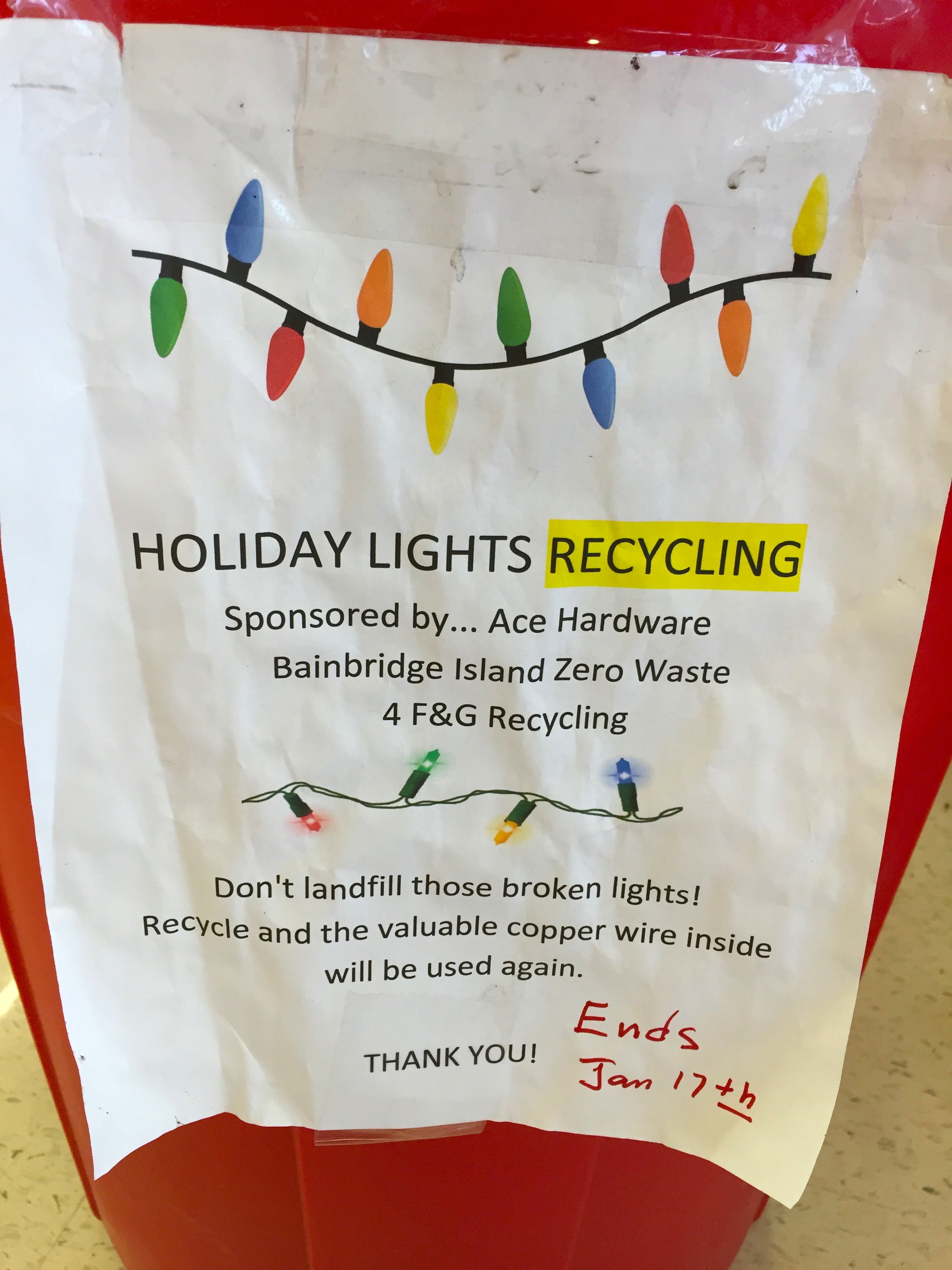
    Ace Hardware is Doing Good Things in Our Hometown © Liesl Clark

    Ace Hardware is Doing Good Things in Our Hometown © Liesl Clark

  4. Recycle your broken holiday/tree lights: When your lights stop working (and, sadly, these things are so poorly made their working life is not very long), don’t throw them away. Most communities have a local option for recycling string lights. Ace Hardware, for example, is our local drop point on our island. But if you can’t find a local venue, you can send your lights to Light Source, in Texas, where they sell used string lights for recycling and give the proceeds back to charity. Or, better yet, collect a few from friends and neighbors and send the tangled mess in a larger box so you know you’ve diverted more than your own from your waste stream. The Refining Company in Medford, OR also recycles holiday lights. Recycling string lights is a booming business in China and although the practices aren’t the most environmentally-sound, thousands of tons of string lights are kept out of our landfills. The Atlantic has a must-read article about the recycling of our string lights in China to mine out the copper wiring inside. After reading the article, I swore we’d never buy string lights again. We receive thousands of unwanted string lights at our local summer community auction, so our family retrieves a few of the unwanted strings from there each summer and use them until they stop working, which, sadly, isn’t very long. IMG_0769 copy
  5. Stockpile your styrofoam and recycle or reuse: Styrofoam is the single most prolific plastic material found on our beaches. In some communities, it has been banned. If you received styrofoam as part of a gift this holiday season, consider yourself the future steward of this highly toxic material. Finding your local recycling option for year-round styrofoam stewardship is the single best thing you could do for the environment this season. In the Seattle area, for example, a free drop-off location in Kent is the place. In the meantime, ask your local zero waste group if there’s a nearby store, like Bay Hay and Feed on Bainbridge Island, that conducts drives to collect the stuff so it doesn’t end up in our waters.
  6. Save your Christmas cards for repurposing: You can always recycle the cards you get from friends in your paper recycling bin. But a fun activity is to cut off the side with the writing and save the card with its attractive artwork for future homemade gift tags. Some people use them to create wreaths for next year, too. And I found a pretty bunting idea for displaying them on your hearth.
  7. Save all ribbon for reuse: Ribbons are made of plastic and survive in our oceans unscathed for years. We’re always surprised to find ribbon from birthday balloons wrapped up in seaweed (they are also known to entangle baby seals, sea otters and sea turtles) and once we break them free from the wrack line debris, the ribbon is as good as new. Save the ribbon you receive on gifts and give the gift of life to our marine creatures by not buying more of it. If you reuse what you have, and receive in the future, you’ll never need to buy more ribbon again. Giving and receiving is cyclical like that.
  8. Find a spot to store re-usable tape: This is a true insider’s tip. There’s plenty of tape and stickers that will peel right off a bag or shiny package and it, too, can be reused. The trick is to have a convenient spot in your home where you keep it. My friend Rebecca puts hers on the side of the fridge for the kids to access easily (kids go through gobs of tape.) We put our reclaimed tape on the inside of a closet door where office supplies are kept. Family members know that’s the community tape dispenser. We haven’t bought new tape in months.
  9. Save what wrapping paper you can for reuse: You don’t need an explanation for this. It’s yet another way to see how reuse can save you money. Most wrapping paper can’t be recycled because of the materials used to make it. Composting or burning it, too, isn’t recommended because of the toxins involved. Because we are committed to not buying new wrapping paper, what do we use? We make beautiful cloth gift bags and give them to friends and family for reuse. We recycle our children’s art as wrapping paper. We use pretty cloth as wrapping paper in the Japanese style of wrapping. We keep items in their shipping boxes and decorate the boxes with ribbon we’ve found on our beaches or plastic marine debris we’ve recovered as a reminder of our mission in the first place. These packages below are how our children creatively wrap their gifts in found items from our home or the beach:

10) Pass on your unwanted faux tree through The Buy Nothing Project or give to Goodwill: Thousands of plastic trees end up in the landfill after the holidays. These aren’t meant to be single-use items. If you need to get rid of yours, pass it on to Goodwill, sell it on Craigs List, or Buy Nothing it.

11) Don’t throw away your unwanted or broken items or toys: One of the single-most satisfying activities you can do with your family is create a workspace where you can repair the items you received over the holiday that were made to break within the first 6 months’ (or sometimes 6 hours) of use.

Send us your stories of what broke, and how you fixed it! We’re looking for inspiration from you, stories about how you defied the odds and came up with a smart solution to repair or repurpose an item so it could be diverted from a landfill and have a new life.

12) Thank your tree: And finally, a special thank you movie in tribute to the pesticide-free, sustainably grown US Forest Service tree we weeded from the dense thicket on the tree-laden slopes of the Olympic National Forest: