How to Build a Backyard Quinzhee

A what? A quinzhee.

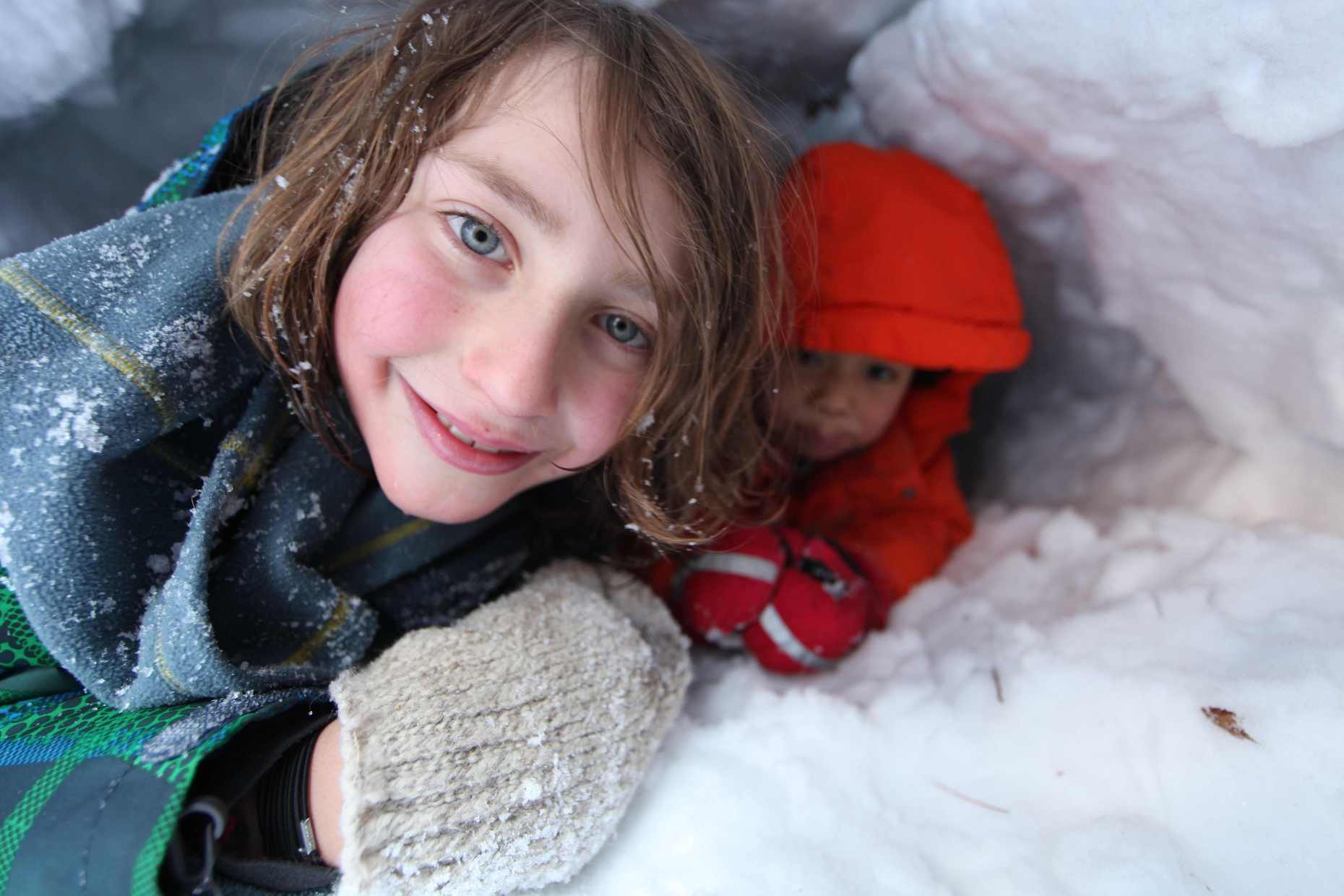
Life is Good in a Quinzhee, Photo © Liesl Clark

Life is Good in a Quinzhee, Photo © Liesl Clark

Quinzhee is an Athabaskan word for snow shelter and when there’s enough snow about, our resident mountaineer can’t help but make one with the kids. Mountaineers learn how to build them as an emergency refuge from the ravages of winter storms in the mountains. It’s more fun when you have one just 5 feet from your back door.

How do you build a quinzhee? It’s easy. And you don’t need a lot of snow on the ground to pull it off. We built this one with only about 8 inches of snow on the ground.

First make a huge pile of the white stuff, packing it with shovels and skis if you have them, without walking on the pile. Get it as tall as you can and make it cone-shaped, adding a good volume of snow to the back end. Really pack it down. Let it sit as long as you can, to settle the snow and let the snow crystals sinter. Sinter? Yes, sinter. Sintering is bonding of the snow crystals and this happens when snow crystals come in contact with each other. Packing it really helps.

We let ours sit over night. But you might not be so lucky. In the event you are stuck out in a storm in your backyard because you forgot your house key, you can let it sit for an hour.

It Might Look Like a Pile of Snow. But In No Time It'll Be Home.

It Might Look Like a Pile of Snow. But In No Time It’ll Be Home.

Next, you’ll want to cut a small entrance close to the ground. You’re essentially cutting a flat slab-like face on the surface of the quinzhee. Then, you can start digging into it.

Digging Out the Tunnel, Photo © Liesl Clark

Digging Out the Tunnel, Photo © Liesl Clark

Dig a small tunnel to start, only large enough to allow your body to slither in. Dig in about a body-length. Then you can start to enlarge the room.

Excavating Snow From the Quinzhee, Photo © Liesl Clark

Excavating Snow From the Quinzhee, Photo © Liesl Clark

Dig an oval-shaped room, complete with sleeping platforms on either side of the tunnel and inside the void. You want to elevate the sleeping platforms off the ground if you have enough space because the cold sinks to the bottom and the small entrance-way will keep the heat from escaping out the entrance because your entrance is low to the ground. But if you just want it to be a fun playspace, forget about the sleeping platforms. Who’s going to camp in this thing unless they absolutely have to?

Quinzhees are actually warm at night.

Quinzhees are actually warm at night.

When the snow falls, isn’t it fascinating how we come to use it for our pleasure and benefit? Some of us like to slide on it, others strap skis on to travel over it, my husband and I like to think about how the snow can be turned into a resource for our family. This quinzhee has been a true hit.

Inside the Quinzhee, Photo © Liesl Clark

Inside the Cozy Quinzhee, Photo © Liesl Clark

Next time the snow falls, don’t just shovel the snow off your sidewalk or driveway randomly. Throw it into a big pile and you’ll have a fodder for a quinzhee in no time for the whole neighborhood to enjoy.

Mapping Plastic: The Lost Coast

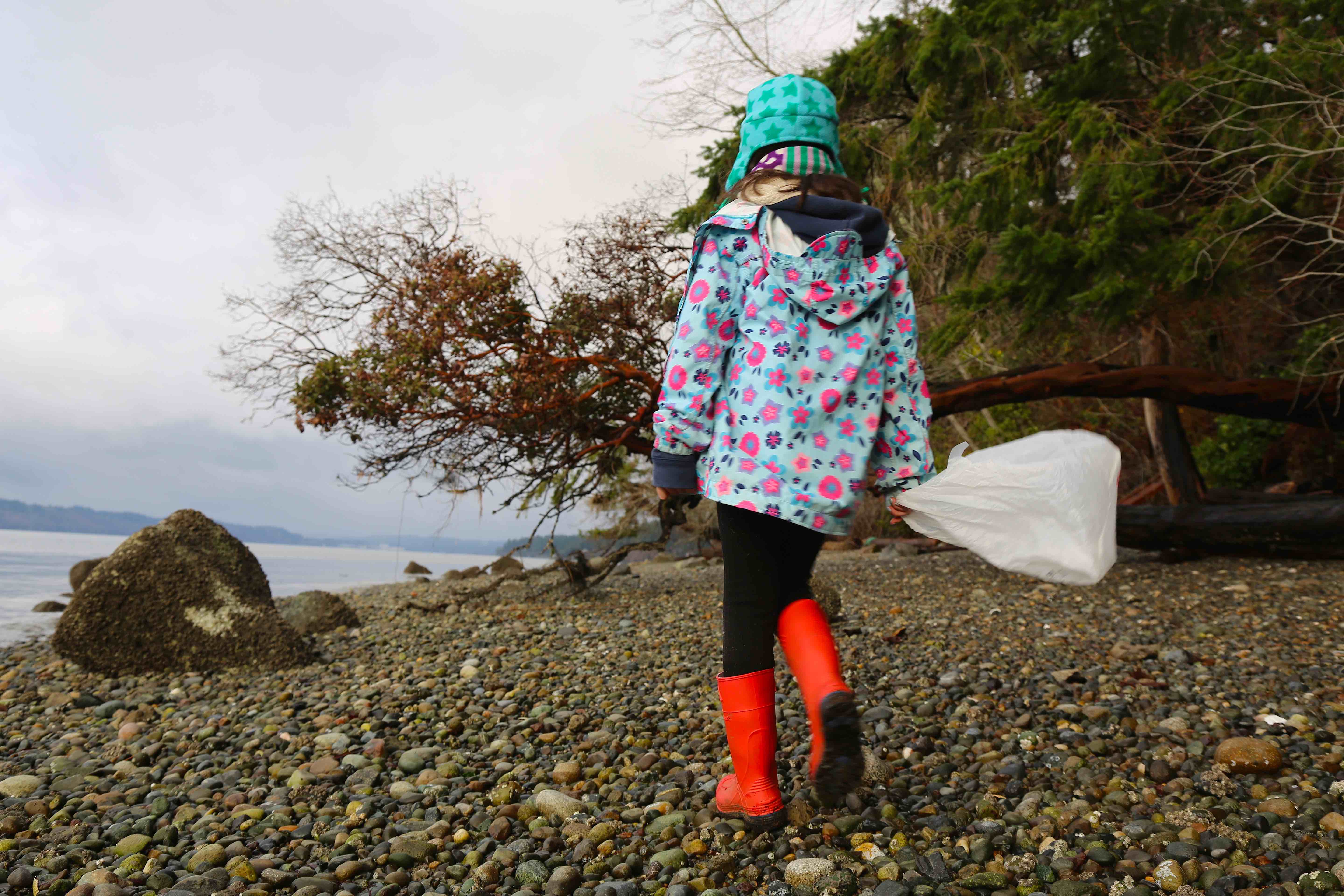
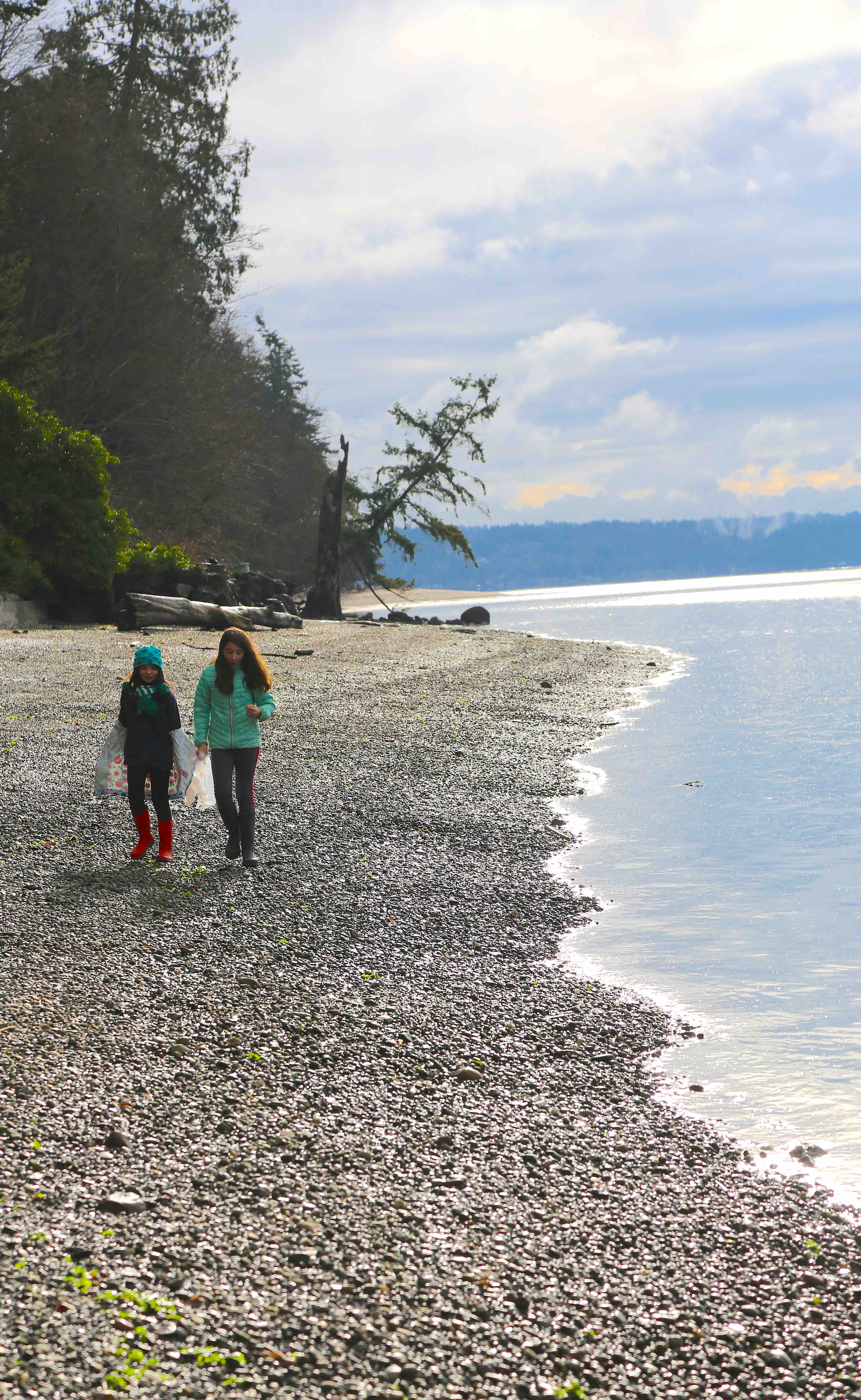
Exploring Bainbridge Island's Lost Coast © Liesl Clark

Exploring Bainbridge Island’s Lost Coast © Liesl Clark

Who owns the shoreline?

This is the question we’re asking after walking one of the most beautiful stretches of Bainbridge Island’s coastline. The mile-long stretch of nearly house-free shore had very few plastics along it, too. Does this prove that the plastics are washing down into our waters from our homes? Possibly.

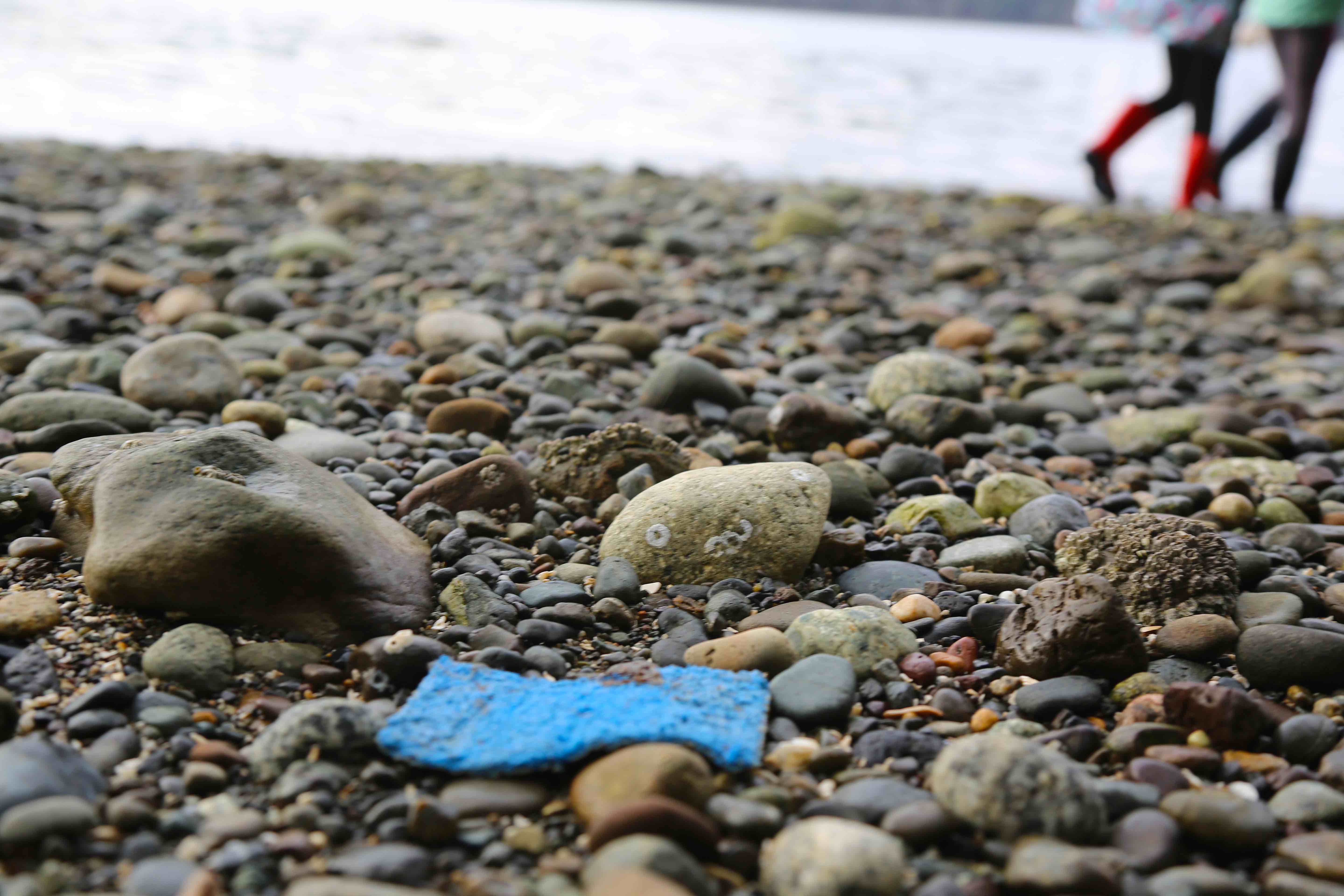
Kitchen Sink Scrubby. They're Made of Plastic. © Liesl Clark

Kitchen Sink Scrubby. They’re Made of Plastic Fibers. Try a Plastic-Free Alternative. © Liesl Clark

This gorgeous stretch of beach lies along the southwest side of the island, skirting Port Orchard Bay and leading up toward the Poulsbo Marina in the distance. There’s about 2 miles of water between this shore and Bremerton’s shoreline, and the tidal currents move through here pretty swiftly, leaving little ability for plastics to make purchase ashore. Yet they still do.

Water Skiing Anyone? © Liesl Clark

Water Skiing Anyone? © Liesl Clark

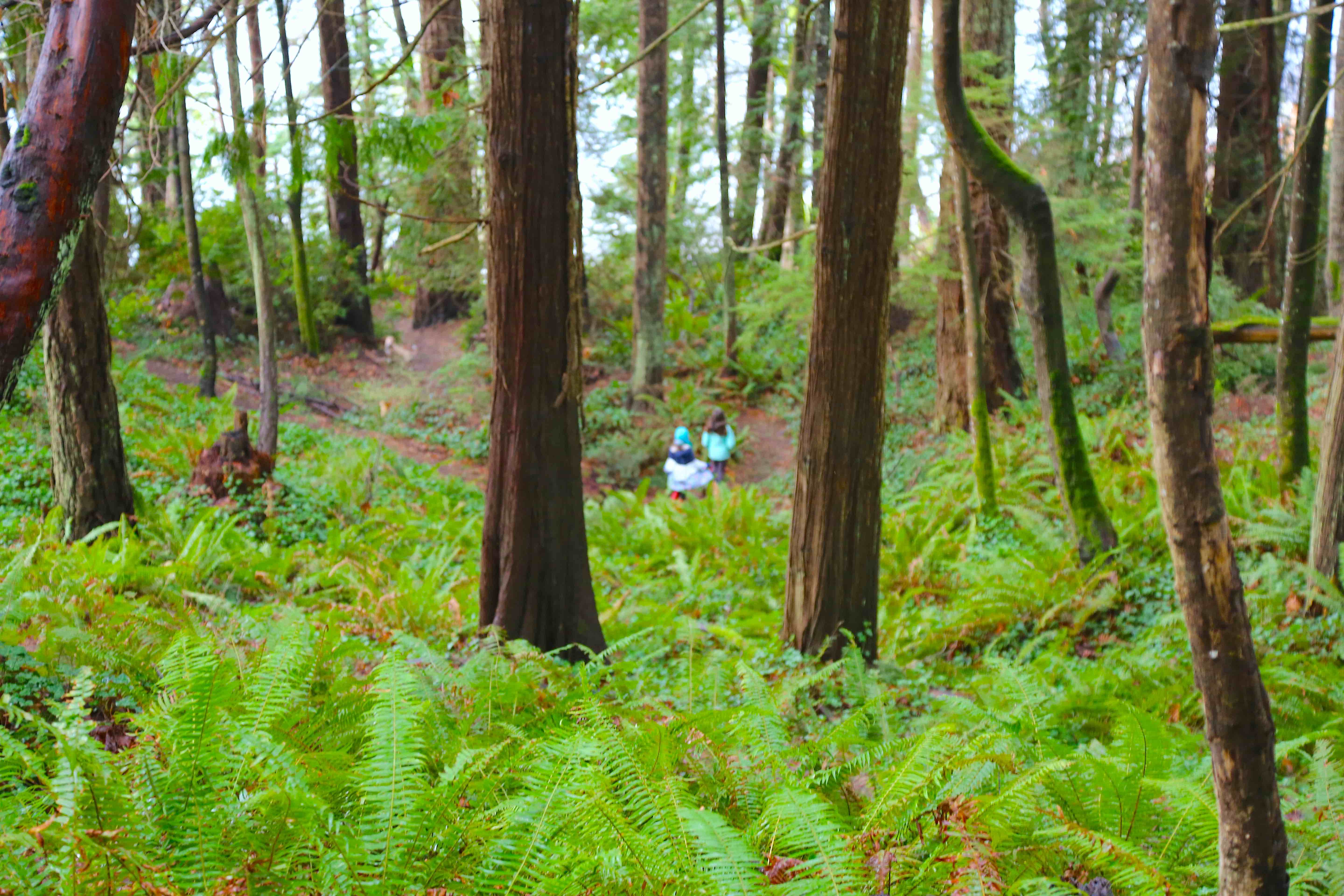
The Lost Coast starts with a hike down the Close Property Trail to the rocky shore. It’s a classic Northwest coastal hike through old douglas firs and ferns, the trail switch-backing down the steep green scape to the water. We turned right and headed north, my two children and one of their good friends. Everyone had a bag in hand, to pick up plastics, or pretty shells and rocks. We had a feeling this stretch of shore wouldn’t have many plastics because we come here often and only find the occasional offender.

Hiking Through Ferns on the Close Property Trail © Liesl Clark

Hiking Through Ferns on the Close Property Trail © Liesl Clark

A high bank leaves jungle for us to enjoy, with a few properties that have carved out a beach presence, stashing their plastic lawn furniture in the brambles. It’ll only be a matter of a few storms before the plastic furniture is set free onto the billowing seas. Some kayaks were imaginatively lashed to trees and a couple of landowners had cool pulley-elevators for getting people and gear down to their stretch of paradise.

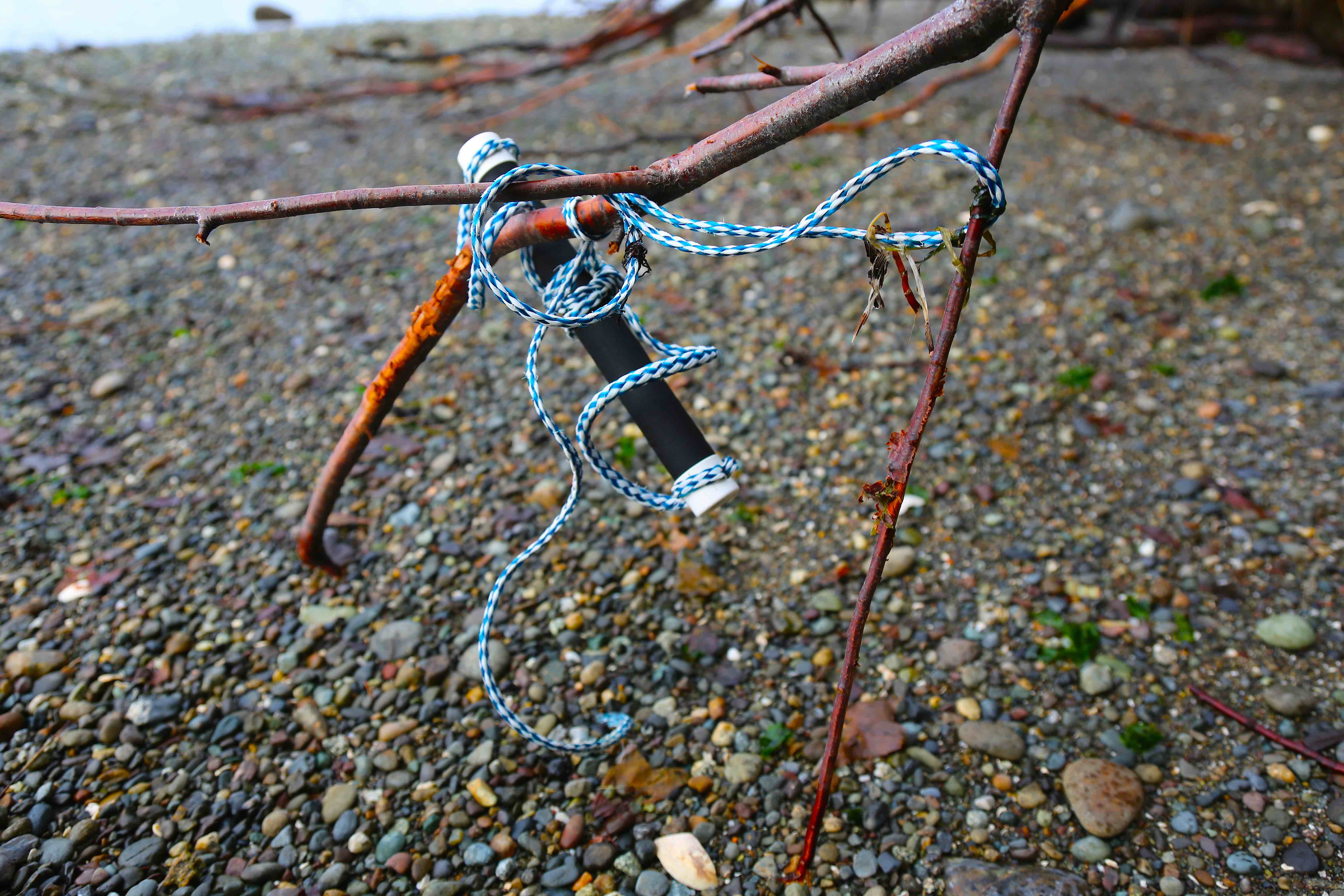
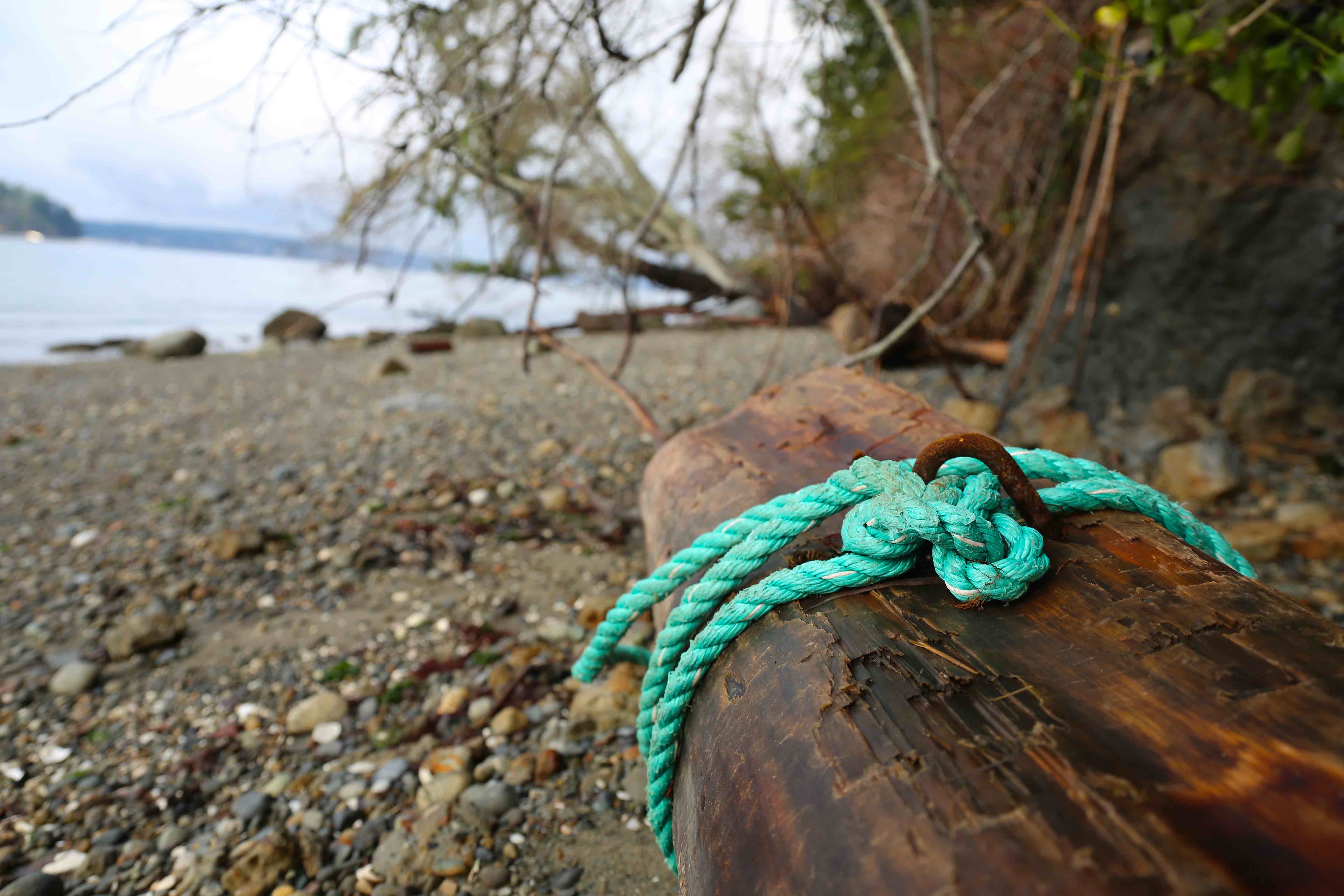
The Ever-Present Marine Rope, Made of Plastic © Liesl Clark

The Ever-Present Marine Rope, Made of Plastic © Liesl Clark

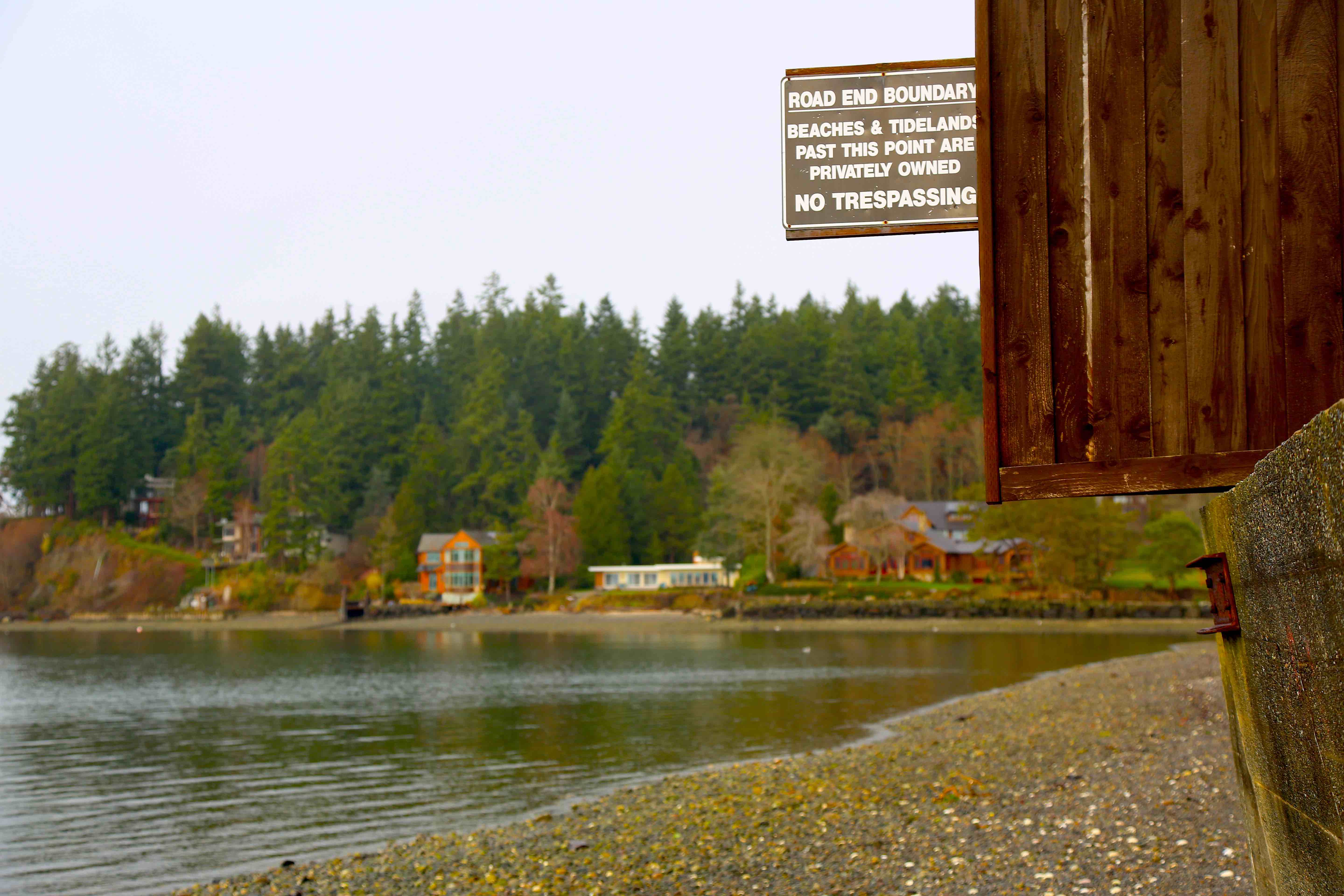
But after about an hour, our walk was cut short by a sign indicating we couldn’t pass.

No Trespassing!? © Liesl Clark

No Trespassing!? © Liesl Clark

Can the beach, even at the lowest mean tide, be privately owned? According to The Public Trust Doctrine, passed down from English Common Law, we have the right, especially at extreme low tides, to walk shoreline beaches, to recreate along the shore’s edge. The thinking is that below the common high tide mark, the land is not privately owned. But some homeowners beg to differ and the state of Washington, in particular, has no final judgement on the matter. Can we cross this section of beach at the lowest winter tide possible to continue our beach plastics survey? Or do we have to take up a friend’s offer to ferry us by row boat past this 100 yard stretch of beach to the other side? Fletcher Bay is a narrow residential bay, one of the significant watersheds of our island, that could hold clues to the question of where our ocean plastics are coming from.

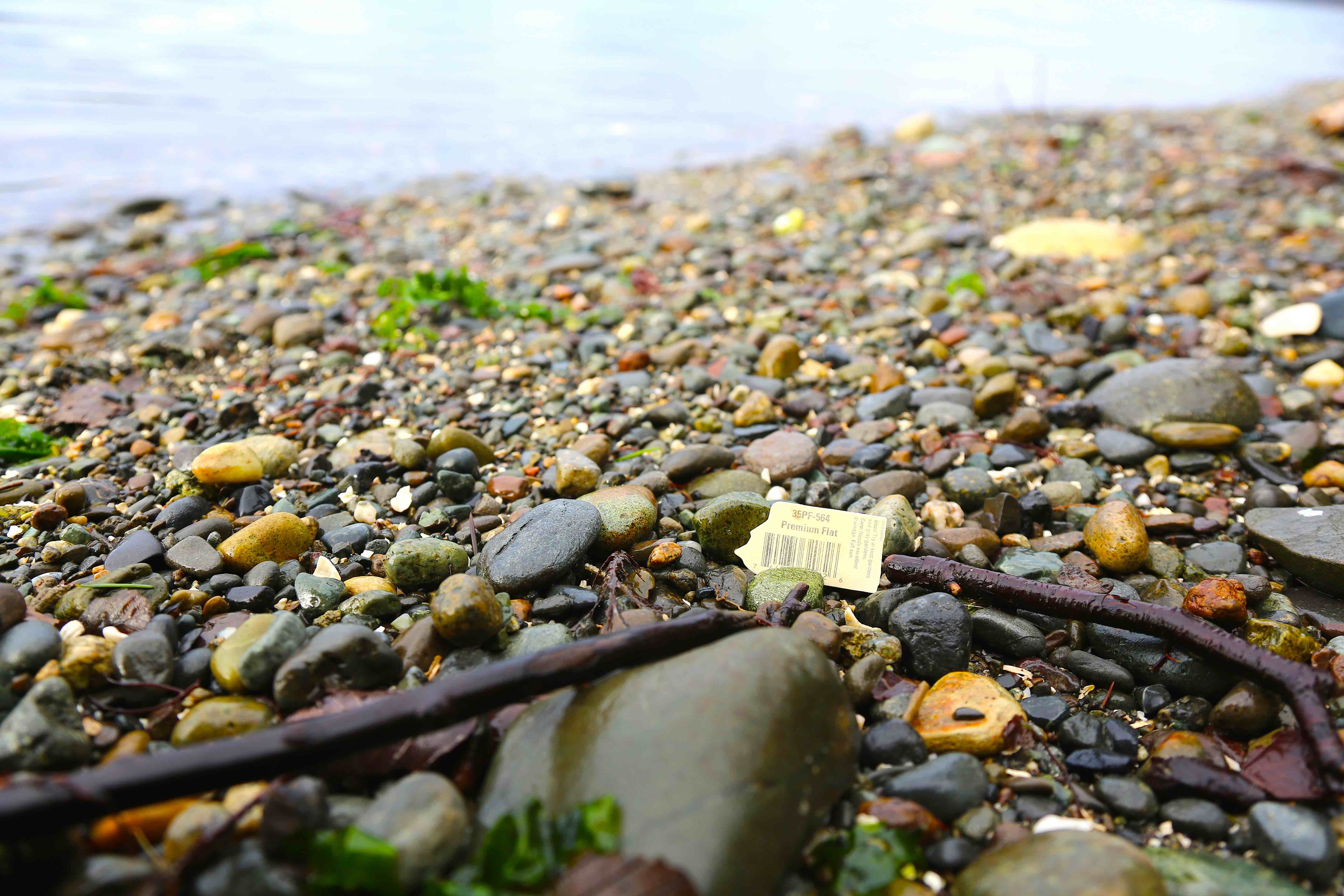
Nursery Plant Tags are a common Beach Plastic © Liesl Clark

Nursery Plant Tags are a common Beach Plastic © Liesl Clark

Most people think the plastics in our oceans comes from boats. We’re convinced it comes from our homes. Case in point: Those plastic tags you have in a nursery plant pot, giving you the latin name of your purchase and growing instructions. Do we find nursery plants on boats? No. This culprit has washed down a watershed into the salty sea and we plucked it from Bainbridge Island’s Lost Coast.

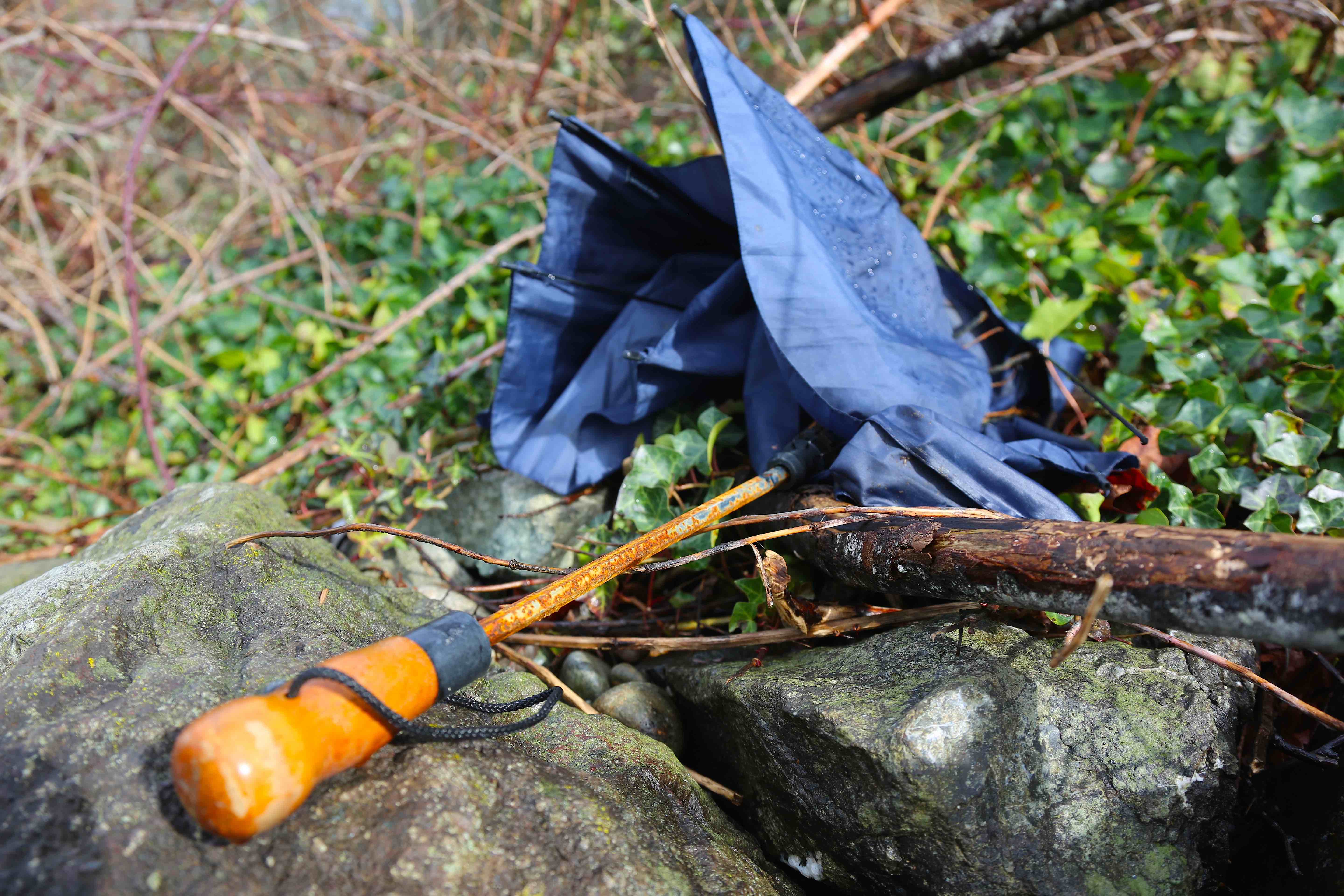
Landed Umbrella © Liesl Clark

Landed Umbrella © Liesl Clark

If it has plastic in it, even if a small percentage of it is plastic, you’ll find it on the beach. I don’t think there’s anything made of plastic that we haven’t found washed ashore. The tally from our Lost Coast walk included, shoe soles, lots of styrofoam pieces, motor oil containers, plastic toys, and easily a hundred meters of marine rope.

If you’d like to join us on a leg of our circumnavigation of Bainbridge Island, to see for yourself, just let us know in the comments.

Bainbridge Island's Lost Coast. The Most Plastic-Free Stretch of Beach on the Island. © Liesl Clark

Bainbridge Island’s Lost Coast. The Most Plastic-Free Stretch of Beach on the Island. © Liesl Clark

Read about the previous leg on our circumnavigation of Bainbridge Island.

Mapping Plastic: First Days of Our Journey

Even Point White Pier ain’t plastic-free. We found Chapstick tubes lodged in the cracks. Photo © Liesl Clark

Our journey started on a windy day. Circumnavigating Bainbridge Island to map the plastic on its shores has started off like any other beach walk where we tease plastic detritus from tall grasses, seaweed, and huge boulders. Our friends, Rebecca Rockefeller, David Dale Campbell, and their daughters met us at Pleasant Beach, aka Lynwood Center Beach, and we headed south at the day’s lowest tide in hopes of reaching Point White Pier by dark. But we hit a snag.

Rich Passage is a narrow waterway providing access between Seattle and Bremerton for ferries, submarines and naval boats from the nearby seaports. Strong tidal conditions prevail and a winter shoreline walk along the Bainbridge side of the passage is impossible. Lined entirely with bulkheads, houses built right up to the coast, Rich Passage isn’t actually passable on foot. Our map here shows the section, right at Point White, that we had to skip, but we’ll return at a minus tide in the spring to complete as much of it as possible and collect whatever plastics are plastered to the human-made coast.

Legs 1 and 2 of the Bainbridge Island Plastic Mapping Project. Our Track is in Blue.

It’s a 53-mile circumnavigation we’re undertaking and we’ve done about 2. Beginnings are all about logistics, so the fact that we managed to track our progress by GPS and map it for you here is a huge feat.

Rebecca Rockefeller Inspecting “The Armored Coast,” Photo © Liesl Clark

We resumed our route on the west side of Point White 2 days later and cleaned the armored coast of plastic to Point White Pier, a landmark on Bainbridge where the fishing is good and summer swimmers hurl themselves into Puget Sound’s frigid waters.

According to the U.S. Geological Survey, “One of the largest estuaries in the United States, Puget Sound has roughly 2,500 miles of sheltered coastline, about one-third of which is armored. An increasing regional population and rising sea level will likely increase the pressure for additional shoreline armoring. Bulkheads, seawalls, and other armoring structures protect shoreline properties from damage and loss due to erosion, but armoring can also affect the nearshore habitat that is so important to restoring and preserving the health of Puget Sound.”

The man-made basalt armor of Crystal Springs. Plastics are jammed around the boulders. Photo © Liesl Clark

We see the daily affect of the sea upon the armored coastlines we walk and know climate change and sea level rise will ultimately win out. And studies are proving that armored coasts cause increased erosion on neighboring shorelines and adversely affect wildlife habitats. For us plastic pluckers, the armored coastlines mean there’s little plastic to be procured as there’s no true high tide line. Those plastics will have to deposit themselves somewhere else.

Rope Is Easily Caught in Man-Made Boulder-Strewn Coastline, Photo © Liesl Clark

Marine rope and fishing line is easily found behind and around boulders placed along Puget Sound’s shorelines, a barrier between sea and land but a catchment sieve for ropes and lines. We approach these coastlines with steely knives, our tools to free plastic filament ropes so we can remove them permanently in an effort to prevent future entanglement of marine species. The ropes placed by people to moor or tie down their boats, of course, are left alone. Most ropes we free, we’re able to simply pull from the rocks or pick up from the high tide line.

Some marine rope is reused by our researchers. Photo © Liesl Clark

Every beach walk brings surprises, sometimes in the form of items our intrepid children would like to keep — gifts from the sea — or bizarre relics in plastic that have no purpose on a beach. The new-looking basketball was a surprise, until we found a second one and realized they can’t be uncommon. Then the plastic spongy pig thing brought shouts of joy.

A Pig on the Beach? Photo © Liesl Clark

What the? Photo © Liesl Clark

But it was the white plastic replica sculpture of “The Last Supper” that won first prize this time.

“The Last Supper” on the Beach. Photo © Liesl Clark

What weird stuff have you found on the beach?

Our beach plastics survey would be remiss if we didn’t highlight the usual suspects, like balloons. This is one of the hundreds we’ve picked up in the last year alone.

Balloon and Pool Noodle Washed Up On Bainbridge Island. Photo © Liesl Clark

If you haven’t noticed, balloons blow, and when they have a ribbon attached to them that ribbon gets wrapped up in seaweed or around the necks of curious seals. We’ve seen countless images of seals entangled in plastic. Balloons and their attendant ribbons contribute to this problem. Please consider alternatives to balloons for your next birthday party to help prevent their inevitable migration to the sea. We don’t buy gift ribbon anymore, now that we’ve seen how much of it lines our shores.

Inner Plastic Lining of a Mylar Balloon, Washed Ashore. Photo © Liesl Clark

The Tally So Far:
We’re inventorying our island plastics by item. And so far, the most populous plastics are plastic bottle caps, styrofoam chunks, earplugs, construction zone tape (37 feet), fireworks, pvc piping, snack food bags & wrappers, plastic drink bottles, styrofoam food trays, tape, and 209 feet of marine rope. We’ve recycled the plastic bottles along with any glass bottles and aluminum cans we pick up along the way — just putting what’s plucked from the sea back into our materials economy.

Items of Note?
Three plastic wreath frames presented themselves on a high shoreline bank. In an upcoming post we’ll expose what ecologists say about the affects of throwing your yard clippings and organic waste into the sea. Grass clippings are not good for our oceans, yet we’re finding that Bainbridge Island residents are piling their yard waste and organics along their sea walls so they can be pulled out to sea with high tides and storm events. Hence the wreath frames, nursery tape, plastic plant pots, and those plastic tags that tell you what kind of plant you’ve bought are found all over Puget Sound. If we find things that can be reused, we put them back into circulation. So, we’re proud to note that the two of the plastic wreath frames were shared on our local Buy Nothing group and an island neighbor will use them for upcoming holiday wreath-making. I was inspired by her enthusiasm and reused one for a wreath I made of rosemary clippings from one of our plants. We’re also collecting all golf balls, tennis balls, and beach toys to be reused by local friends.

On a lighter side, we found a very old and rusty plastic lighter from The Derby lounge in Ketchican, Alaska!

Want to join us, physically or virtually, in our adventure around Bainbridge Island on our Plastic Mapping expedition? No need for us to do this alone! Drop us a line in the comments and we’ll arrange a date.

Mapping Plastic: A Circumnavigation of Bainbridge Island

Many have done it by sailboat, motorboat, even kayaks. One person recently swam it. But how many people have hiked around Bainbridge Island? I mean all the way around, skirting its shores, circling the entire landmass like a May pole?

Circumnavigating Bainbridge Island To Map Plastics, Photo © Liesl Clark

The 53-mile circumnavigation is precisely the journey we’re embarking upon, but it’s not just a walk in the rock-strewn, slimy, barnacle-laden park, nor is it a pristine walk on the beach. This journey has a critical element: We’re picking up all the man-made trash we see on the shoreline along the way. What sorts of debris are washing up on this 36-square-mile island, 8 miles off the coast of Seattle in the middle of Puget Sound?

Circumnavigating An Island’s Shores Bring New Light to Single Use Plastics, Photo © Liesl Clark

We’re no strangers to beach debris, more accurately described as “everyday plastics.” My friend and co-founder at The Buy Nothing Project, Rebecca Rockefeller, and I have traversed many island beaches picking up plastics. Indeed, we’ve spent months inventorying the buggers, listing them by item. We’ve created disturbing art about our beach plastics, have conducted beach pick-ups and art projects with local classrooms, and founded a social movement with an eye toward addressing that first of the 3 “R’s,” REDUCING the amount of plastics we consume in the first place. If we just shared what we already had, rather than buying new, wouldn’t that have impact?  If we’ve learned one thing in the last 5 years of research it’s this: If it’s made of plastic, it will end up in our waters.

Beachdebris, Robbins Island, MA, Photo © Liesl Clark

The obvious solution to our dependence upon plastics is to find reasonable alternatives and obvious reuse solutions and convince people to choose those over buying new plastics. We aim to show people in innovative ways how plastics will never go away and are ubiquitous in our environment. Hence, we collect those plastics we find washing up on our beaches and determine where they’re coming from. What percentage are single-use plastics like straws, syringes, and water bottles and tampons? What percentage are coming from the fishing and shipping industries, from construction projects, and from our own homes and cars? The only way to find out is to pick up a sampling from every shoreline on our island, to prove they’re on every beach, washed down our watersheds or blown ashore by the prevailing winds.

A few hundred yards’ collection of plastic, Photo © Liesl Clark

Bainbridge Island is like any landmass, encircled by the waters of Puget Sound, some beaches more exposed to currents and wind drift than others. We see this circumnavigation as a sort of metaphor for all islands, indeed all continents, with watersheds and beaches dumping and receiving debris over time.

Storm Drains Go Unfiltered and Unchecked on Bainbridge Island, Photo © Liesl Clark

My online search for the earliest pioneers to have circumnavigated our beloved island brought up a single result, and an ironic one at that: Bruce Barcott, writer and friend. We had no idea Bruce had taken on the journey, let alone that he wrote about it in Backpacker Magazine. He even self published a book about it, having also mapped his route on Google Earth in an incredible interactive tour-de-island-force worth checking out. Bruce’s map will be our baseline, a critical resource to discover interesting shoreline features as well as the ins and outs of the inlets, coves and private properties potentially off-limits to hikers like us. But if we’re doing some good (picking up pollution) will we be barred from passing? Due to tide constraints, Bruce apparently didn’t actually complete his full circumnavigation, opting for inland trails instead. We’re going to try our hand at completing a full circumambulation.

I first met Bruce Barcott in Seattle at the offices of Alpine Ascents International. My husband, Pete Athans, and I, along with our 1 and 3 year olds, had just moved to the area from north of Boston, one of the furthest points on the continent away from Seattle. Bruce and Pete were hired by Alpine Ascents International to assist them in procuring a coveted mountaineering concession on Mount Rainier. Two years later, when we were headed for a month to Nepal, Bruce and his family were looking for a home to occupy while house-hunting on the island. They house-sat for us and quickly found a home for themselves on the island. Bruce, in an effort to get to know the island first-hand, decided to hike around its shores, mapping his progress on his iphone.

We, too, will employ iphones and our trusty GPS to log in waypoints and document our progress. Other essential tools will include reusable bags, backpacks, and haul bags for collecting plastics, strapping the big pieces to our backs, and a knife for cutting marine rope and fishing line from rocks and washed-up tree trunks. Our cameras will record specific plastics that marine biologist friends are interested in documenting, and the essential iphone app, Tide Chart.

Plenty of Pens on the Beach, Photo © Liesl Clark

With a population of 23,000 and 36-square-miles of land, our island demographics prove that there are approximately 834 people per square mile on this speck of Northwest terra firma. That’s a lot denser than I would’ve thought, but significantly less than Seattle’s 7,251 people per square mile. We’re all contributing to the plastics that are making their way down from our homes, cars, and businesses to our seas. And our islandround journey is yet another means to figure out where it’s all coming from, why, and how we can stop it.

Come Help Us Inventory Bainbridge Island’s Beach Plastics, Photo © Liesl Clark

If you’re on Bainbridge and want to join us, please contact us and we’ll coordinate days and times to meet up for a leg of the journey. We’d love to have your eyes, hands, and backs for the recovery of human-made debris from the sea. We welcome classrooms, community groups, and all our island friends on this journey. And when this encircling of our island is done, we’ll welcome help in assessing the inventory of documented plastics in our island to determine where it’s coming from and come up with ideas for reducing it in the first place.

It’s winter storm season, and we expect some sobering results and strong shoreline winds but hopefully we’ll encounter some unanticipated surprises as we map our collective plastics, coming closer to uncovering the truth behind the flow of synthetic polymers into our seas.

Voyager Montessori School’s Rainbow of Puget Sound’s Beach Plastics, Photo © Liesl Clark


Post-Holiday Zero Waste Living

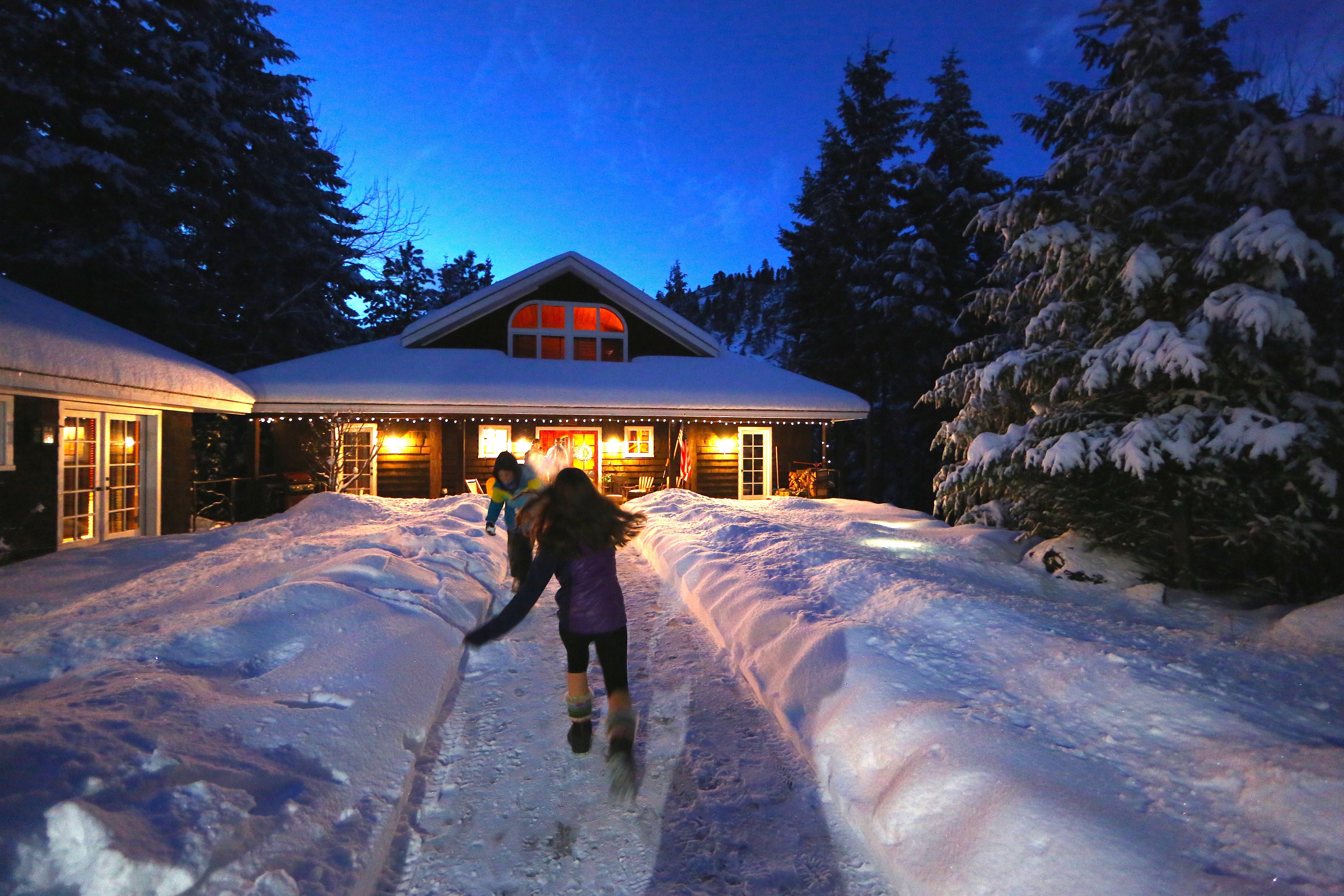
Carefree Holiday Fun in Zero Waste Style

Carefree Holiday Snowball Fun in Zero Waste Style © Liesl Clark

Some reliable sources say Americans produce 25% more waste over the year-end holidays than we do the rest of the year. I’m not surprised, given the household waste-management we’re undergoing this time of year. Our consumption, through gift giving/receiving and party-throwing, is at an all-time high.

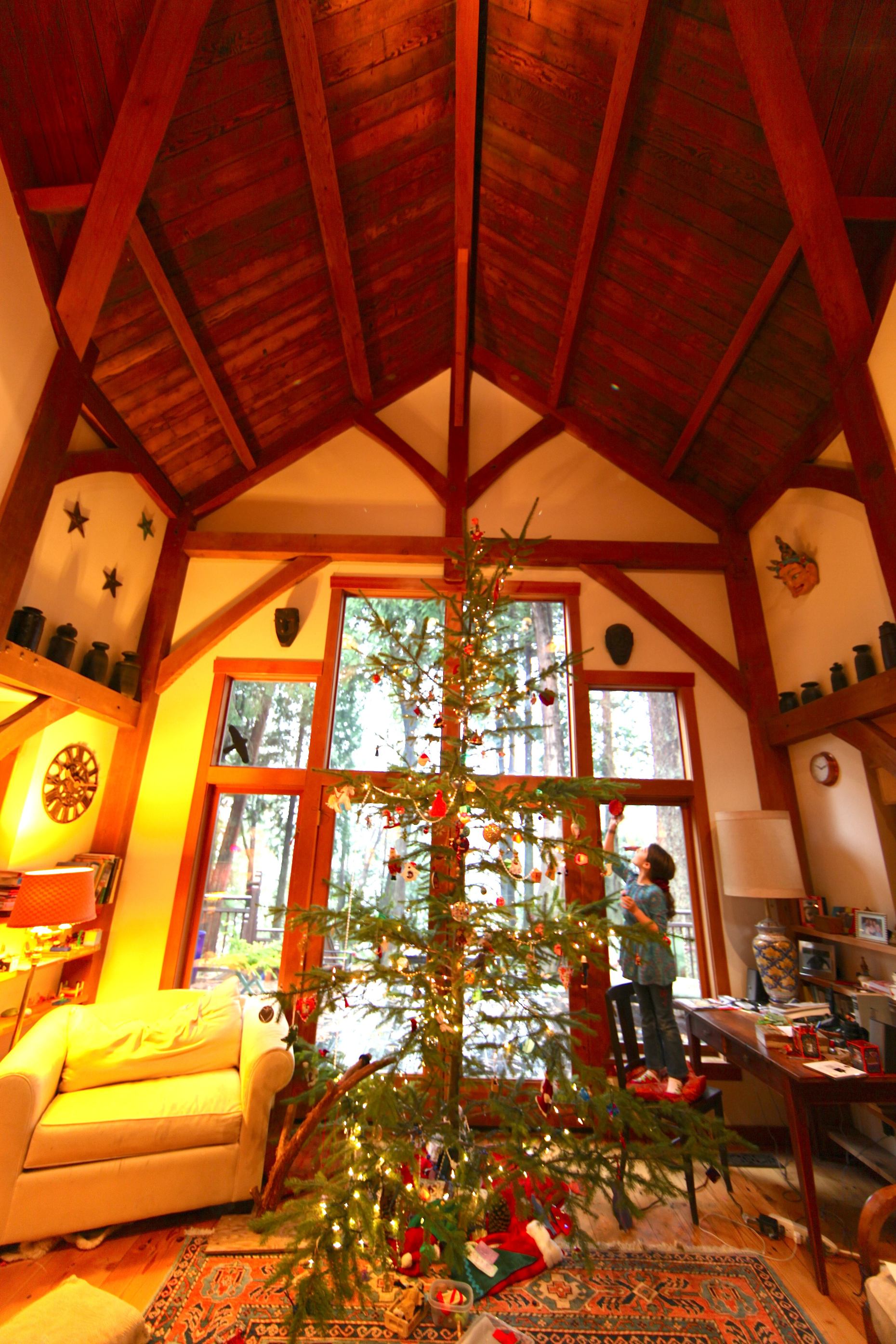
Trimming the Tree, Photo © Liesl Clark

What steps can we take to make this year a game-changer, reducing our impact at years’ end? Here are some easy zero-waste practices that should make you feel good:

  1. Recycle Your Live-Cut Christmas Tree: Most communities have tree recycling options available. Boy Scouts in some communities conduct drives to collect trees and chip them up into compost, for example. Other communities will allow you to put your tree in your yard waste bins.
  2. Reuse Your Live Christmas Tree: We throw ours in our brush pile and then cut it up for kindling once the wood has cured. But we’ve created a list of 15 reuses for your Christmas tree if you’re interested.
  3. Take a moment to turn off your power, enjoy a few hours of power disconnection with family for introspection and connection. We do this for an entire day and the appreciation for each other, and the magic of slowing down comes back  into our lives.

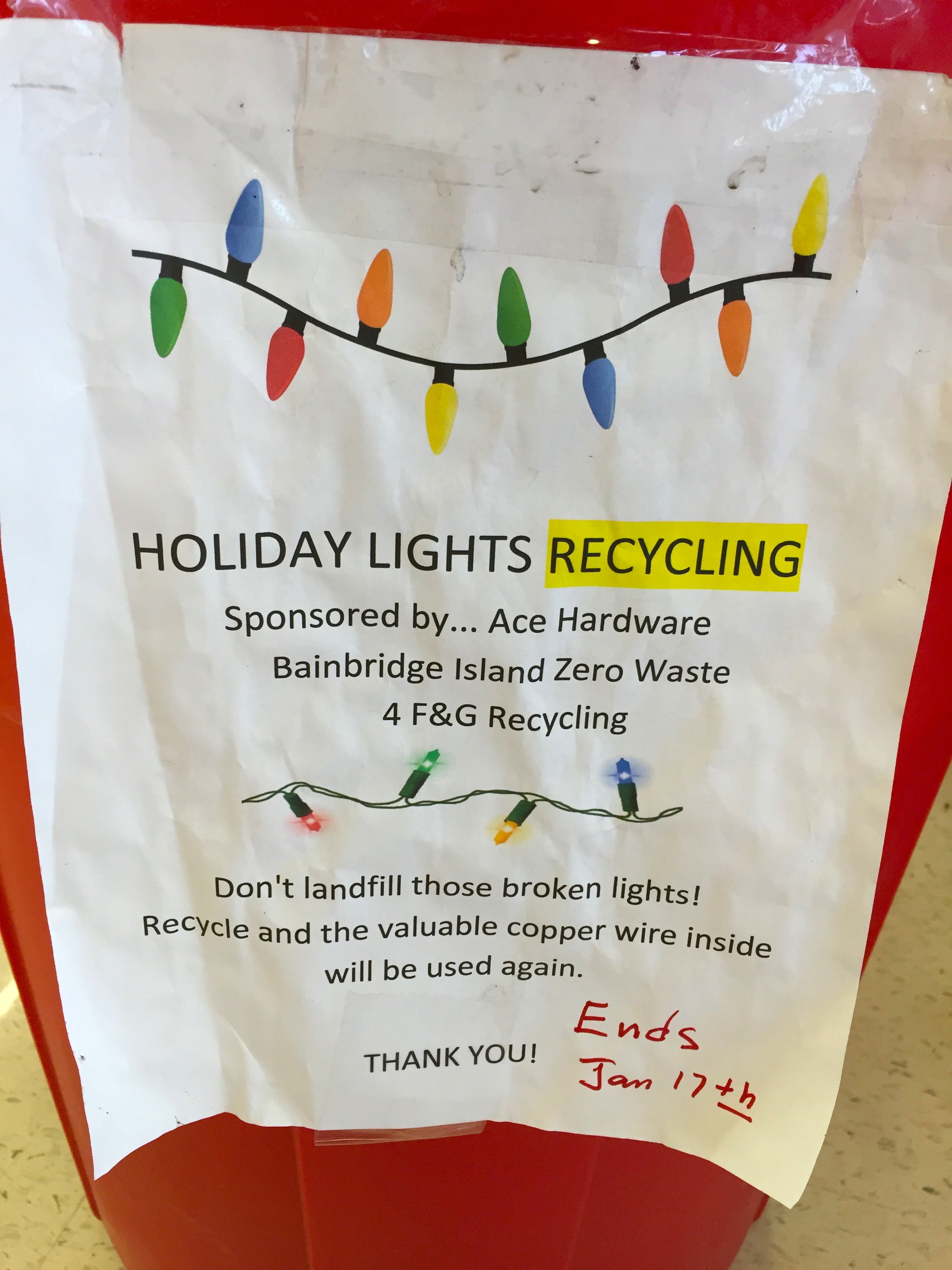
    Ace Hardware is Doing Good Things in Our Hometown © Liesl Clark

    Ace Hardware is Doing Good Things in Our Hometown © Liesl Clark

  4. Recycle your broken holiday/tree lights: When your lights stop working (and, sadly, these things are so poorly made their working life is not very long), don’t throw them away. Most communities have a local option for recycling string lights. Ace Hardware, for example, is our local drop point on our island. But if you can’t find a local venue, you can send your lights to Light Source, in Texas, where they sell used string lights for recycling and give the proceeds back to charity. Or, better yet, collect a few from friends and neighbors and send the tangled mess in a larger box so you know you’ve diverted more than your own from your waste stream. The Refining Company in Medford, OR also recycles holiday lights. Recycling string lights is a booming business in China and although the practices aren’t the most environmentally-sound, thousands of tons of string lights are kept out of our landfills. The Atlantic has a must-read article about the recycling of our string lights in China to mine out the copper wiring inside. After reading the article, I swore we’d never buy string lights again. We receive thousands of unwanted string lights at our local summer community auction, so our family retrieves a few of the unwanted strings from there each summer and use them until they stop working, which, sadly, isn’t very long. IMG_0769 copy
  5. Stockpile your styrofoam and recycle or reuse: Styrofoam is the single most prolific plastic material found on our beaches. In some communities, it has been banned. If you received styrofoam as part of a gift this holiday season, consider yourself the future steward of this highly toxic material. Finding your local recycling option for year-round styrofoam stewardship is the single best thing you could do for the environment this season. In the Seattle area, for example, a free drop-off location in Kent is the place. In the meantime, ask your local zero waste group if there’s a nearby store, like Bay Hay and Feed on Bainbridge Island, that conducts drives to collect the stuff so it doesn’t end up in our waters.
  6. Save your Christmas cards for repurposing: You can always recycle the cards you get from friends in your paper recycling bin. But a fun activity is to cut off the side with the writing and save the card with its attractive artwork for future homemade gift tags. Some people use them to create wreaths for next year, too. And I found a pretty bunting idea for displaying them on your hearth.
  7. Save all ribbon for reuse: Ribbons are made of plastic and survive in our oceans unscathed for years. We’re always surprised to find ribbon from birthday balloons wrapped up in seaweed (they are also known to entangle baby seals, sea otters and sea turtles) and once we break them free from the wrack line debris, the ribbon is as good as new. Save the ribbon you receive on gifts and give the gift of life to our marine creatures by not buying more of it. If you reuse what you have, and receive in the future, you’ll never need to buy more ribbon again. Giving and receiving is cyclical like that.
  8. Find a spot to store re-usable tape: This is a true insider’s tip. There’s plenty of tape and stickers that will peel right off a bag or shiny package and it, too, can be reused. The trick is to have a convenient spot in your home where you keep it. My friend Rebecca puts hers on the side of the fridge for the kids to access easily (kids go through gobs of tape.) We put our reclaimed tape on the inside of a closet door where office supplies are kept. Family members know that’s the community tape dispenser. We haven’t bought new tape in months.
  9. Save what wrapping paper you can for reuse: You don’t need an explanation for this. It’s yet another way to see how reuse can save you money. Most wrapping paper can’t be recycled because of the materials used to make it. Composting or burning it, too, isn’t recommended because of the toxins involved. Because we are committed to not buying new wrapping paper, what do we use? We make beautiful cloth gift bags and give them to friends and family for reuse. We recycle our children’s art as wrapping paper. We use pretty cloth as wrapping paper in the Japanese style of wrapping. We keep items in their shipping boxes and decorate the boxes with ribbon we’ve found on our beaches or plastic marine debris we’ve recovered as a reminder of our mission in the first place. These packages below are how our children creatively wrap their gifts in found items from our home or the beach:

10) Pass on your unwanted faux tree through The Buy Nothing Project or give to Goodwill: Thousands of plastic trees end up in the landfill after the holidays. These aren’t meant to be single-use items. If you need to get rid of yours, pass it on to Goodwill, sell it on Craigs List, or Buy Nothing it.

11) Don’t throw away your unwanted or broken items or toys: One of the single-most satisfying activities you can do with your family is create a workspace where you can repair the items you received over the holiday that were made to break within the first 6 months’ (or sometimes 6 hours) of use.

Send us your stories of what broke, and how you fixed it! We’re looking for inspiration from you, stories about how you defied the odds and came up with a smart solution to repair or repurpose an item so it could be diverted from a landfill and have a new life.

12) Thank your tree: And finally, a special thank you movie in tribute to the pesticide-free, sustainably grown US Forest Service tree we weeded from the dense thicket on the tree-laden slopes of the Olympic National Forest:

Easiest Prettiest Ornament You’ll Ever Make

As we’re just two days to Christmas, I’ll keep this brief. But suffice it to say, this is a great children’s activity in the days before Christmas.

Items Needed:

1 Plastic Lid

Non-stick cooking oil or spray

Glue

Leftover beads, sequins, glitter, sparkly stuff

We even used some beach glass and small shells from the beach

Piece of ribbon or yarn

All you need is to pull a plastic dairy tub lid out of the recycle bin, like a large yogurt container lid. The 4″ wide version works well but you can use a small one, too, for a smaller ornament. Spray or lightly oil with non-stick cooking oil. Then pour glue into the lid. Start placing your items in the glue spaced nicely around and don’t be shy just throw it all in there. Be sure to also stick a loop of yarn or ribbon at the top to act as your hanging ribbon. Wait for a couple of days for the glue to dry. If you place your lids in the sun or in a warm place the drying time goes faster. When it’s dry, just flex the lid around a bit and the ornament will come off easily! You end up with a pretty ornament that glows and sparkles with Christmas lights behind it. Easy!

Easy Peasy Pretty Ornament From a Plastic Lid Mold

Easy Peasy Pretty Ornament From a Plastic Lid Mold

Have Yourself a Handmade Christmas

In our house, Christmas is a special time to create things together and follow traditions we’ve established since our children were born. There are so many wonderful projects to undertake together: Wreath-making, gingerbread house constructing, ornament crafting, cookie baking, tree-finding, gift-making, creative wrapping, card-garlanding, and candle-making. Every day our activity advent-ure calendar is filled with yet another family-bonding event that makes this time of year so alluring. I try my best to use this special time as a model for the rest of the year. The lessons learned from these projects spill over to the new year and beyond as we work together to create outdoor garden and play spaces, grow our own food together, and transform everyday things back into useful items for our household.

Felted wool elf hats are easy for children to make. Photo © Liesl Clark

Felted wool elf hats are easy for children to make. Photo © Liesl Clark

Elf Hats: If you have an old wool sweater, either green or red, felt it and then have the kids craft little elf hats. They’re really easy to sew together and embellishing them with your saved-up scraps of fabric, ribbon, bells will make them a permanent part of Christmases to come.

Edible Zero Waste Snowmen: If your children are having a Christmas gathering or a party at school, they can contribute to the party by making zero waste snowman treats! How are they zero waste? We buy the candies from our supermarket’s bulk bin, the marshmallow bag can be recycled with plastic bags, the baking cups are compostable (and the box recyclable), the sprinkles container can be recycled, the toothpicks are compostable, and the toothpick box can be recycled with our paper.

Little Marshmallow Snowmen, A Zero Waste Treat Handmade by Kids

Little Marshmallow Snowmen, A Zero Waste Treat Handmade by Kids

We love these little snowmen because they’re fun to make and appeal to the nut-free gluten-free crowd. We use our favorite vegan marshmallows, Dandies, which are smaller than traditional marshmallows.

Marshmallow Stacking is Fun, Photo © Liesl Clark

Marshmallow Stacking is Fun, Photo © Liesl Clark

First thread 3 marshmallows through a toothpick leaving the end of the toothpick sticking out. Next, place a spice gumdrop on the snowman’s head for a hat, spearing it with the toothpick tip. Use another toothpick to poke eyes and buttons into the marshmallows. Press jimmies or sprinkles into the holes for eyes and buttons. Break the toothpick in half and place them in as arms for your snowmen and women.

Enough for the Entire Class, Photo © Liesl Clark

Enough for the Entire Class, Photo © Liesl Clark

Use some paper baking cups (stack 2 together so they’re sturdy enough for small hands) to hold your snowpeople in a bed of organic jelly beans — just enough to make any child’s mouth water.

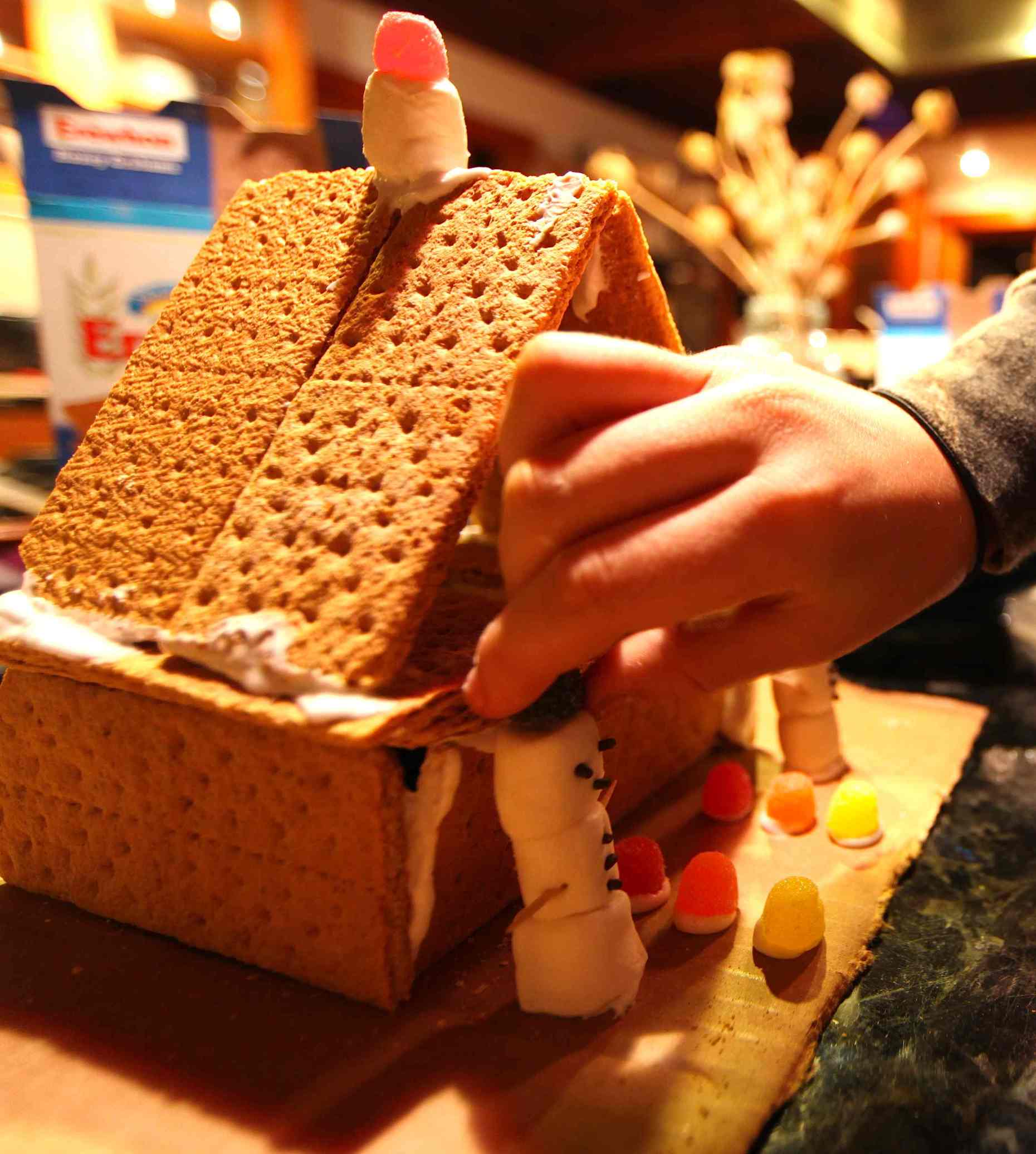
Graham Cracker Gingerbread Houses: Another zero waste edible we love to create are our holiday graham cracker gingerbread houses. With the leftover jelly beans, gum drops, snowmen and some powdered sugar and graham crackers, we were able to build little houses for display on the dining room table.

Graham Cracker House Magic, Photo © Liesl Clark

Handmade Christmas Magic, Photo © Liesl Clark

The key is to have good “sugar glue” by making your own royal icing. I had a cup of powdered sugar, some cream of tartar and an egg in the hen house so we were able to whip up the icing and the rest was our own hands.

Cottage Construction Zone, Photo © Liesl Clark

Cottage Construction Zone, Photo © Liesl Clark

All on a Fancy Cardboard Platter

All on a Fancy Cardboard Platter

Garlic Press Gingerbread Hair

Plate of Gingerbread Cookies for the New Year, Photo © Liesl Clark

Plate of Gingerbread Cookies for the Holidays, Photo © Liesl Clark

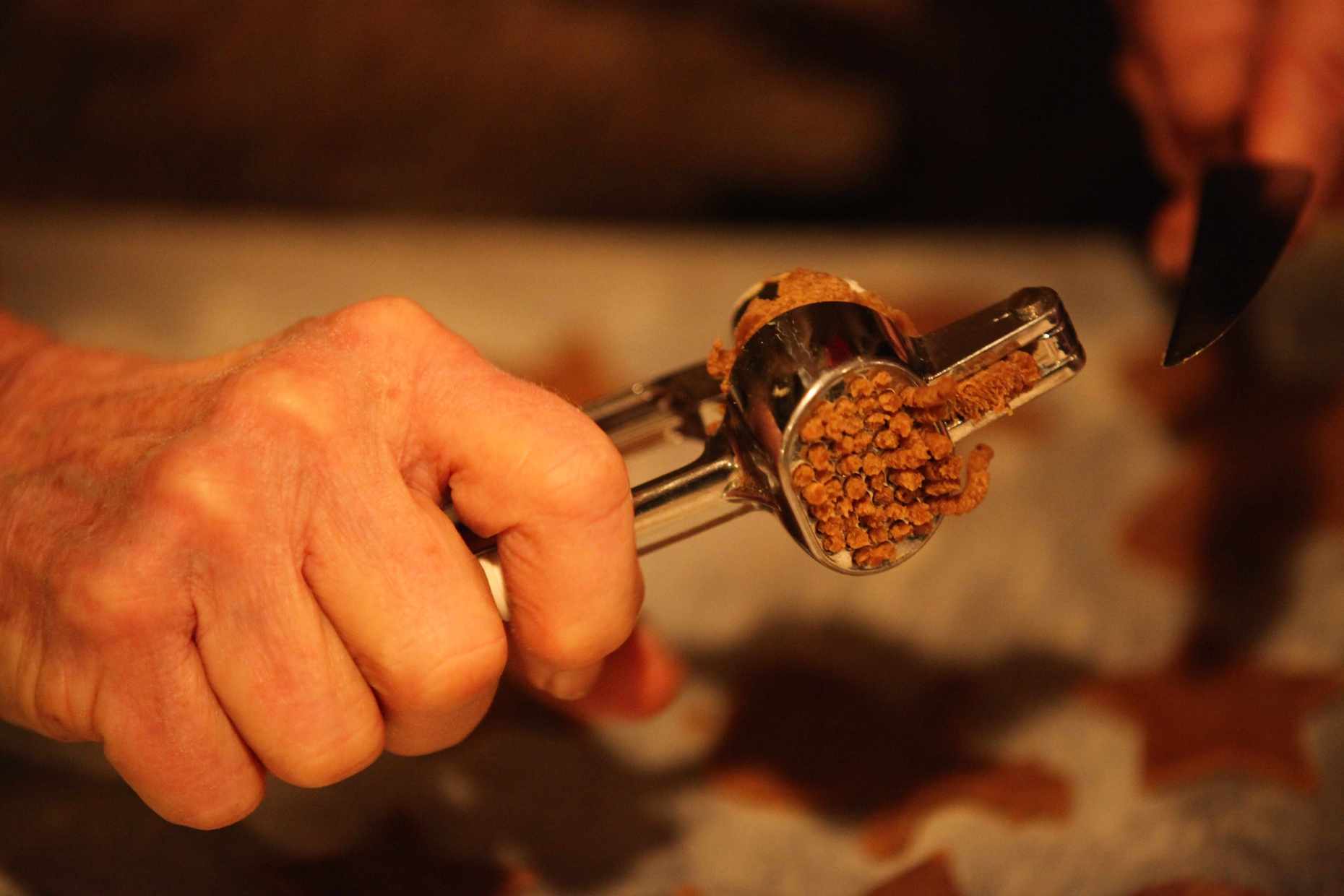
As we’re in the heart of the holiday season, baking gingerbread men is a tradition our family has endured since I can remember. True to form, my mom, “Grandma,” has come up with yet another innovative reuse for an everyday kitchen tool: Use a garlic press to make gingerbread people hair!

Squeezing Dough Through a Garlic Press for "Hair," Photo © Liesl Clark

Squeezing Dough Through a Garlic Press for “Hair,” Photo © Liesl Clark

Use a knife to cut the hair off at the length you’d like and then press the hair into the top of your gingerbread person’s head.

Applying Hair, Photo © Liesl Clark

Applying Hair, Photo © Liesl Clark

Adding Decorations, Photo © Liesl Clark

Adding Decorations, Photo © Liesl Clark

Bake your cookies and you have a more 3D cookie for your family to enjoy!

Gingerbread Man with Hair, Photo © Liesl Clark

Gingerbread Man with Hair, Photo © Liesl Clark

Gingerbread People Love to be Decorated, Photo © Liesl Clark

Red Haired Gingerbread Girl, Photo © Liesl Clark

Yum! Photo © Liesl Clark

Yum! Photo © Liesl Clark

What cool reuse traditions do you have in your home over the holidays? Please share.

Reuse Your Wreath Frames!

Rosemary Wreath, All From Salvaged Materials. Photo © Liesl Clark

Rosemary Wreath, All From Salvaged Materials. Photo © Liesl Clark

When it’s time to take down your wreath after the holidays, get out your pruning clippers and cut the wreath frame free from the pine boughs, compost your pine boughs and you’ve got a wreath frame for next year.

Last Years' Wreath Adorns the Chicken Yard and Still Smells Nice. Photo © Liesl Clark

Last Years’ Wreath Adorns the Chicken Yard and Still Smells Nice. Photo © Liesl Clark

We place our aging wreaths around the chicken coop fence to adorn their abode and when Christmas comes around the next year, I reuse my frames. But this year I was lazy. My husband, Pete, and friend Rebecca found 3 wreath frames on the beach when we were on one of our “Mapping Plastics” legs circumnavigating our Puget Sound Island.

Plastic Wreath Frames Rescued From the Beach

Plastic Wreath Frames Rescued From the Beach

Seems some islanders throw their grass, tree, garden, and bush clippings along the banks of the shore, including their wreaths. This is a long-standing practice as evidenced by the number of yard debris dump sites we’ve found along the shore. Residents want to fortify their bluffs and low banks with grass, sticks and garden waste. But now there’s evidence this practice isn’t great for our waters.

Pete and Rebecca, Recovering Plastics Embedded in the Bank. Photo © Liesl Clark

Pete and Rebecca, Recovering Plastic Wreath Frames Along the Banks of Puget Sound. Photo © Liesl Clark

According to Island County’s Shore Stewards News, “If you use fertilizer or other chemicals on your lawn, those chemicals will make it to the shoreline along
with your clippings, killing fragile marine life. Grass without chemicals can be dangerous, too, as the excess nitrogen can raise temperatures and pose a danger to marine life.”

Yard Debris Piles Along the Banks of Puget Sound Pose Problems for the Marine Ecosystem. Photo © Liesl Clark

Yard Debris Piles Along the Banks of Puget Sound Pose Problems for the Marine Ecosystem. Photo © Liesl Clark

The dense organic debris in piles, which will ultimately end up in the Sound, can pose problems for shellfish beds, too. Our discovery of the wreath frames wasn’t a surprise, after all, because they’re plastic. They were destined to begin a journey onto our waters, but we plucked them from the bank as they easily rested on top of some sticks. We had no idea what they were at first and it wasn’t until we later inventoried the plastics that we determined their purpose. I shared some on our local Buy Nothing group, saved one, and now I have a homemade wreath to show for it!

Rosemary Bush Gets a Haircut, Photo © Liesl Clark

Rosemary Bush Gets a Haircut, Photo © Liesl Clark

Truth is, my rosemary bush needed a haircut. Pete pruned it and I’m using the clippings for my wreath. A trip to the back yard with pruning shears resulted in a few sprigs of salal and holly. And with a few pieces of salvaged thin wire found on the beach, I wove together my rosemary wreath — all from salvaged materials.

A Rosemary Wreath Smells Lovely. Photo © Liesl ClarkA Rosemary Wreath Smells Lovely. Photo © Liesl Clark
Share with us your own homemade wreath ideas!


Trash To Treasure Christmas Ornaments

Every year a few pieces of trash are pulled out of our bin and gleefully turned into ornaments for the tree. Call it a family tradition for waste-minded children. This year, we started with a couple of CDs that I have been meaning to drop off for recycling at Green Disk in Seattle. But then I noticed how shiny the discs are and got an idea.

Shiny CD Ornament

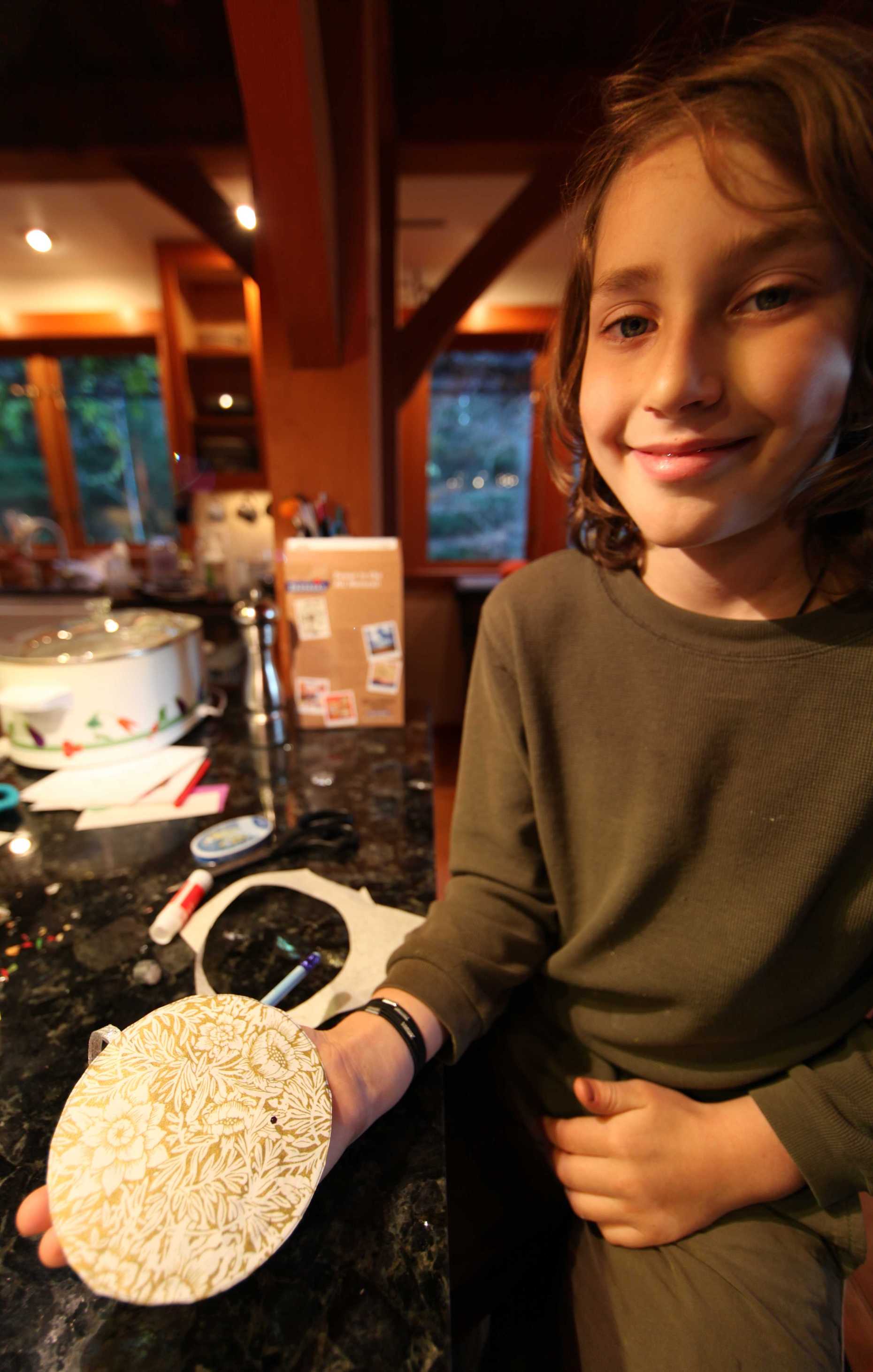
Take some pretty scrap paper (even wrapping paper will do) and have your kids trace a circle around the edges of your CD and then let them cut the CD-sized circle out. Glue the pretty paper to the non-shiny side of your CD, but be sure to glue a little looped ribbon as an ornament hanger at the top. We also glued some tin foil over the hole in the middle so the CD looks like a perfect shiny circle with no hole.

Scrap Paper Glued to Backside of CD with Ribbon for Hanging Ornament

Then, get out your glitter glue or puffy glue and let the kids make designs on the shiny surface. My children love symmetry so they both tried to create symmetrical patterns on 4 sides of the CD.

Starting in the Middle

Finished CD Ornament

Done!

Finished CD Ornament, His.

Scrap Paper Star Ornament

This one is almost as easy. First, we pulled some paper out of the trash that had printing on one side and white on the other. We threw it in the printer and went to our favorite paper craft site, The Toymaker. This site, created by artist Marilyn, is full of fantastic fold-able paper toys that are perfect for small hands. We’ve made gift bags, small puppet theaters, animals, toy airplanes, perfect building blocks, and gift boxes using the beautiful hand-drawn designs on this lovely site. For the 3D star ornament go to the Christmas page and scroll down to the star.

Free PDF Printable Star Ornament at TheToymaker.com

Print out your template for a fold-able star from Marilyn’s downloadable PDF file. Her templates are all free and very easy to understand.

Cut Your Pretty Scrap Paper Into Strips

Next, cut out strips of scrap paper! We used colorful tissue paper we got from a freecycler so that we could still see the PDF template through the tissue.

Felines Like Ornament-Making, Too

Glue your tissue to the star in any design you’d like. Simply cover your PDF printout with colorful paper scraps. Next, cut out your star template.
Cutting Out the Star

Cutting Out the Star 2

Finished Star Cut-Out. Now Ready For Folding.

Start folding along the dotted lines (Marilyn indicates which folds are “mountains” and which are “valleys” and where to put glue.) It’s really easy!

Folding a 3D Star

Your finished star took about 15 minutes to make.

Star Girl

Finished Scrap Paper Star Ornament

What are you making this year for your tree?