Fabric Scrap Doll Tutu

Easy Fabric Scrap Tutu For a Child to Make, Photo © Liesl Clark

Visiting grandma means we get to dive into her boxes of fabric scraps. For 40 years, no fabrics have been wasted in her house. Just last month, she passed on several boxes to a local quilt-making organization, but luckily we found a few more up in her attic.

Grandma's Fabric Scraps, Photo © Liesl Clark

We looked in the Trash Backwards app for some good fabric scrap reuse ideas for small hands and landed upon a fun tutu tutorial for a little girl. My daughter decided she wanted to make it for her stuffed panda. So, we took our lead from the tutorial at Home Sweet Home and made a mini version for a doll or stuffed animal.

Strips of Fabric Scraps, Photo © Liesl Clark

1) First, cut your fabrics into 1/2 inch to 1 inch wide strips. We made ours approximately 6-8 inches long.

2) Find an elastic waistband, about 8-12 inches-worth and sew 2 ends together so you have it in a loop.

Sew Your Waistband Into a Loop, Photo © Liesl Clark

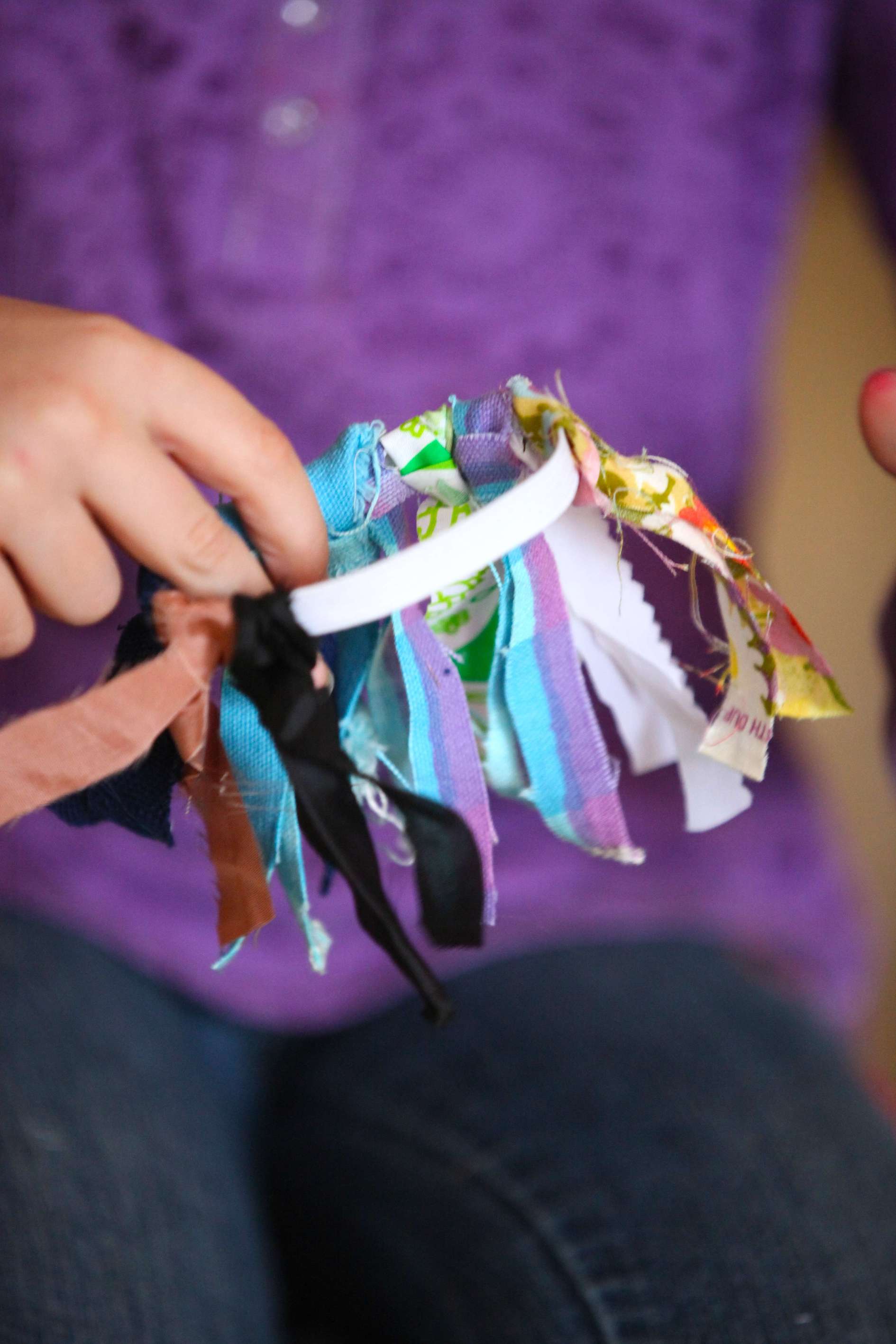
3) Fold your strips in half length-wise and place them underneath the waistband with the loop sticking out of the top and thread the ends of the fabric scrap through your loop, tying half of a square knot. This is how you tie on your skirt scrap pieces.

Adding Fabric Scraps to The Waistband, Photo © Liesl Clark

4) Tie your scraps on one after the other and gather them together tightly.

Tying One On, Photo © Liesl Clark

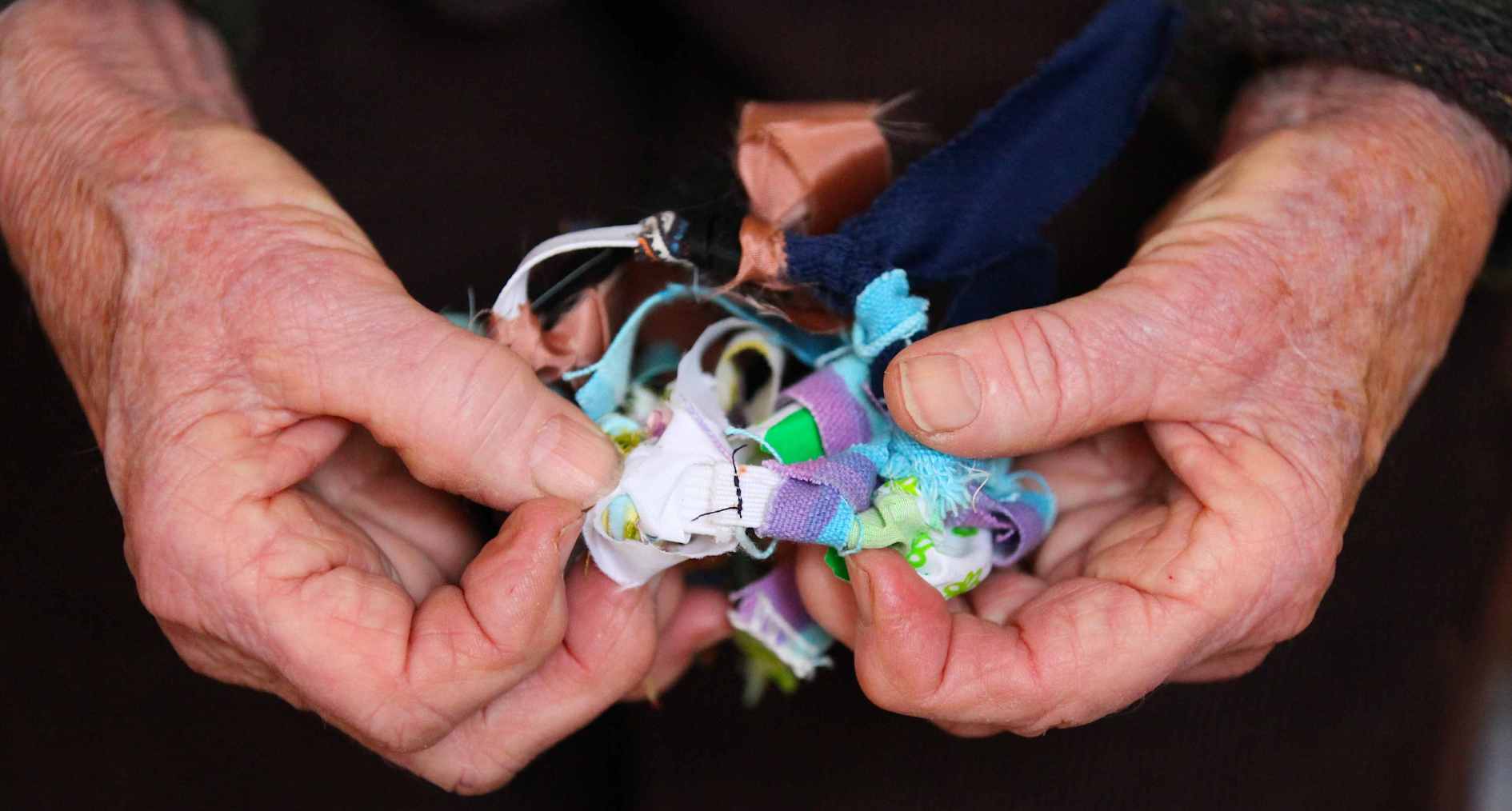
5) We wanted to be sure that the waistband was sewn together well, so grandma reinforced it with some hand-sewing.

Reinforce Your Waistband Ends, Photo © Liesl Clark

You’re Done! Spread around your strips so they even-out your skirt and you can add on more strips of color wherever they’re needed.

A Tutu For a Doll or Stuffed Friend, Photo © Liesl Clark

Panda Loves Her Tutu, Photo © Liesl Clark

Dancing With Her Tutu, Photo © Liesl Clark


Fabric Scrap Tutu, Photo © Liesl Clark

25 Bread Clip Reuses

IMG_4795 Photo © Liesl Clark

Photo © Liesl Clark

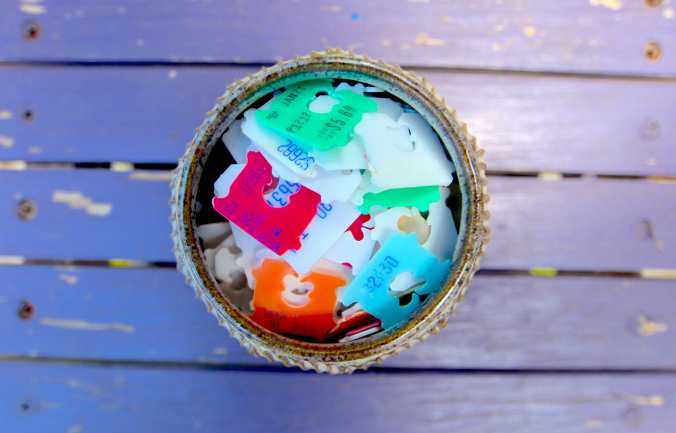
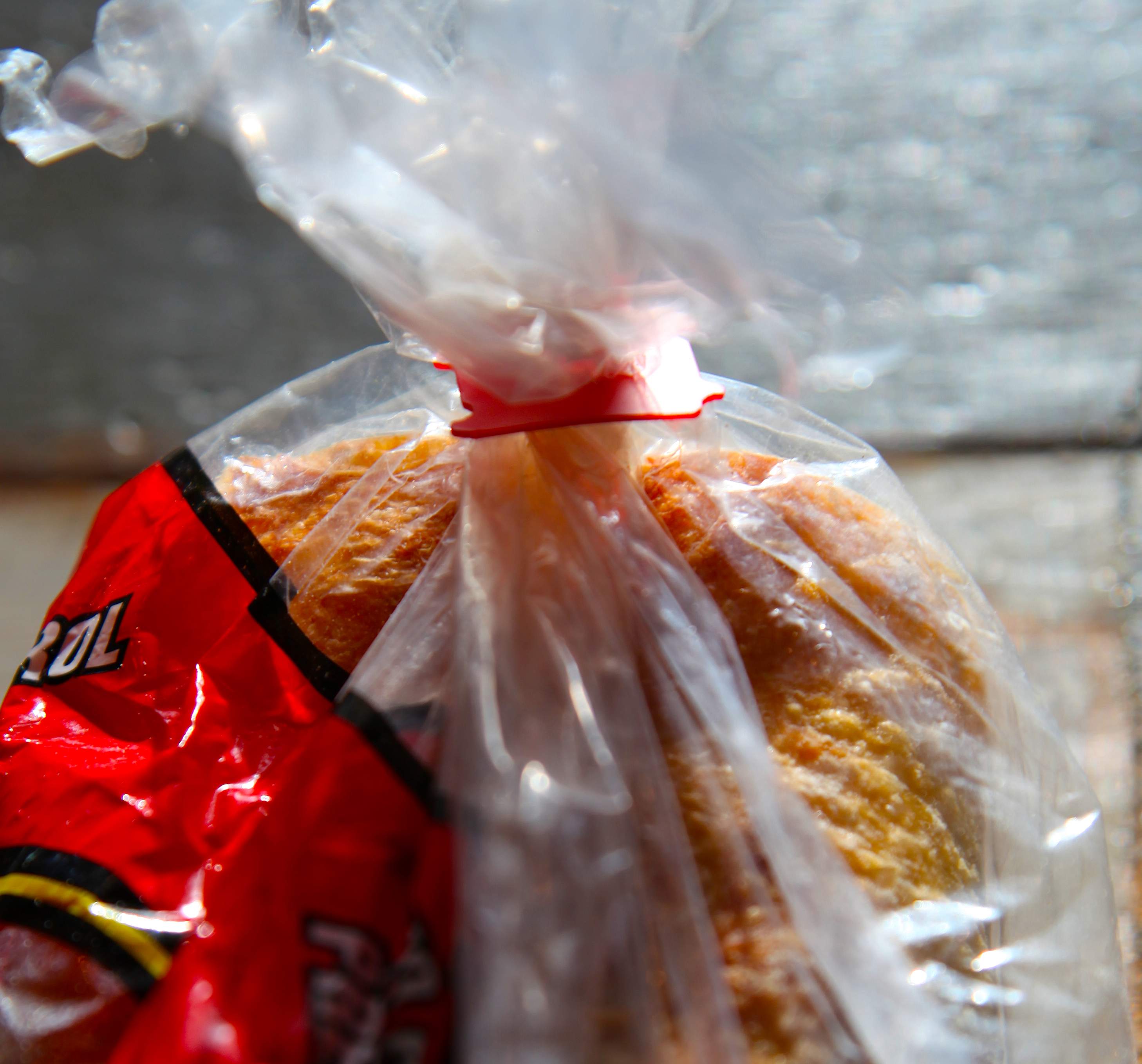
Although we most often bake our own or purchase locally baked plastic-free bread from our local baker, there is the occasional store-bought bread that comes in a plastic bag (recyclable at most grocery stores, if clean) with a hard plastic clip to keep it shut. These clips might also make their appearance on produce bags. Some call them bag clips, others bag tags. They’re made of hard plastic and as of yet we know of only one address in the US where you can send them, where they’re stockpiled and sold to help wheelchairs get to South Africa where they’re needed. So, if you’ve collected them over the years, please send them to this address here.

Did you know that over 20 cases of accidental ingestion of plastic bag clips have been published? The incidence are so detrimental to health that a team of researchers have classified in the British Medical Journal “morphology” chart the many varieties of bag clips, in an effort to determine which ones are most dangerous to the digestive tract and which designs are more benign.  Don’t swallow them, or you might become yet another statistic for this study.

We do have a few bread clips saved in some drawers, mostly for reuse. Here are a few of the ways we’ve used them in our home?

1) Reuse to seal other bags (yep, it’s obvious but I had to list it so you don’t throw them away.) We store our bread in a bread box, to keep it plastic-free. But, occasionally we’ll need to pack it in plastic when we go camping. Bread clips come in handy then.

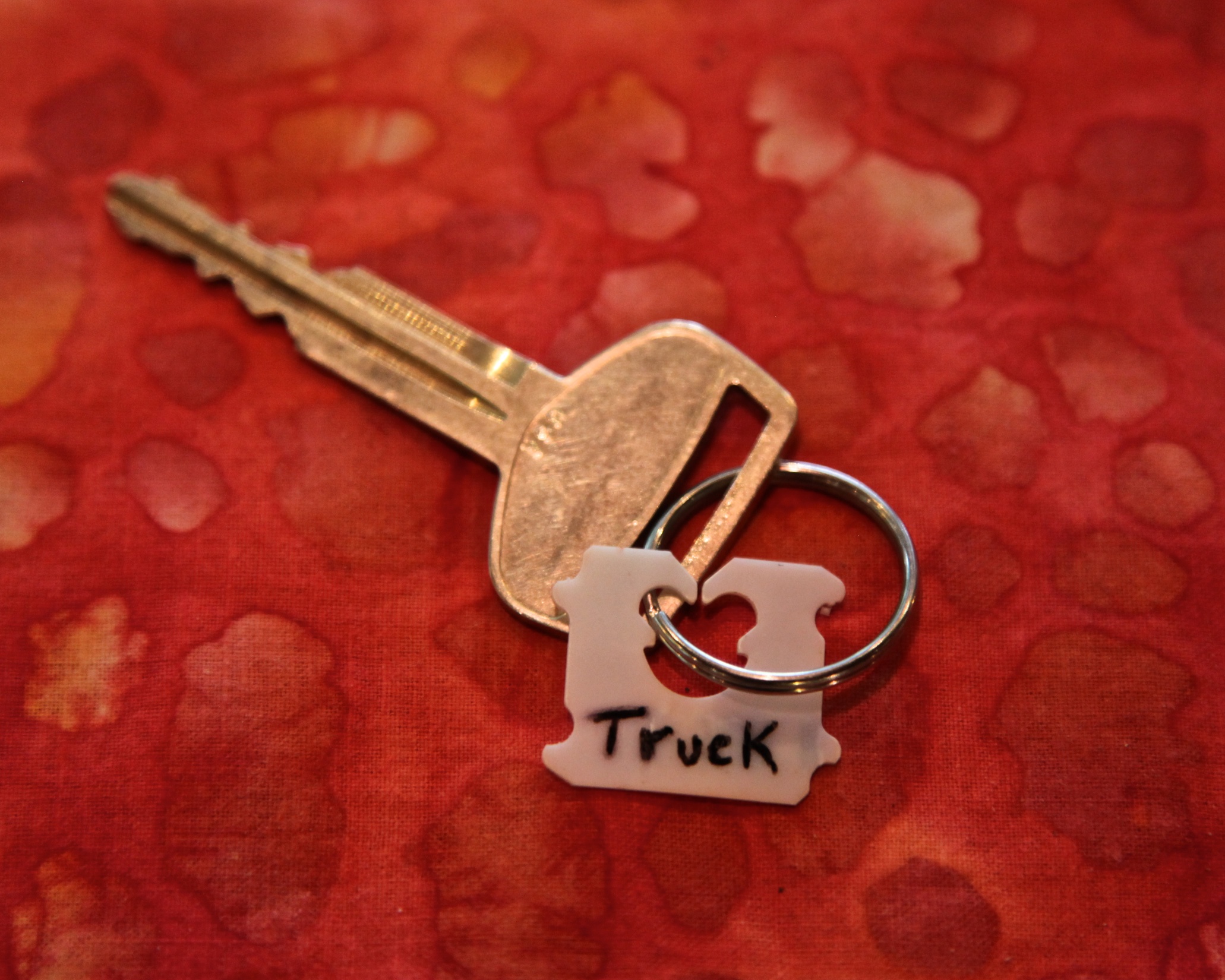
2) Label your spare keys with them!

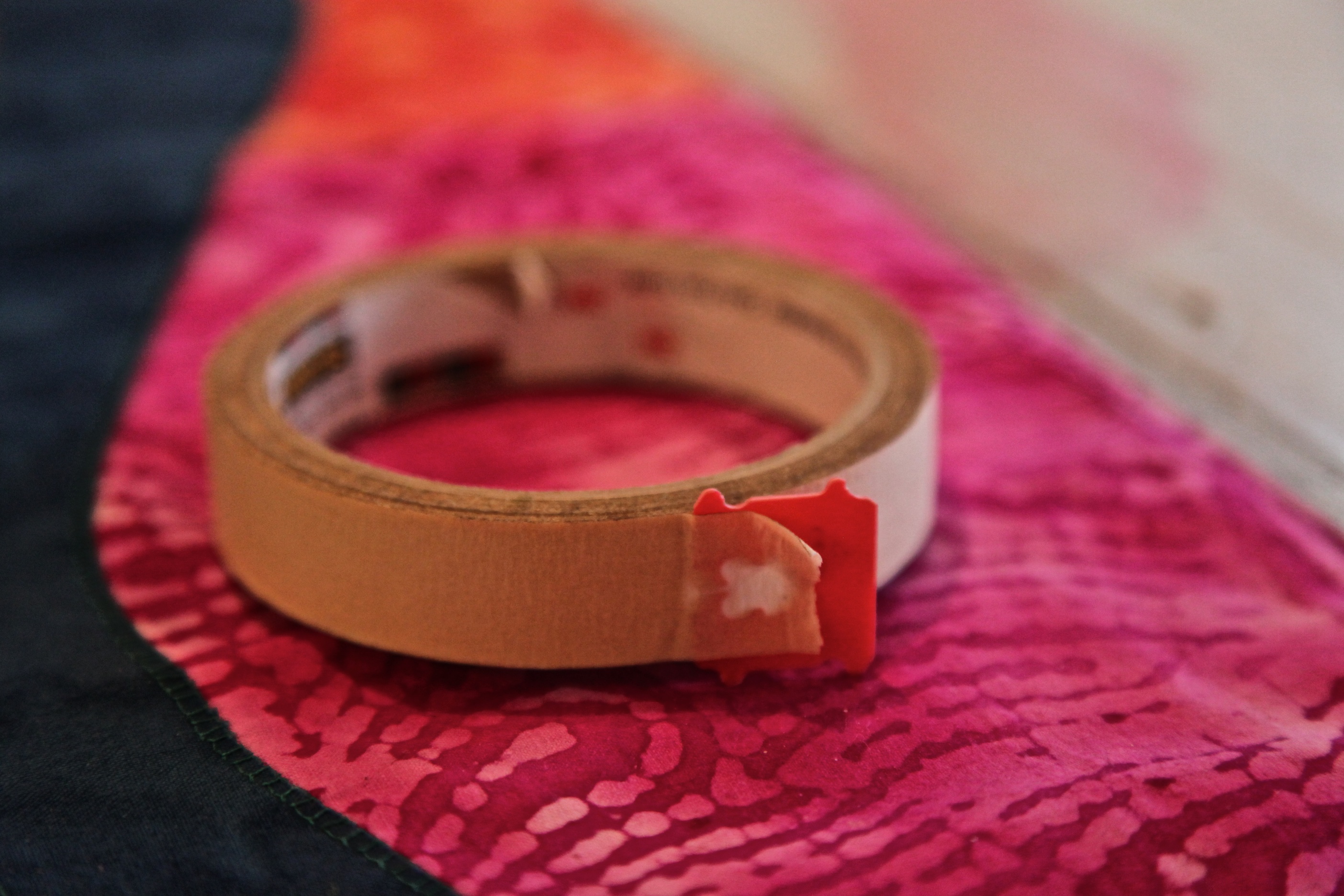
3) Place on the end of tape, like duct tape and masking tape, so you don’t have to spend time peeling the tape off itself.

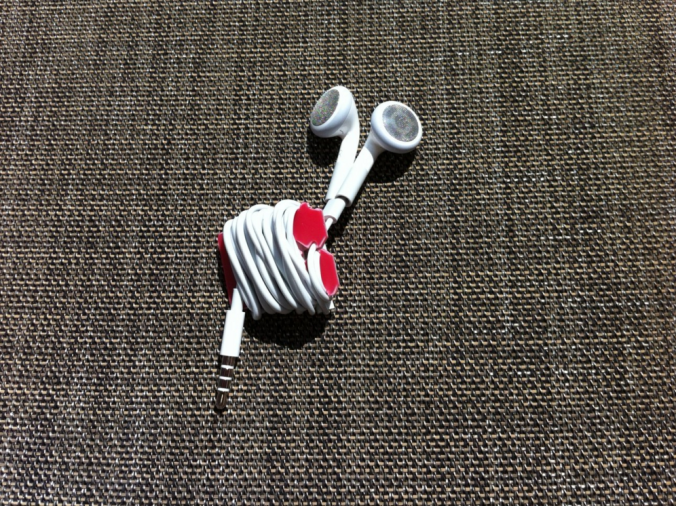
4) Use them as earbud tamers to store those earbuds and prevent the inevitable tangles.

Screen Shot 2016-03-01 at 3.19.01 AM

Photo: Jake Ducey

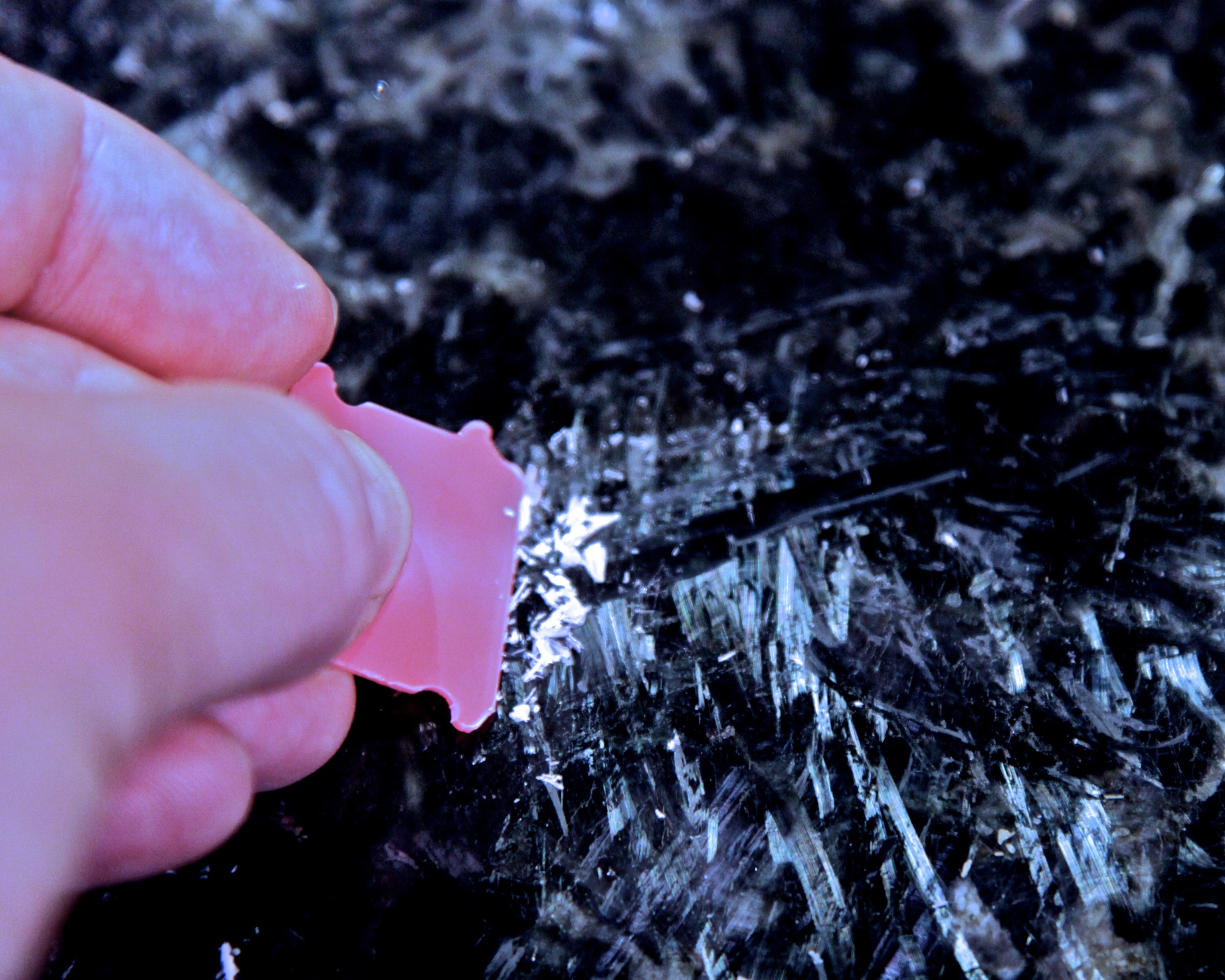
5) Use them as counter scrapers for hard-to -scrape -off crud. Same for pots and pans.

6) Use to hold together all your rubber bands in your everything drawer.

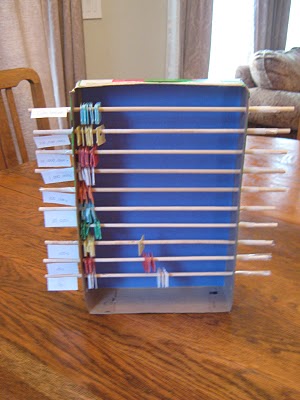
7) Make a cool cereal box and bread clip abacus by following this tutorial provided by Almost Unschoolers!

8) Use your bread clips to organize and label your desk and entertainment cables.

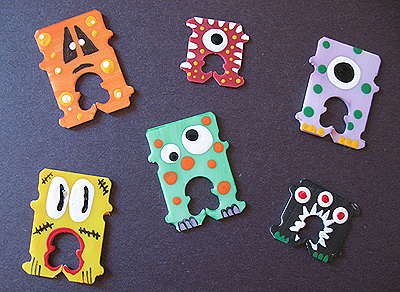
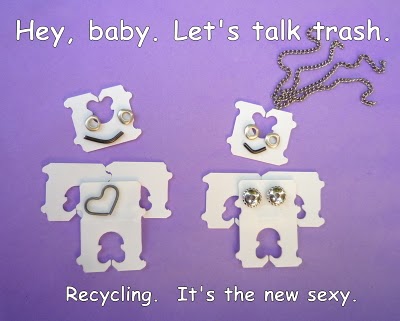
9) Make bread clip monsters like these at Crafts by Amanda.

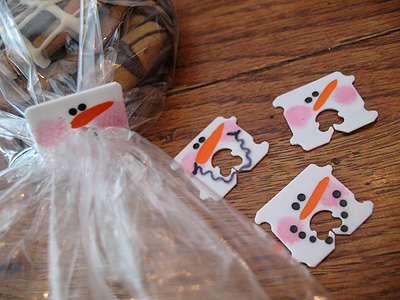
10) Make bread clip snowmen a la Crafts by Amanda, and impress your housemates.

11) Use as a bookmark.

12) Use to replace missing game pieces. A bread clip avatar for monopoly could be quite imposing if you put a scary business face on it.

13) Make a bread clip monster garland. Cute.

14) Use as wine glass identifiers for a party. Multicolored bread tags, or ones you’ve added faces to, work well to differentiate your guests’ glasses. Just clip ’em to the stem of the glass.

15) Write the letters of the alphabet on 26 bread clips and let your child put them in order.

16) Make some cute bread tag earrings.

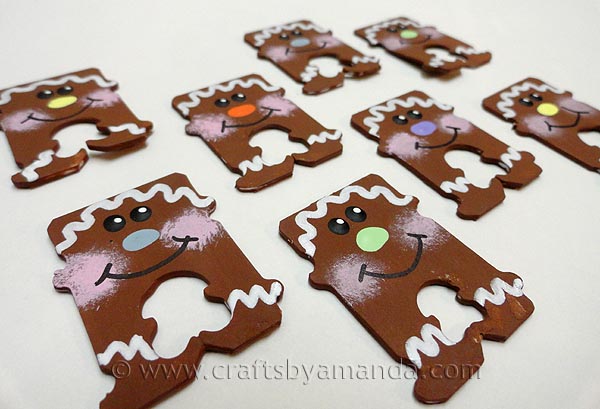
17) Make bread clip gingerbread men!

18) Use them to hold hair ties in the bathroom.

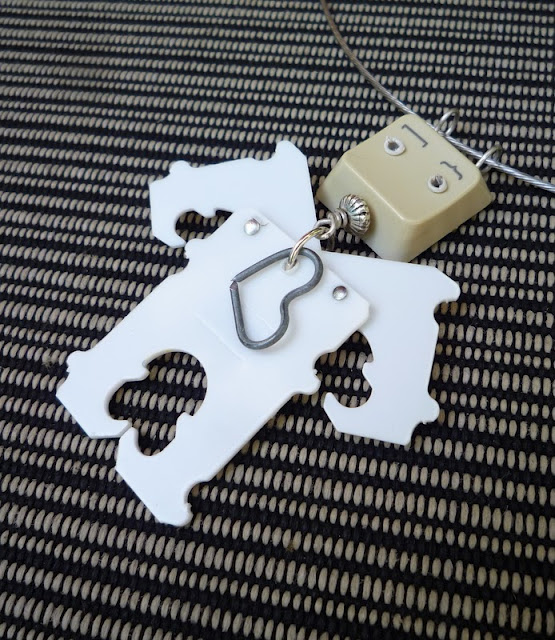
19) Learn how to make a robot necklace from Mich L in LA.

20) Make some more fine jewelry.

21) Here’s a pendant for some more ideas.

22) Use them to hold your twist ties in your reusable grocery bag for bulk items. I reuse these twist tie bulk food labelers, so having them in a bundle helps keep track of them when I’m in the bulk department.

23) Flip flop about to blow out? Use a bread tag on the bottom to hold the little end in place for a quick reinforcement fix.

24) Make a bread clip shower curtain (ok, I know you won’t, but it’s an interesting and artful idea.)

25) For some fun bread clip robot reprintables, please visit Mich L in LA’s blog, which is an inspirational site for repurposing our “trash” into artful creations.


How To Fix Dead Ballpoint Pens

I promise, I haven’t gone off the deep end. I hate to throw things away that don’t need to be tossed, and most pens that stop writing can be fixed in a matter of seconds.

Fix Those Pens

We had a few hundred pens to test after having collected them from boxes bound for a dumpster. Sure, we had saved them from the landfill, but did they work? Most did, but the 30 or so that wouldn’t write just needed a little nudge. The roller ball was locked in place by dried-up ink from lack of use and we decided to put an age-old remedy to the test. If you put the tip of a ballpoint pen in a flame for a second or two it heats up the ball and gets it moving again.

Moving parts are all that’s needed when you know there’s still ink in that pen. Here’s how we did it. This ain’t rocket science:


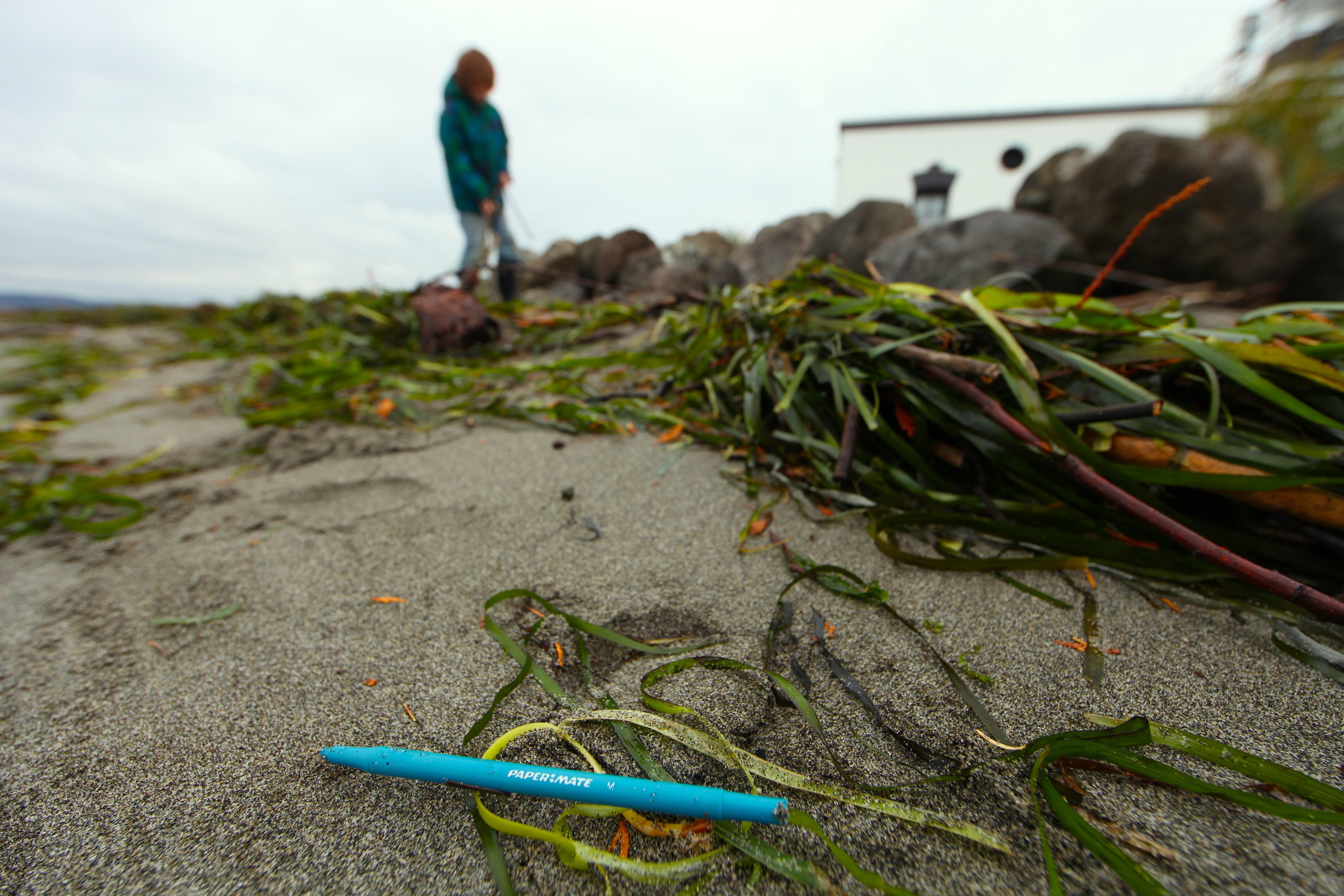
I had 2 excellent lab testers to do the job. The result? Thirty pens saved! And, why do we do this? Because we find too many plastic pens out in the environment, on our beaches, sides of roads, sidewalks. Every time we go to the beach or to town, we find pens.

Papermate Washed Ashore at Point No Point, WA © Liesl Clark

Paper Mate Washed Ashore at Point No Point, WA © Liesl Clark

I don’t think I’ll ever need to buy a pen again. They’re everywhere, and most are made of plastic so they’re here to stay, forever. Let’s try to fix the ones that don’t work and give them a second, third, and fifth life if necessary. And when all the plastic pens have been used up, we can start buying one special metal pen a year, like my husband does. He carries it with him and uses it religiously, because it’s his one pen, his favorite pen, meticulously made, and ready for him to write beautiful things because it’s well made and doesn’t dry up so easily.

Valentines: The Original Folk Art Scrap Hack

Handmade Paper Valentines, An Original Folk Art. Photo © Liesl Clark

I remember having to make valentines cards in elementary school for each of my classmates. The handmade cards tended to come from whatever scrap paper, lace, and paper doilies we had around our home. Each valentine was different, a scrapper’s attempt at making beauty from what was available.

Scraps of Paper. All You Need to Make an Original Valentine. Photo © Liesl Clark

And then things changed, and there was a new ethic afoot: Skip the handmade valentine and buy a mass-produced version for your friends, complete with a stash of sweets. All you had to do was fill in your name, the recipient’s name, and add a packet of hearts. It certainly was a time-saver, but these so-called valentines felt like a cop-out and an opportunity for some not-so-creative folks to make money off of us. I’m still a big fan of the hand-crafted valentine. You might say the valentine is an original form of folk art, and some still practice it today.

Our kids, over the past few years, have been assigned, at school, to make valentines for their classmates from materials found in their home. Alas! We could bring back the tradition. Here are a few examples I’ve pulled from our photos over the years:

1) The Traditional Scrap Paper Valentine:  We first gathered our scrap paper and cut out traditional hearts on card stock we had rescued from the landfill. We also save pretty scrap paper from magazines and junkmail so we have plenty of colors and textures to choose from for projects like this.

Cutting, folding, and gluing paper is all it takes to make a valentine. Photo © Liesl Clark

2) A Scrap Fabric Valentine:  Then we found some pretty scrap fabric and cut out hearts to glue to the reclaimed card stock. Those felt a little more 3D and folksy.

Add a fabric scrap to your valentine for a more 3D effect. Photo © Liesl Clark

3) Bookmark Valentines:  Cut long strips of paper about 2 inches wide by 6 inches long.

Paper strips from handmade paper. Photo © Liesl Clark

Punch a hole (we punched a star, really) into one end of each strip.

Punching a hole in the end of your strip. Photo © Liesl Clark

Tie a little ribbon or scrap fabric through the star, and you’ll have bookmarks ready to decorate as useful valentines.

Bookmark Valentines are Useful. Photo © Liesl Clark

4) Valentine Heart Wands: In our pantry, we found some pie tins and colorful plastic straws we had found on the beach, saved, and washed. These would become our raw ingredients for heart wands we made for several of the students:

Heart wands are easy. All you need are pie tins, straws, and a glue gun. Photo © Liesl Clark

Cut a heart out of your pie tin and glue it to the end of a straw. They work with pretty sticks, too. And if you want to embellish your silvery pie tin heart, you can glue a smaller heart to your tin heart.

Hearts of Paper and Hearts of Tin. Photo © Liesl Clark

The Tin Man would be proud.

Heart Wands From Pie Tins and Straws. Photo © Liesl Clark

We've been making these for years. Photo © Liesl Clark

5) Wire and Yarn Hearts:  We often craft wire hearts from scavenged wire and then wrap them in yarn. The children love hanging them around the garden. The little heart below was made by my daughter when the deer ate her bleeding hearts. She was so saddened by the loss of her hearts, she placed a fence around them and crafted this wire heart on the outside for the deer to eat, still leaving them something to enjoy. The sweetness of a 6-year-old is undying.

A wire and yarn heart to help protect the bleeding hearts from the deer. Photo © Liesl Clark

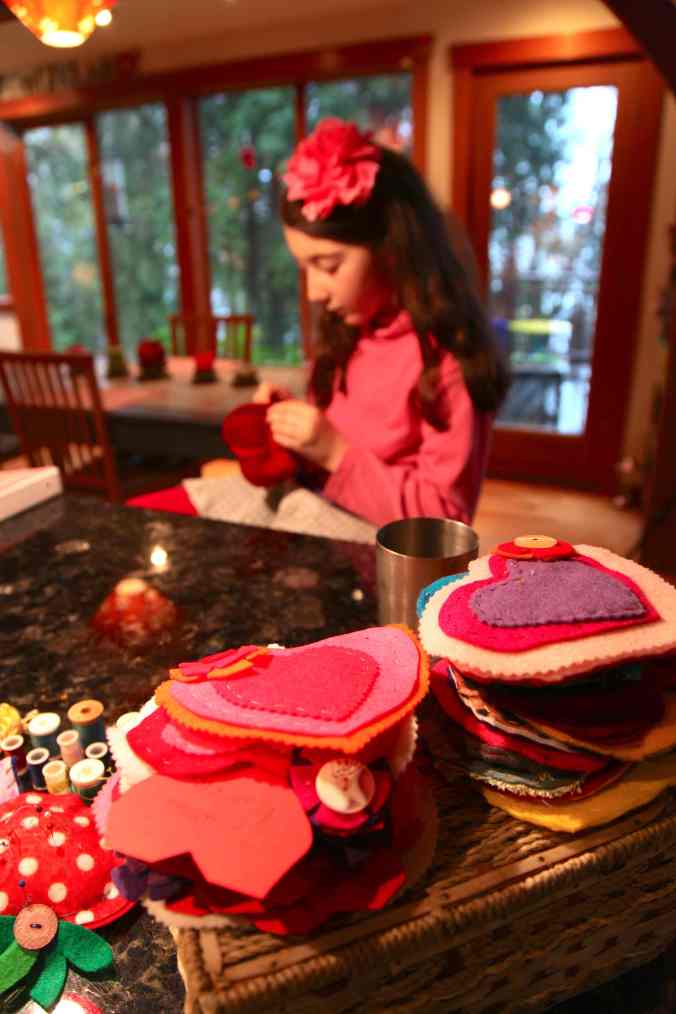
6) Classic Hand-Stitched Valentine: My daughter love to sew by hand. These hand-stitched valentines took her a month to make, but she poured her love and talent into each one. She left a little pocket in each to be filled with organic jelly beans, her favorite treat we buy in bulk at our local store. These are pretty easy to make so long as you have felt. We asked for felt on our local Buy Nothing group, and neighbors had plenty to share! She cut out hearts in varying sizes with my pinking shears and then layered them and sewed them together, leaving a pocket at the top.

IMG_0347

7) Produce Sticker Heart:  This one might be a bit of a stretch, but for those health-conscious sweethearts in your life, why not craft a produce sticker heart valentine? It was a cathartic exercise, for me, because those plastic stickers to announce that we’ve bought organic produce bother me greatly. No tutorial necessary, right?

Produce Stickers are Pink and Perfect for this Healthy-Heart Valentine. Photo © Liesl Clark


Send in a picture of your own homemade valentines. We’d love to share them with all our sweethearts.

Backyard 7 Summits Project: Kitsap County’s Highest Peak

By Cleo Clark-Athans, Grade 4

IMG_475892539-11

Climbing Gold Mountain © Liesl Clark

We did it!

We reached the highest point in our county today. It’s called Gold Mountain and is only 1,687 feet high. It took about an hour and 10 minutes to get to the top. Two miles to the summit, but it was straight up through a thick forest, until we hit a logging road with extraordinary views.

IMG_1327

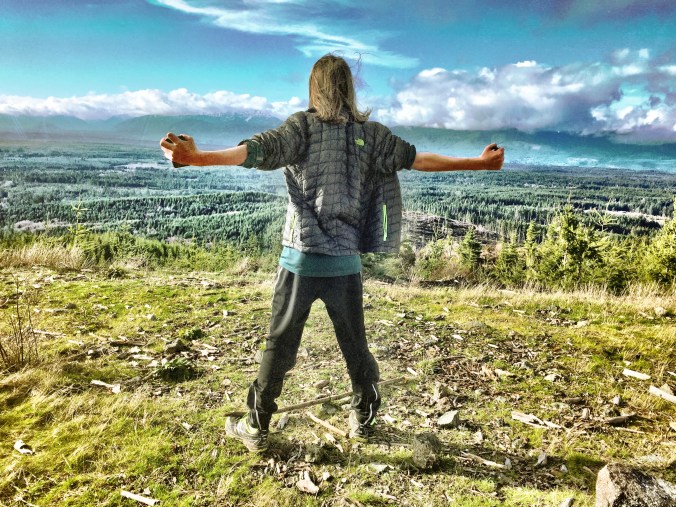
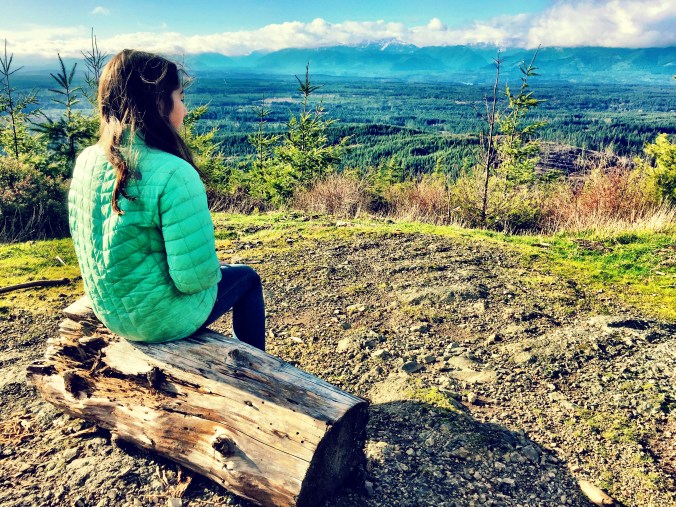
We could see across many lakes and Hood Canal to the Olympic Mountains out on the Peninsula. My brother was happy to get to the top, with sweeping views and high winds.

IMG_1328

Million Dollar View, 50 Miles Wide © Liesl Clark

Although our county doesn’t have extremely high peaks, I’m planning to climb all 7 of the highest mountains as part of my Backyard Seven Summits Project, an attempt to get kids outdoors to explore the high points in their own counties.

IMG_1329

Gold Mountain Lets You See From Sea to Summit © Liesl Clark

We’ve done 2 out of 7 summits and they’re all beautiful hikes, in the Blue Hills of Kitsap County. Most people don’t even know about these peaks. They’re hilltops for all of us to get on top of for great expansive views of a luscious green landscape from the sea to the glaciers on the highest points of the Olympic Peninsula.

IMG_1331

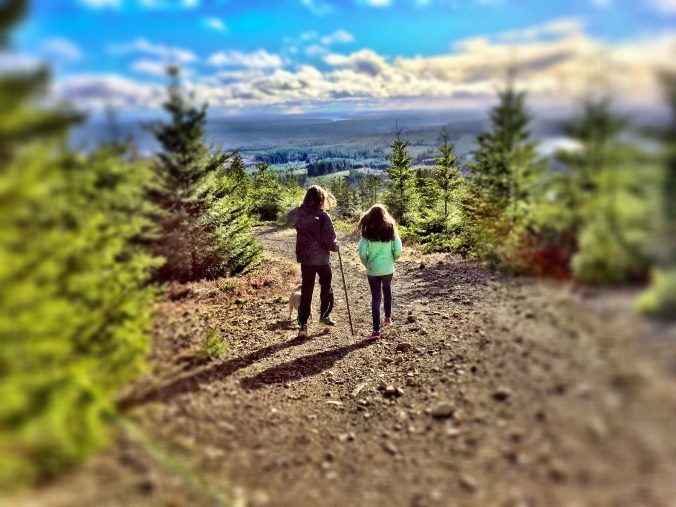
Sibling Time Together © Liesl Clark

The journey down is like a dream, easy, and it goes by fast, with so much to see on the horizon miles and miles away. But if you watch your feet there are semi-precious stones to be found on these trails, like agates. We learned this from a man we met on the trail. He also said he saw fresh puma tracks. Hiking gets people outside but it also gets people to talk to each other.

IMG_1325

PNW Whimsey © Liesl Clark

There’s plenty to marvel at when you just get outside. Our dog, Sailor, knows this.

Have you climbed your own seven summits in your neighborhood? If so, please write in the comments below so we can hear about your adventures.

IMG_1324

The Backyard Seven Summits Project © Liesl Clark

Garden Glove Love


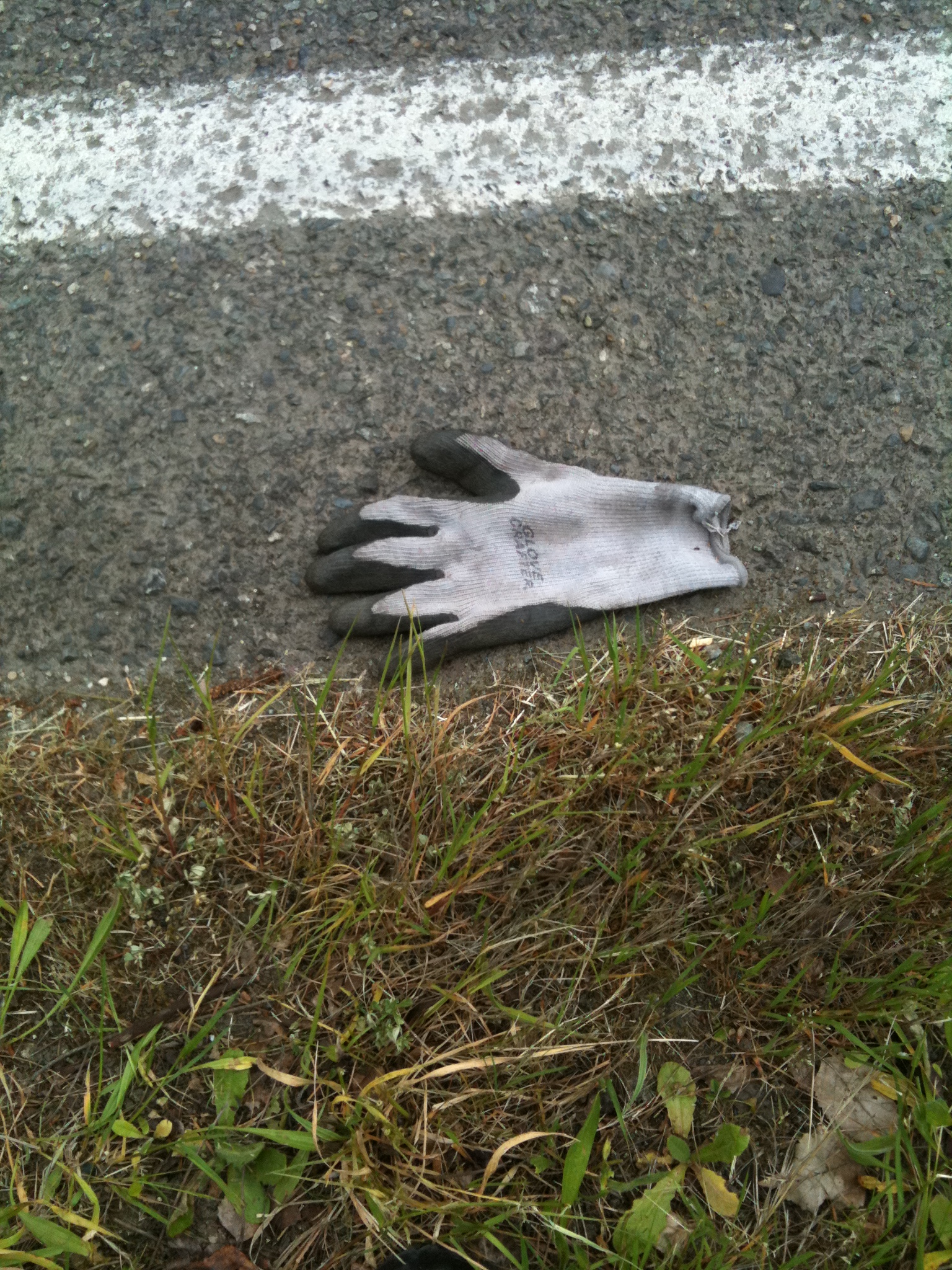
Roadside Garden Glove. Photo © Finn Clark

It all started on a bike ride. We kept seeing garden gloves along the side of the road. In fact, we had seen the gloves lying there for weeks and finally decided to pick them up. One by one, over the course of about 2 weeks, we had managed to collect 20 pairs!

I Have Good Garden Glove Karma. Photo © Liesl Clark

We’re an island of avid gardeners, farmers, and a world-famous garden tour called “Bainbridge in Bloom.” Twelve months of gardening weather here on Puget Sound has afforded us 4 seasons of dirt digging. The problem is that the gardeners’ (or perhaps it’s the hired landscapers’) gloves too often end up along the sides of the roads, having fallen from the backs of landscaper’s trucks, farmers’ tractors, or islander’s cars. Being a food-grower myself, I couldn’t just let those gloves rot in the ditches.

Garden Gloves Rain or Shine. Photo © Finn Clark

My children and I have been collecting them: pulling to the side of the road, jumping out of the car, jumping back in, celebrating, for a year now and have 45 pairs plus about 50 singles ready for a mate. Do you have a single garden or work glove awaiting a partner? Don’t throw it out! Send it to us so we can marry it to one we have here because their next life is going to be GOOD.

We have gloves in every color. Photo © Liesl Clark

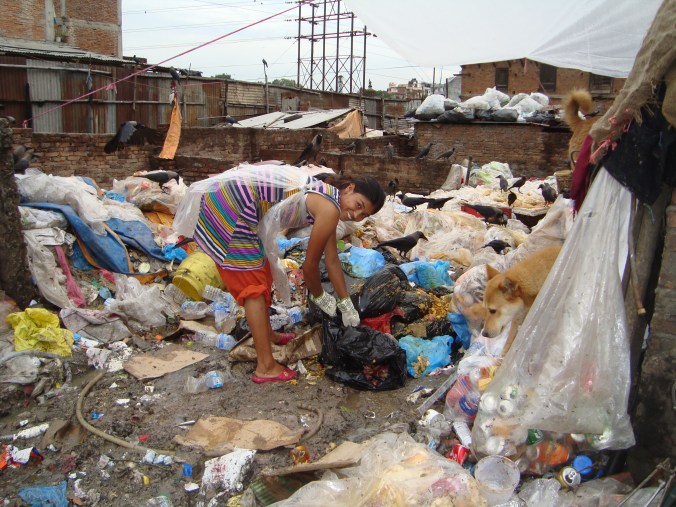
All pairs of gloves we reunite will go to Kathmandu to protect the hands of the rag pickers there. Life as a rag picker is tough, really tough, and many are children in their pre-teens. These kids, and plenty of adults, make a living picking through other people’s trash to compile enough polyethylene plastic or PET plastic bottles to send to India for recycling. It’s a decent living, but the conditions are among the worst on the planet.  We want to help by giving them the garden gloves we’ve found on our streets and in your garden sheds.

Give Garden Gloves or Help in Other Ways to Improve Conditions for the Rag Pickers of Kathmandu. Photo © Liesl Clark

My children and I made a movie about the rag pickers in Kathmandu. If you have a few minutes, this film short will give you a brief look into the work they do:

Most rag pickers have no gloves at all. They pick bare-handed through broken glass and human excrement to find their quarry, and the best protection they can have, in my humble estimation, is for their hands (of course it doesn’t hurt to have a face mask, too.) We’ve seen some rag pickers with just one glove, as that’s all they have.

Packed to the Gills, Ready for Zero Waste Travel

In August, we’ll be headed to Nepal again, to give gloves to Kathmandu’s rag pickers to aid in protecting them from the unsanitary conditions in which they work daily. Over two hundred rag pickers work at the city’s dump some 50 miles from Kathmandu. But countless children pick plastics from the Bagmati River as well as the streets of Kathmandu, and having a glove or two could save a child from infection, disease, and dysentery which comes with the territory.
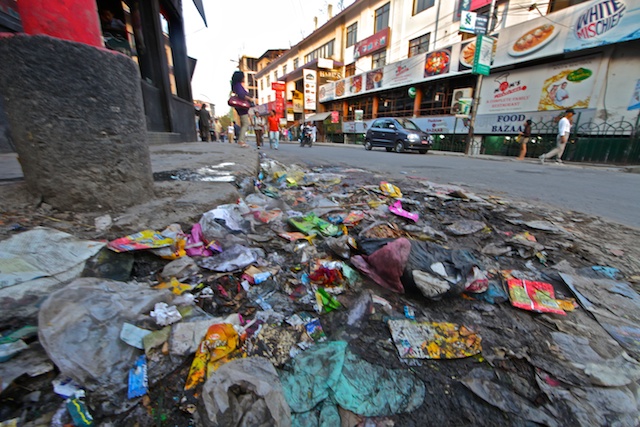
Trash Day Curbside Pile in Kathmandu, Flattened by Rush-Hour Traffic

Want to help us protect the rag pickers, those moving Kathmandu’s trash backwards into new goods, to help reduce the mountains of garbage in the foothills of the Himalaya? There are 3 things you can do to help:

1) Use our Trash Backwards app and indicate when you’ve done something good. By clicking the “I Did It” button on any individual solution, you show us that you’ve changed your behavior to help reduce waste. These simple clicks that show what you’ve done to reduce, reuse, and recycle provide us with data to indicate whether a social movement like ours that educates through social media can make a difference. Every “I Did It” click means we can do some good, too. It’s a one-for-one correlation between your action at home/in the office and our action worldwide. For every “I Did It” click in our app, we’ll do our own good: We’ll hand out a pair of gloves to a rag picker, we’ll remove batteries from a water source in a village, we’ll collect plastics from rivers and shorelines, we’ll conduct a village waste audit. Every action you do enables us to do our greater good and ultimately find the support to do even more! So, please visit us at TrashBackwards.com and find some solutions to our global waste that you can undo in your own small scale, then hit the “I Did It” button and we’ll do the same. The more you do, the more we’ll do in return.

2) Send us your odd (or pairs of) garden gloves. We’ll likely have a match and can then get them into the hands of someone in need. Please know that the conditions are deplorable for a rag picker. Gloves could save someone from infection and truly make a difference. Does one glove have a hole in the thumb but the other is fine? Send us the good one!

Garden Glove Love

6027 NE Baker Hill Road

Bainbridge Island, WA 98110

3) Simply help fund our efforts to improve the lives of Kathmandu’s rag pickers and kids in higher villages. You can do so by donating much needed funds to the Alex Lowe Charitable Foundation so we can get our duffel bags of gloves (we donate shoes and books too) over to Nepal and remove toxic waste from the highest watersheds in the world while also helping to increase literacy in local villages. As little as $20 can go such a long way in Nepal. We’ve been bringing children’s books by porter, yak, horse, and donkey up to the highest villages in the Himalaya for 7 years now, and have opened 7 children’s libraries called The Magic Yeti Libraries. We bring books up and toxics down. Our target this summer is to remove batteries, CFL light bulbs, and plastics from the rivers, streams, irrigation ditches and water supply of villages between 9,000 and 14,000 feet. We’ll get these toxic materials out of the pristine waters and bring them down to a municipal organization that can dispose of them responsibly. We all live downstream of these waters, but for those who live in the villages nearby, the battery and plastics-laden streams need to be cleaned up as soon as possible.

Garden Glove Love was inspired by England’s Glove Love campaign, a nationwide movement to rescue single gloves and give them a new life on the hands of eager people wanting to help reduce our overall impact on the environment.

Start today with your efforts to reduce your own impact on our planet by doing some good with the stuff you already have in your life. Reduce, reuse, re-gift, repair, and rethink your material assets as you use our Trash Backwards web app and you’ll inevitably help others and our planet, too.
Give Books + Rebuild Libraries = Earthquake Relief

Students at Tsarang's Ani School with books in hand. © Liesl Clark

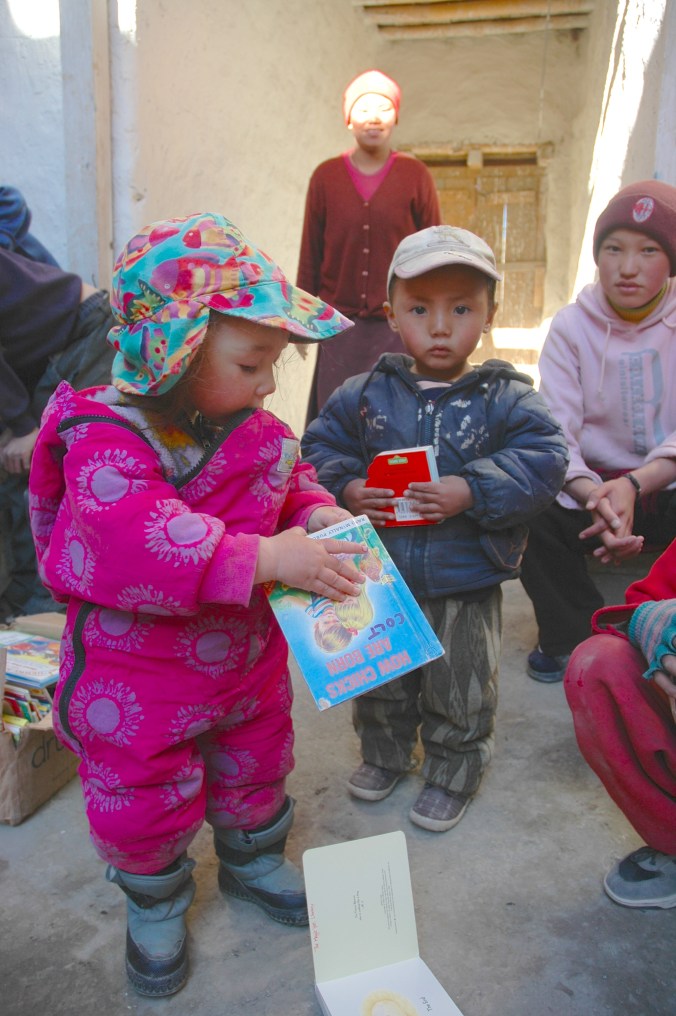
The girls at Tsarang’s ani school want to thank you deeply for the books you’ve donated to our Magic Yeti Library in their beautiful school. This is a well-loved library and put to use each day. Bringing new boxes to the girls is one of my family’s greatest joys and among the earliest memories for our children, who have collected their own books (and books from friends) and donated them here since they were 18 months-old. The girls at the ani school are such lovely inquisitive students who are in excellent health. Our expedition doctor, Steve Overman, checked them out and found only a few toothaches and common colds. They had many questions for us and couldn’t wait to dive into the new boxes of books.

IMG_7357 © Liesl Clark

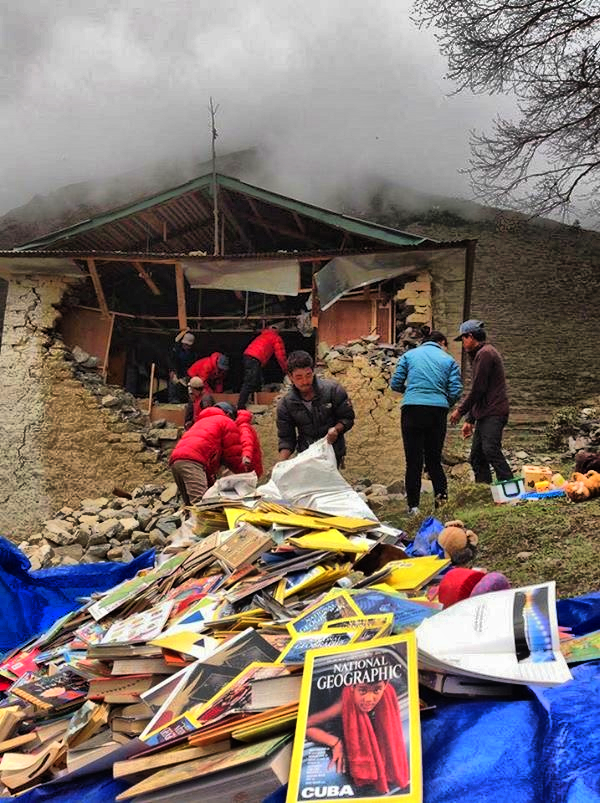
Alas, the earthquake that devastated Nepal on April 25th, 2015 took a terrible toll on our Phortse Library in Solukhumbu and devastated the Thame library and school.

Myl Phortse2

Earthquake damage done to the shelves and books in the Phortse Magic Yeti Library.

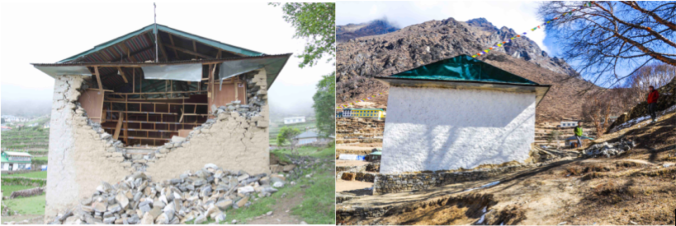
The Phortse building’s walls collapsed, but luckily no one was inside, as the earthquake occurred mid day on Saturday, when the library was closed (the library is open every day before and after school.) The books had to be rescued from the rubble, stored in the nearby school and our friends’ homes for several months until the walls and roof of the community building could be rebuilt.

IMG_5645_DL

Rescue and Recovery of Our Books and Magazines in the Phortse Magic Yeti Library.

Thanks to donations from you, our supporters, friends, and family, and also thanks to a grant from the Simon Family Foundation, the library is now intact and books are back on the shelves!

Phudoma Jenni

Librarian, Phudoma, with The Alex Lowe Charitable Foundation’s director, Jennifer Lowe-Anker, in the rebuilt Phortse library.

Screen Shot 2016-01-25 at 8.57.53 AM

Damaged South Wall: Repaired South Wall!

We deeply appreciate your donations of well-loved children’s books and cash donations through the Alex Lowe Charitable Foundation, enabling the rebuilding of the libraries and the children’s tomes to be read over and over again in Phortse, and our 6 other Magic Yeti Libraries. If you’re interested in helping to bring literacy to our remote village libraries in Mustang and Solukhumbu, please click on the donate button in the lower right hand corner of our Magic Yeti page here.

Checks can go to the Alex Lowe Charitable Foundation (ALCF):

Mailing address:

P.O. Box 6666

Bozeman, MT 59771

And if you’d like to do a book drive at your school or work, we’d love to hear from you and help guide you. Since we no longer have a shipper for books from the US to Nepal, they’ll have to be sent, media rate, directly to our friend and agent, Jiban Ghimire, in Nepal:

Shangri-la Nepal

GPO 6802, Panchakanya Chowk

Kapan 03, Kathmandu, Nepal

http://www.shangrilanepal.com

T+[977 1] 481 0373, 481 0387

F +977 1 481 1317

M +977 985 103 5161

Skype: trekandclimb

Luckily, in the image below, in the second largest village in Upper Mustang that boasts the winter palace of the historic Mustang Kings, the girls and the library were all safe from the rocking of the earthquake.

Magic Yeti Book Delivery Day in Tsarang © Liesl Clark

If you haven’t had a chance to help us out in person, we welcome volunteers joining us on our trips to Nepal for our library projects and we can always use cash contributions to keep the books moving uphill to the rooftop of the world. We’ve seen such improvement in students’ performance when they have a small library of books at their fingertips, books that help answer their questions about the world, or enable them to learn the English language through stories written for their age levels.  Dual language books written in their own language (Nepalese) are extremely popular, too. We set aside a good part of our budget to purchase local Nepali/English books from Room to Read, based in Kathmandu.

DSC_0747

Our 18-month-old daughter, Cleo, donating some of her favorite books to the students at the Tsarang ani school. © Liesl Clark

Thank you for your help in bringing literacy, and some of the greatest stories around the world, to the villages of Tsarang, Phortse, Khumjung, Thame, Kagbeni, Chhoser, and Samdzong!

MYLsign1.jpg

DIY Dryer Lint Fire Starters

By Finn Clark

Finn's DIY Fire Starters

We live in the Northwest where the winters are long and wet. Like most 9-year-olds, I’m interested in (and learning about) fire and what my parents call “combustibles.”

I like to forage for wood with my wood-cutting tools.

Our home is heated almost entirely by wood and since we forage for our own wood in our forest, it’s often pretty wet. I decided it was time to make some fire starters for cold wet nights when nothing wants to burn. These things will definitely help start your wet wood burning, especially if you use 2-3 of them. Here’s how:

The things you'll need: Lint, egg cartons, wax scraps, string, shredded paper, matches.

Gather together:

Lint

Egg Cartons

Wax Scraps (we melt ours into pie tins for easy re-melting)

Wick String or Just Plain String,

Shredded Paper, Paper Scraps, and/or Sawdust

Matches

Melt your wax and dip the wick string in it to make a true wick.

Next, you’ll need to melt down your wax scraps. I place our previously-melted wax scraps in a pie tin with another pie tin underneath and place the double-layer pie tins over our pilot light on the stove. That’s enough to melt the wax in the tins and it’s safe for little hands like mine that could get burned by the wax. Dip your string in the melting wax to make a true candle wick. They burn more slowly and readily with the wax infusion.

Mix your lint and shredded paper (and saw dust if you have it) together in a big bowl.

While your wick is drying, mix all your lint with shredded paper and you can add sawdust and small wood chips if you have them.

Really really mix it well.

I think I like the mixing part the best.

Cut your wicking into little wicks.

Now that your wick is dry, you can cut it into small 2-3 inch wicks for each fire starter.

Stuff your dry ingredients (wick in the middle) into each egg carton cup.

Now you can stuff your lint mixture into the egg carton cups. We take a small handful, wrap it around a wick, and then jam it (with the wick standing up in the middle like a candle wick) into each cup.

Pour your melted wax over the whole mess. Lots of it.

We then pour our melted wax over the top of the paper/lint/wick-filled egg carton. I let my mom do it because even though we have 2 pie tins under the wax, it could spill and hurt me.

Another angle of Mom doing the pouring. It was cold in our house so she's wearing a down vest. That's why we needed fire starters -- to get the fire started.

Do you see little matches standing up in the back row there? That’s my secret ingredient. I like to use matches dipped in wax as my wicks. They’re actually home-made water-proof matches but that’s another post for a later time. They work really really well as wicks, too.

These are my fire starters.

When your wax has solidified and cooled, the fire starters are ready to be used. Simply rip off a single cup at a time and light your wick when you’ve placed your fire starter where you want it in your well-laid fire.

Lighting our fire starter is the best best part.

Now we get to enjoy a warm winter wet wood fire.

Our warm winter fire by home-made fire starters brings smiles.

Mapping Plastic: Aquaculture’s Styrofoam Beaches

Day 5: Pleasant Beach to Fort Ward Boat Ramp

This article is part of a survey of Bainbridge Island’s 53-mile coastline. We’re circumnavigating the entire island to collect and make observations of the kinds (and amount) of plastics we see along the way to try to answer the question: Where does it come from?

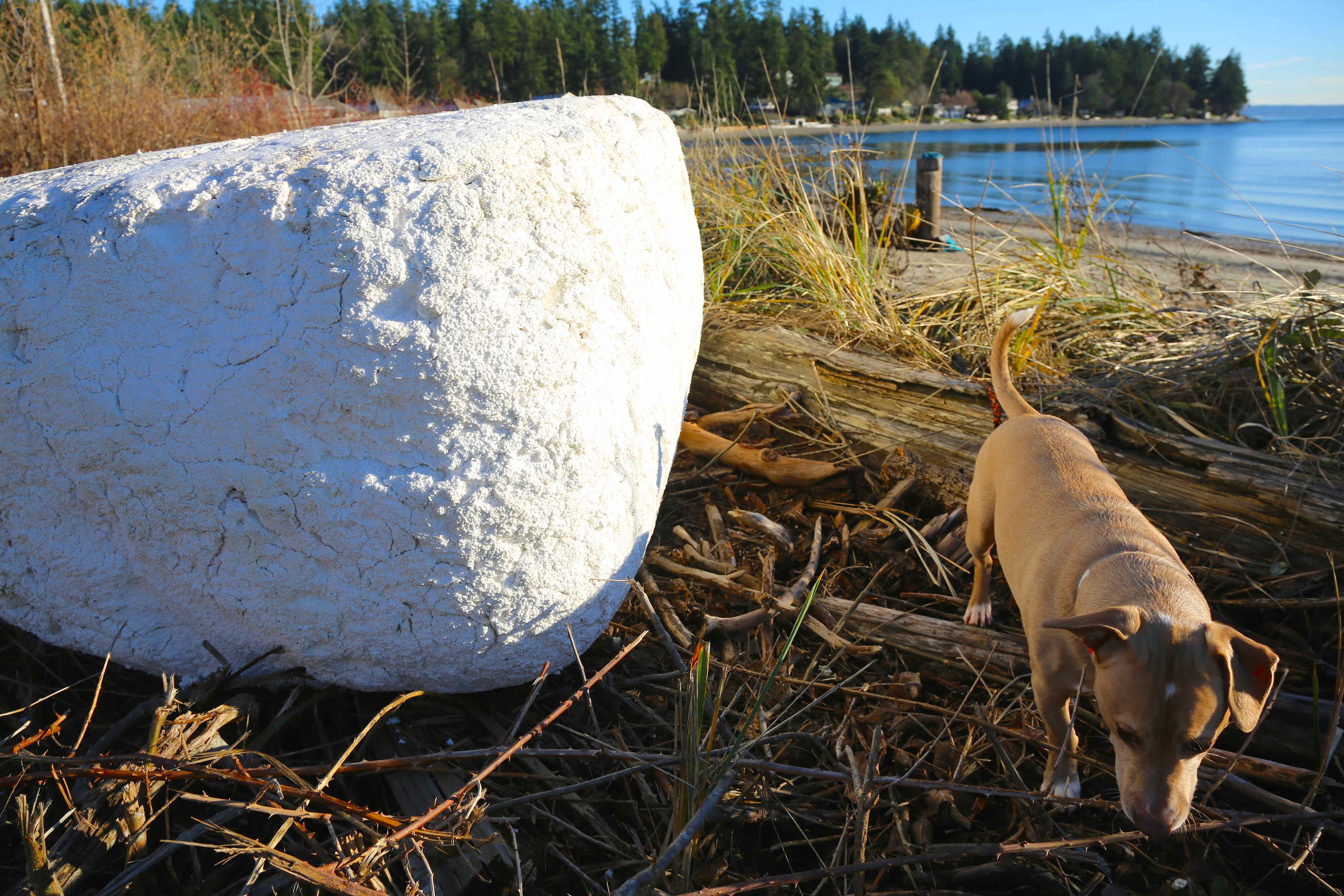
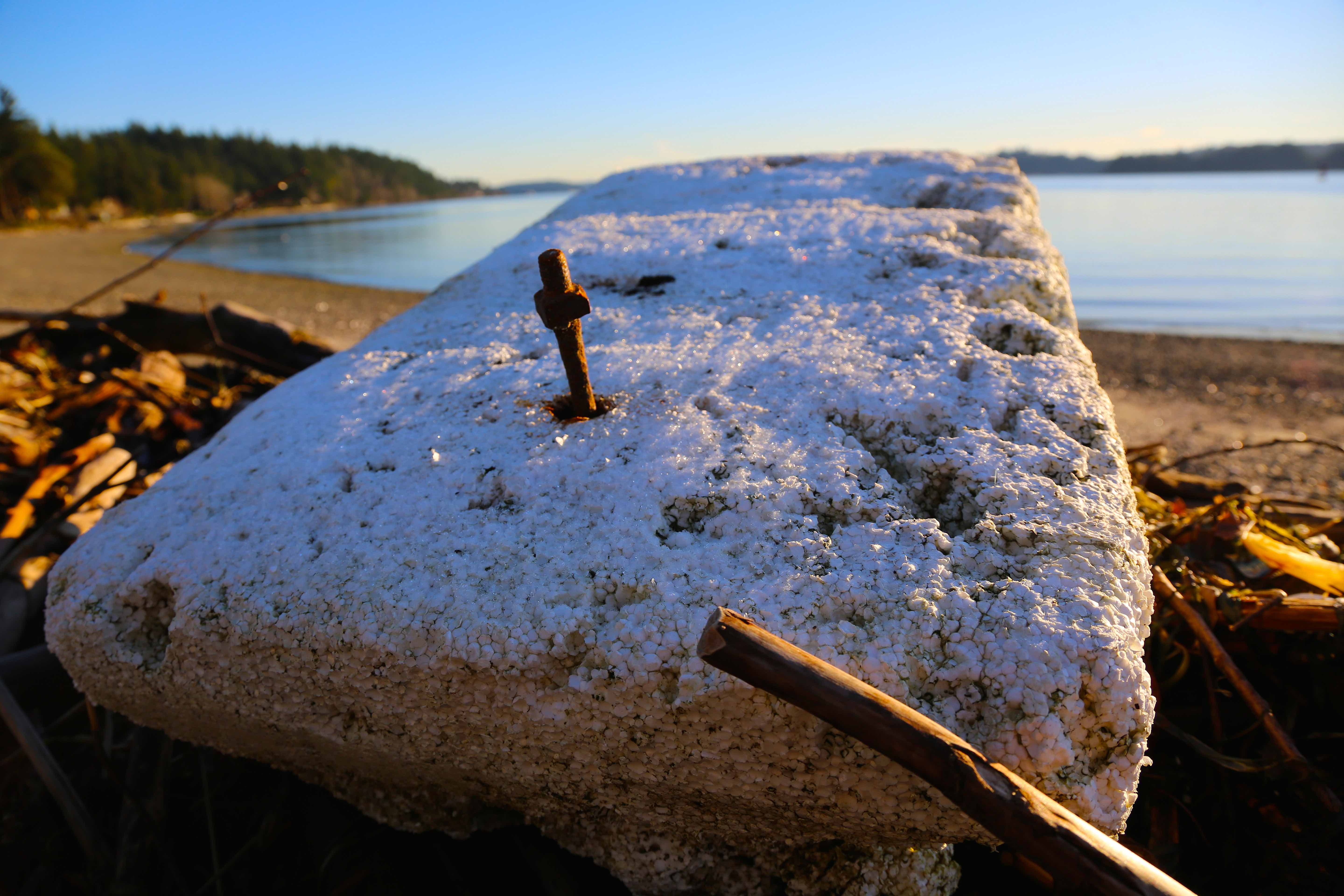
The single-most prevalent plastic we find on our beaches, in our citizen-y-science-kind-of-way, is polystyrene. There’s so much of it, we see it in every shape, from tiny single particles the size of a snowflake to car-size chunks.

Styro-mobile. This car-sized chunk came riding in on the sea. © Liesl Clark

Styro-mobile. This small car-sized chunk came riding in on the sea. © Liesl Clark

But wait, this other one is just 300 yards down the beach. © Liesl Clark

But wait, here’s another enormous one just 300 yards down the beach. © Liesl Clark

Where are these huge styro-chunks coming from?

They’re used underneath floats and docks. The aquaculture industry is known to utilize polystyrene to keep their operations afloat. But nature eventually takes its course. Boring isopods damage expanded polystyrene floats under docks and, in the process, they expel copious numbers of microplastic particles. This paper describes the impacts of these mini drilling marine isopods in aquaculture facilities and docks and the resultant pollution the isopod-infested styrofoam is causing.

Here’s an opening statement in the article (I’ve taken out all of the references for ease of reading):

Like other microplastics (defined as <5 mm in diameter) in the marine environment, these particles may have detrimental effects to marine organisms. Plastics persist for hundreds to thousands of years in normal oceanic conditions. Also, polystyrene fragments and other minute plastics in the marine environment are readily colonized by biofilm and other organisms causing them to sink. Thus, these particles may interact with benthic and pelagic organisms. Ingested microplastics may cause both toxicological effects by transmitting bioaccumulating toxins and possibly physical effects by occluding feeding structures or inducing a false indication of satiation.

What I get from this article is that these little organisms, like shipworms and wood lice, bore into the styrofoam under floats and docks and in so doing they shed tiny plastic particles into the water, like a drill spewing mini-plastic shavings. The isopods start to feel full, after dining on the stiff white stuff, and eventually die off because their fast food source ain’t so good for them. The little ubiquitous particles end up not only in our bellies, but everywhere. On every continent. They even look like plankton and are now a part of our food chain. Experts, for years, have estimated microplastic particles are outnumbering plankton 6:1 in the marine environment. The bigger fish eat the ever-present plastics and then we eat the fish. End of story. The plastics are now in us, and they’re toxic.

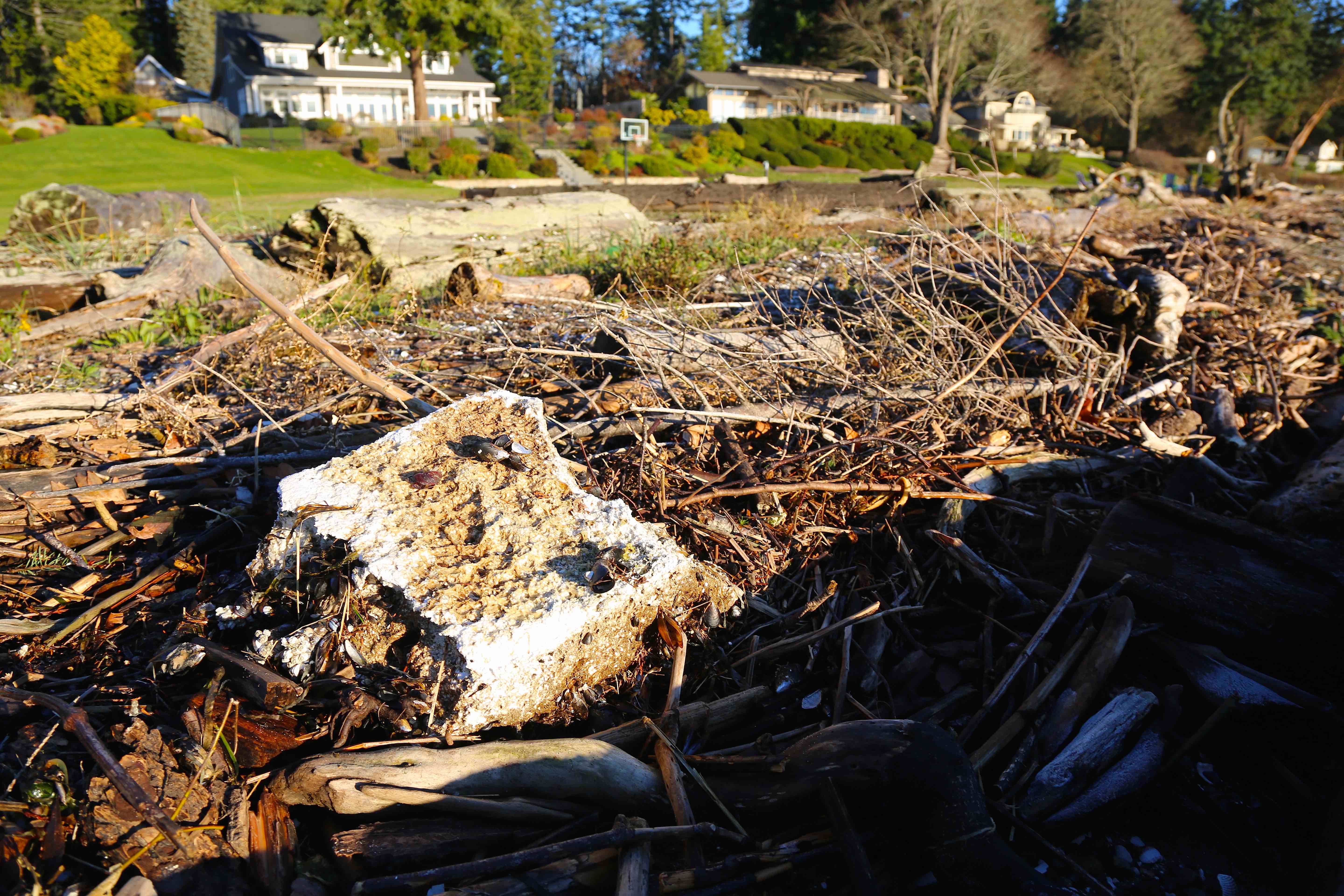
Another little factoid is that mussels and other bivalves raft over the deep blue seas on freed polystyrene floats to foreign lands — lands where they don’t belong, where they’re considered alien and invasive.

Alien bivalves are the plastic-fed zombies of the future.

Unlucky Beached Bivalves © Liesl Clark

Unlucky Beached Bivalves, Rafting on Styrofoam © Liesl Clark

I’ve picked up so much beached polystyrene and other everyday plastics over the years, our personal dumping fees at our local transfer station can be astounding, given we produce as little waste as we can as a family.

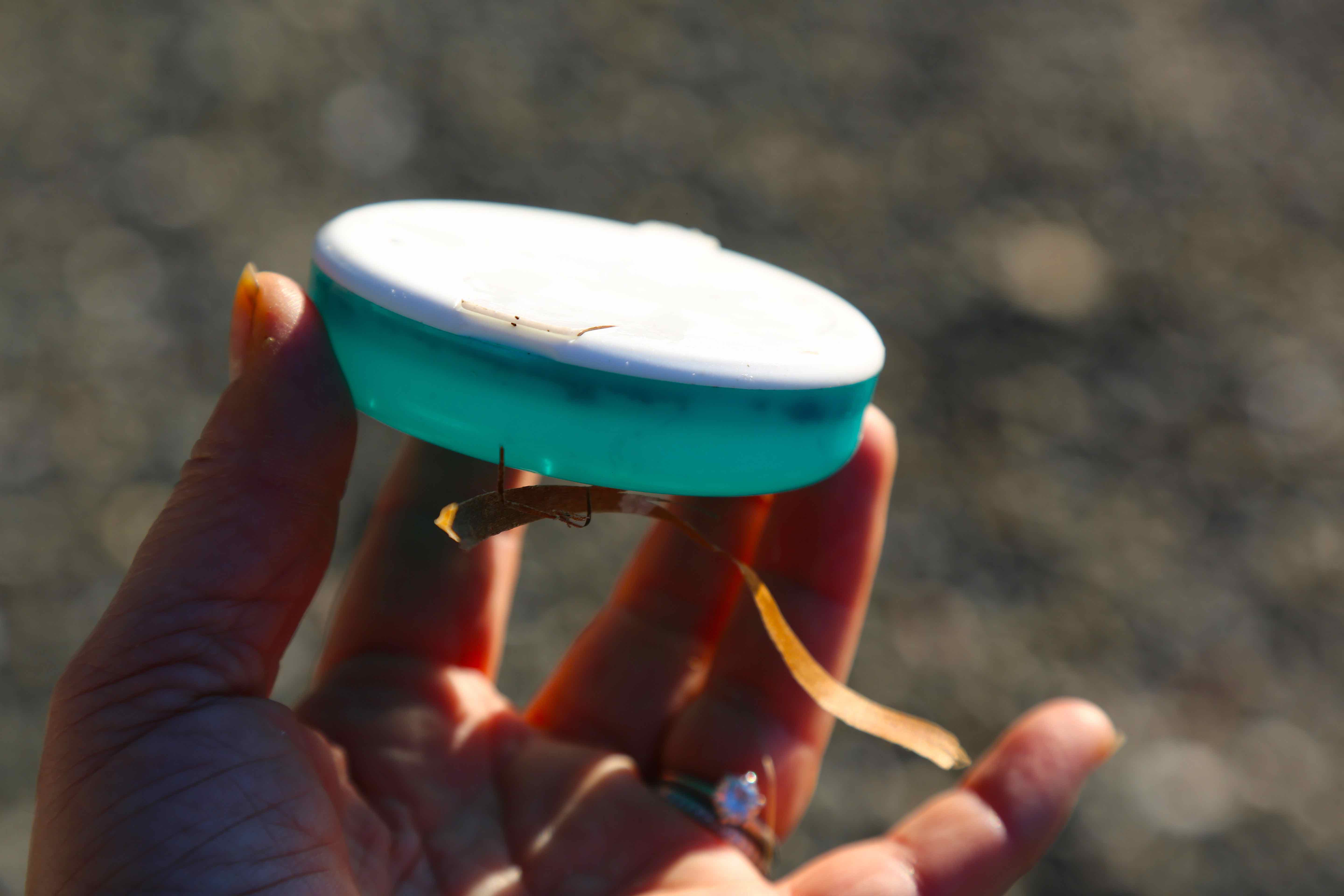
Kids love the mints (or is it gum?) that come in these plastic containers. Why do they have to be packaged in a container that will remain here forever? © Liesl Clark

Kids love the mints (or is it gum?) that come in these plastic containers. Why do they have to be packaged in a container that will remain here forever? © Liesl Clark

Aquaculture’s equipment and incidentals are also polluting our beaches.

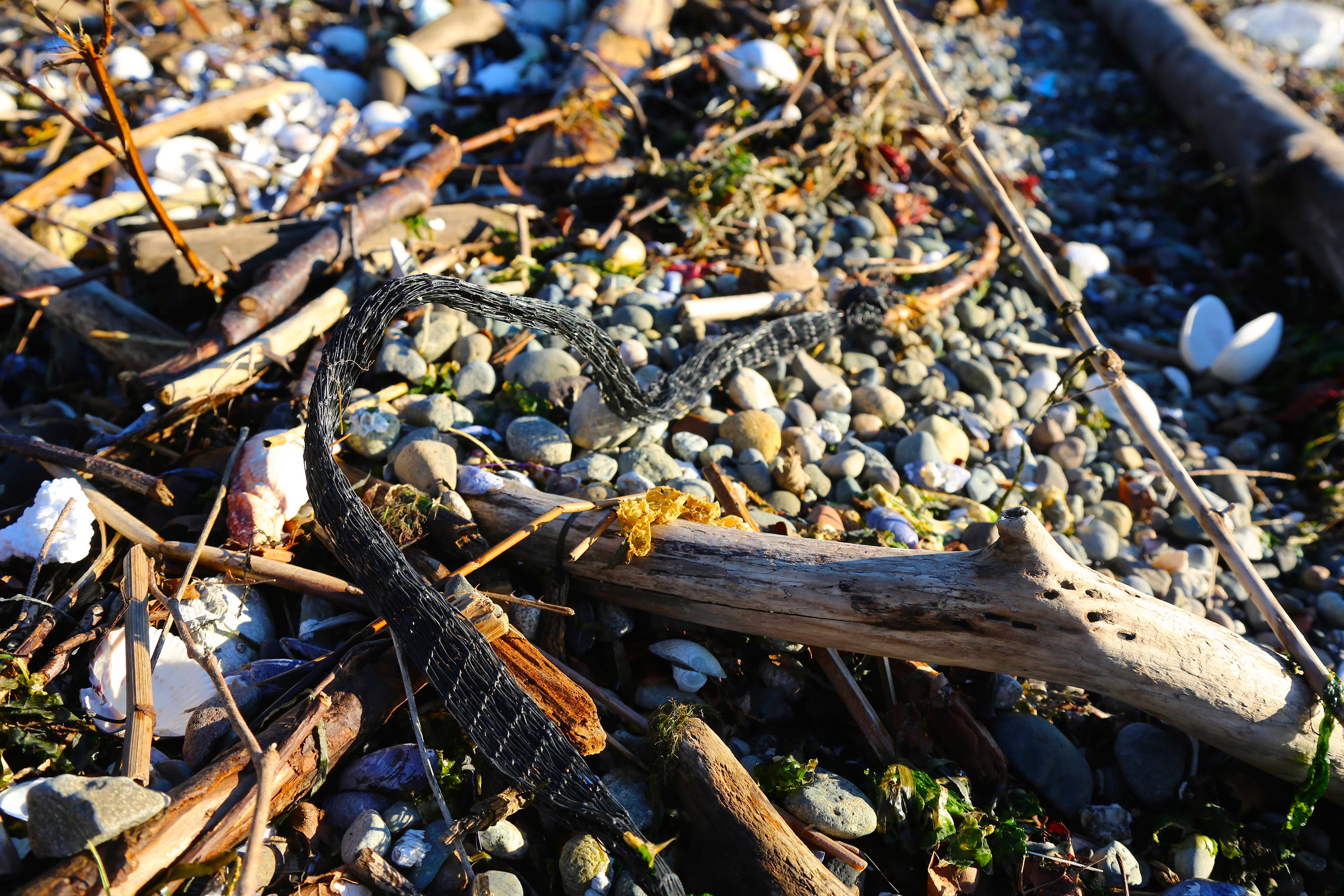
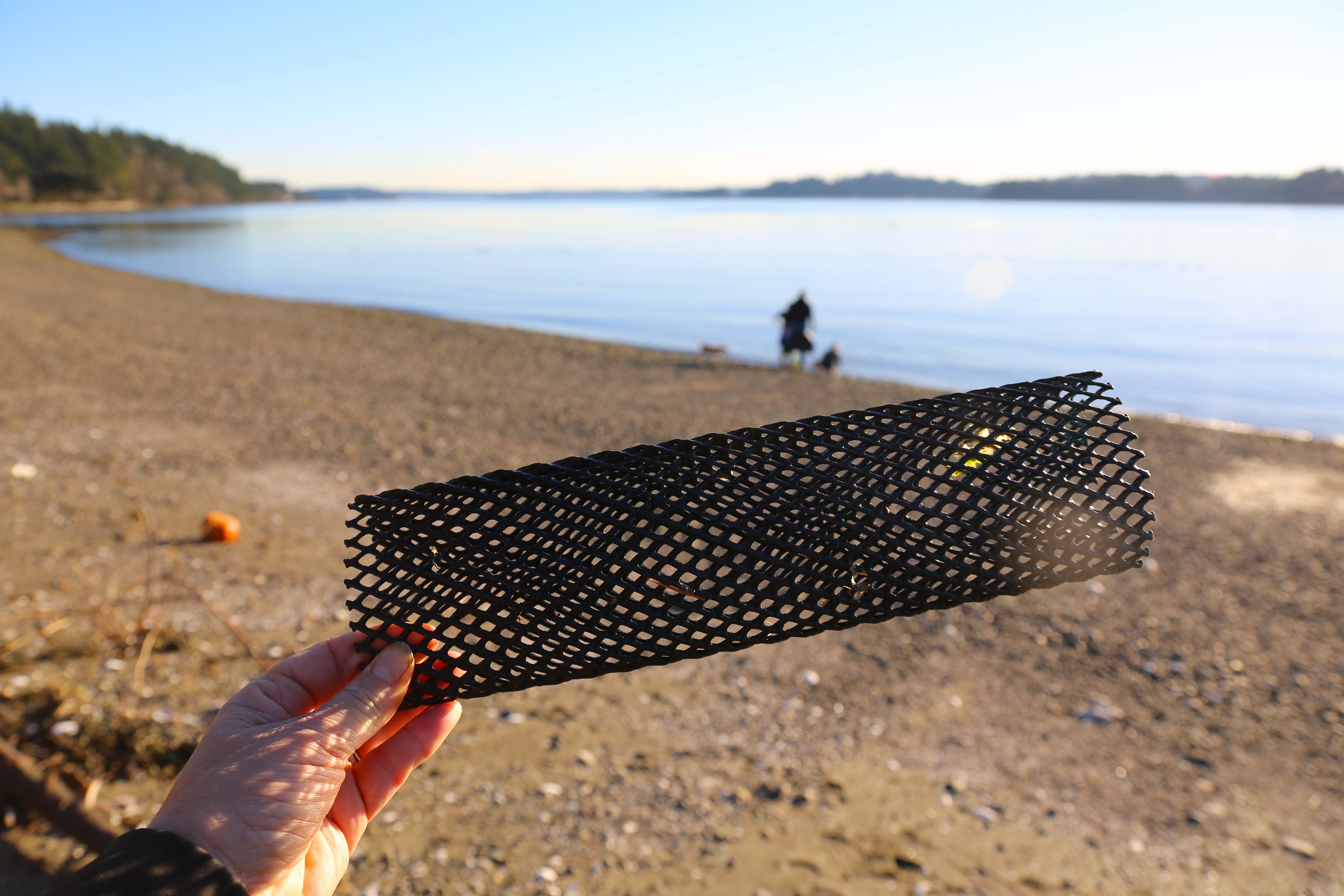
Shellfish Netting? © Liesl Clark

Shellfish Netting © Liesl Clark

Plenty of this plastic netting washes ashore, nets used to hold mussels or oysters.

We find tons of these:
No clue what this is used for, but it has aquaculture written all over it. © Liesl Clark

Some sort of substrate netting used in aquaculture  © Liesl Clark

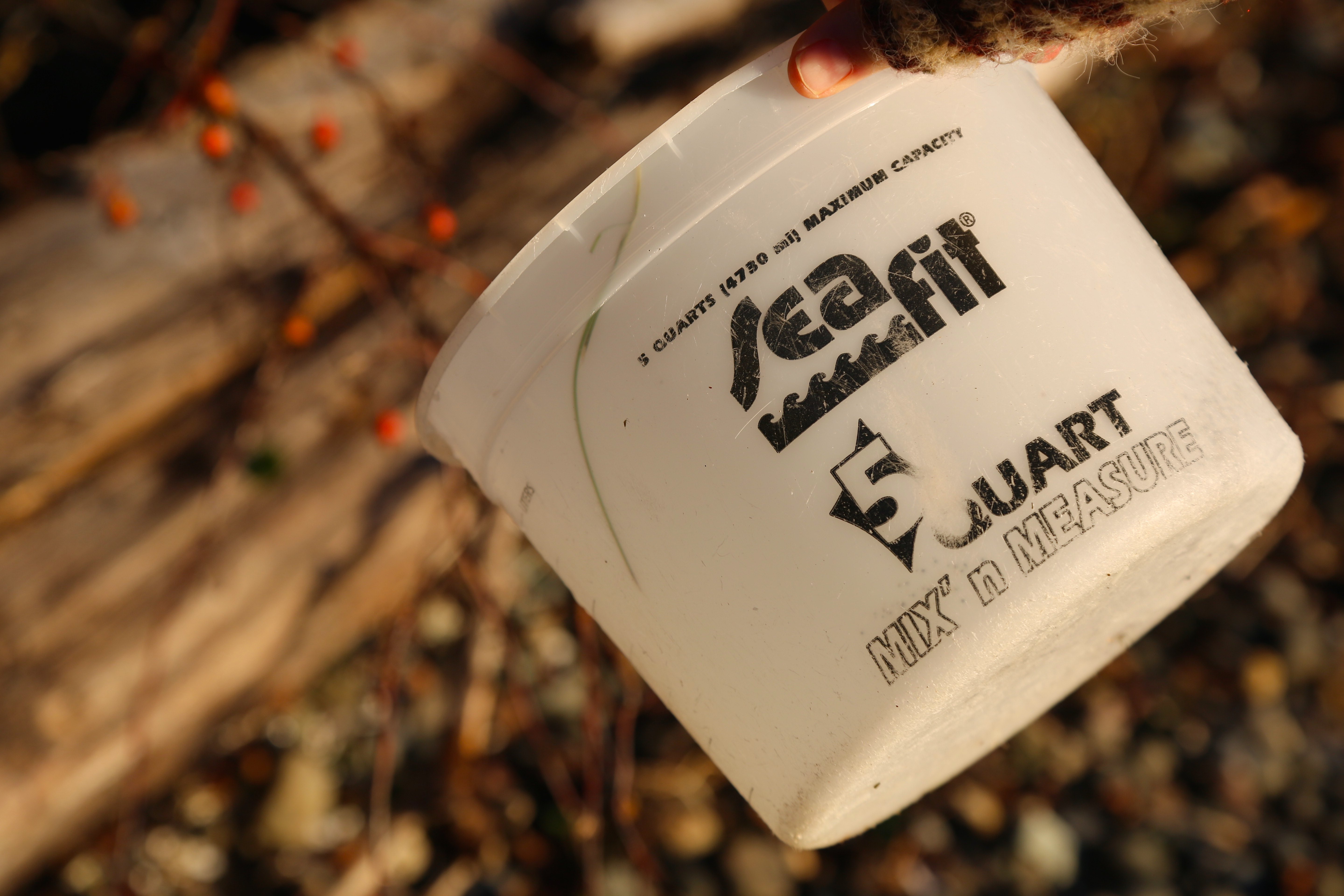
 The aquaculture industry has all sorts of specialty items, 100% plastic:
I beg to differ. This specimen is not sea-fit. © Liesl Clark

I beg to differ. This specimen is not sea-fit. © Liesl Clark

 But we can’t blame it all on aquaculture and the marine industry. We’re all responsible for the myriad plastics in the sea that wash up on our beaches. Plastic floats, it’s buoyant and lightweight, it moves with flooding waters and wind. It mostly comes from us, from our homes.

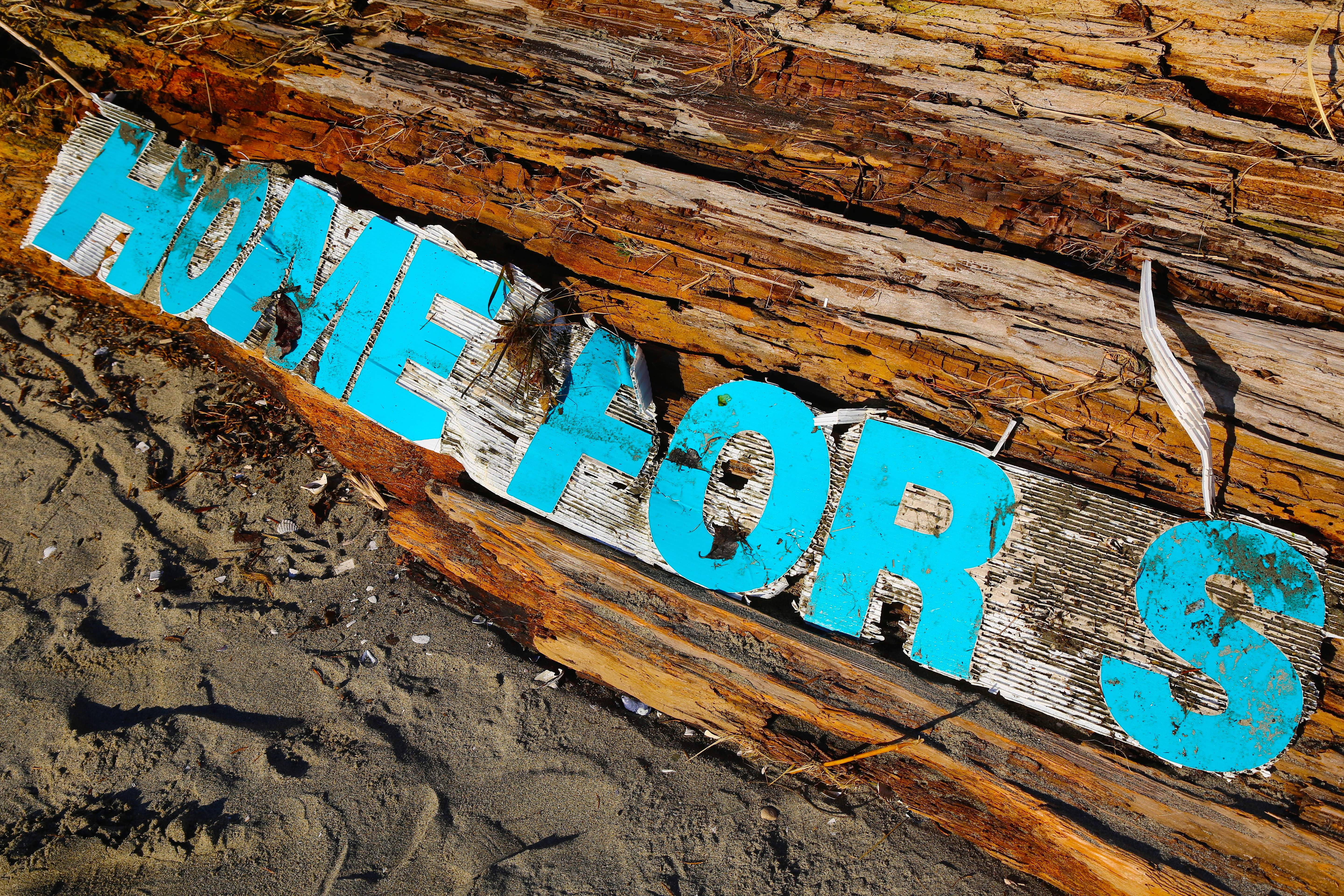
Beached Sign, Tattered By the Sea © Liesl Clark

Beached Sign, Tattered By the Sea © Liesl Clark

The polystyrene that isn’t from marine floats and the aquaculture industry is from us, our fast food takeout containers, styro-block packaging, and packing peanuts flowing into our seas from inland rivers. According to Beachapedia:

The ‘Two Rivers’ study in Los Angeles found that over 1.6 billion pieces of plastic foam were headed to the ocean over a three-day period during surveys in 2004/5. 71% of 2.3 billion plastic items in the survey were foam items and that made up 11% of the overall weight of plastic pollution collected during the surveys.

If that isn’t enough to sound an alarm for you about styrofoam, there are plenty of studies that can fill you in on how polystyrene in the marine environment acts as a sponge for persistent organic pollutants like PCBs and DDT. Chelsea Rochman’s study of the beaches around San Diego shows that the most toxic plastics found in the marine environment is, you guessed it, styrofoam. Her lab fish that ate it didn’t fare so well.

Solutions?
1) Stop using styrofoam: If you mail order a product, ask the shipper to ship it without styrofoam.

2) Refuse takeout containers made of styrofoam.

3) Recycle what styrofoam you can. Our island has a recycle event twice a year for styrofoam and Seattle has a facility that recycles. Just type into your browser “Styrofoam Recycling in (name of your city)” and see if there’s a facility or green organization near you that will take your styrofoam. If not, find the nearest recycling facility (even if it’s a few hours away) and be the person in your community who organizes a styrofoam recycling event on Earth Day each year. Your community will likely get behind the costs of renting a U-Haul to get the stuff to a safe recycling operation.

4) Get out there for yourself and walk your shorelines, river shores, wild places. Pick up what styrofoam you find and start asking questions about where it might come from. Educate everyone you can.

If you’re interested in reading more about the previous legs of this survey, here’s a list of our stages so far:

Special Thanks:

A special shout-out to Julie Skotheim who took time out of her day to join us on this leg of our journey.

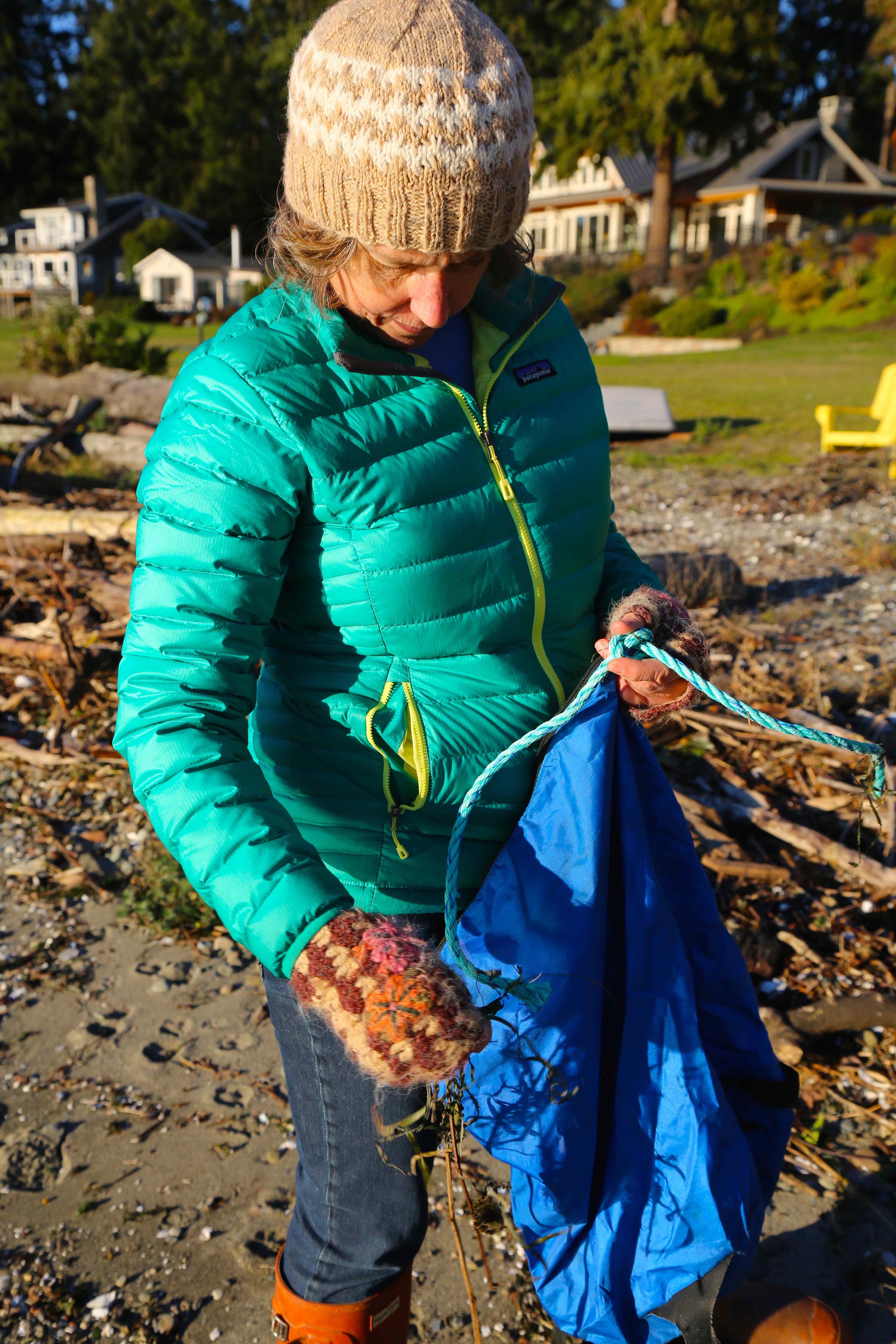
Marine "Rope," 100% Plastic © Liesl Clark

Marine “Rope,” 100% Plastic © Liesl Clark


The Sky Is Falling! A Fine Line Between Avian Life and Death

“Mommy! A bird just fell out of the sky!”

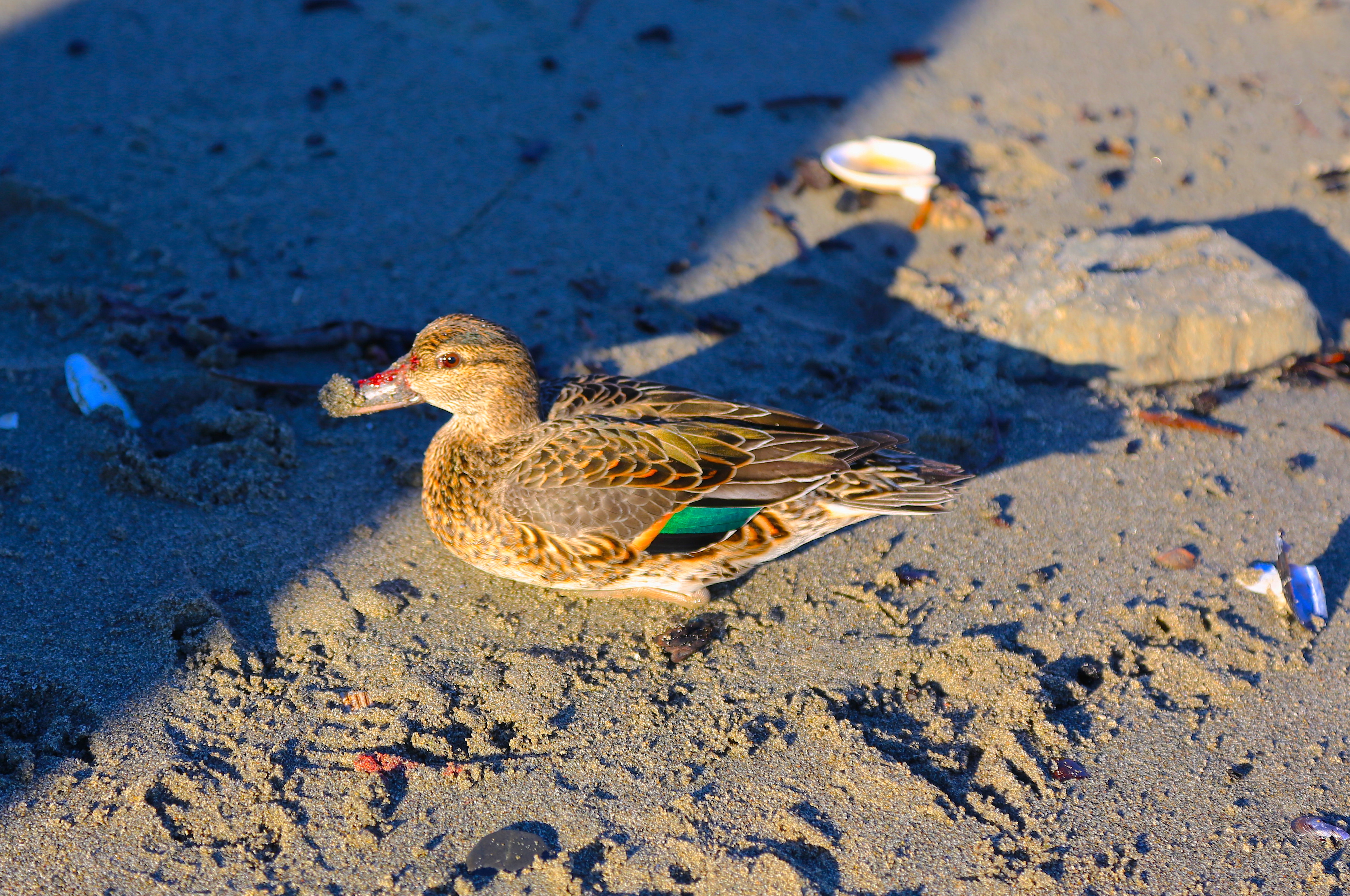
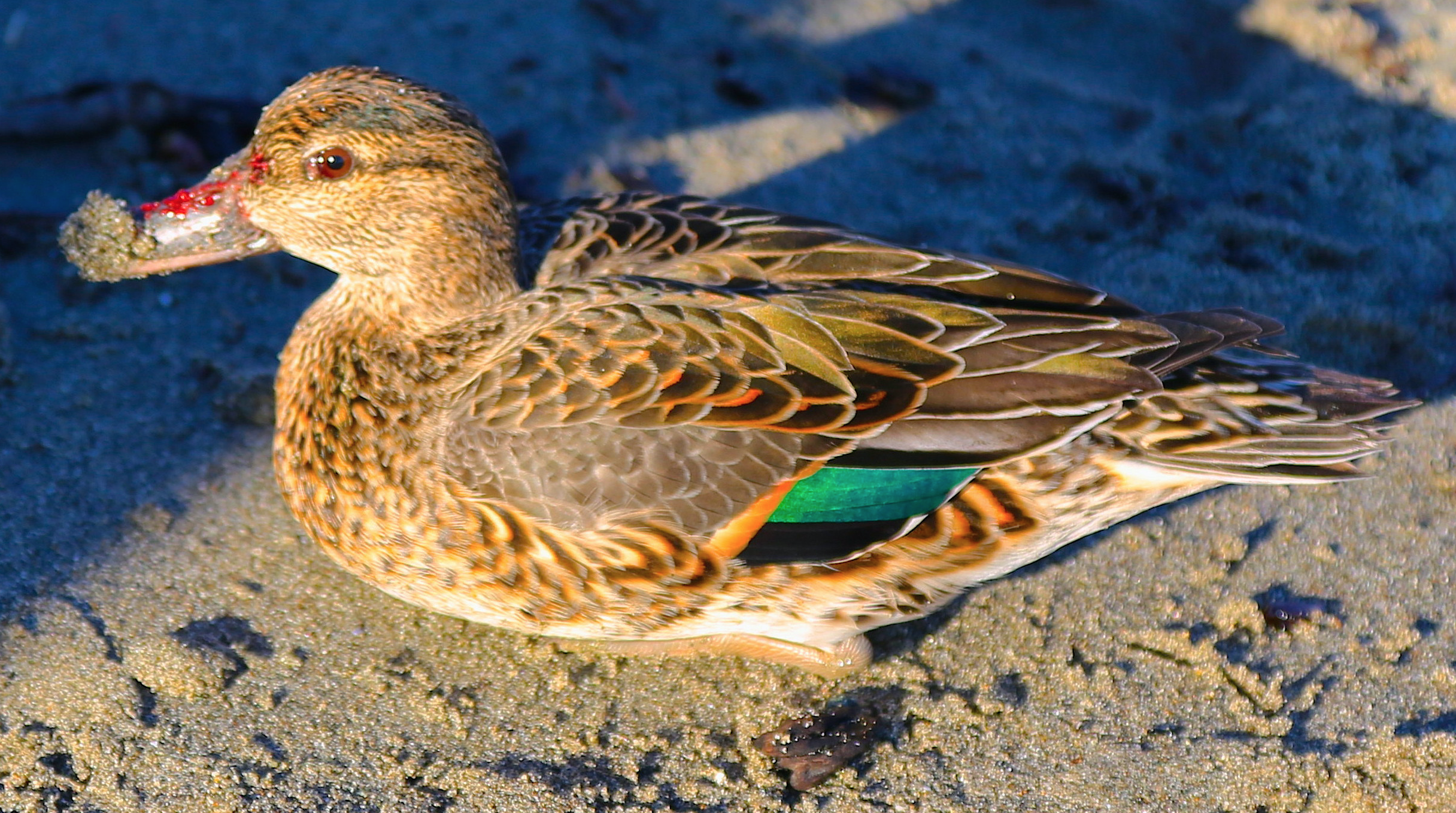
A Stunned Young Mallard, Post Power Line Collision © Liesl Clark

A Stunned Young Mallard, Post Collision © Liesl Clark

I ran to see what my daughter and her friend had found, thinking a small bird had simply landed on the beach. But the sight was a sobering surprise for us all. A small juvenile mallard was heaving deep breaths of stress as blood dripped from its beak.

“It fell out of the sky?” I asked.

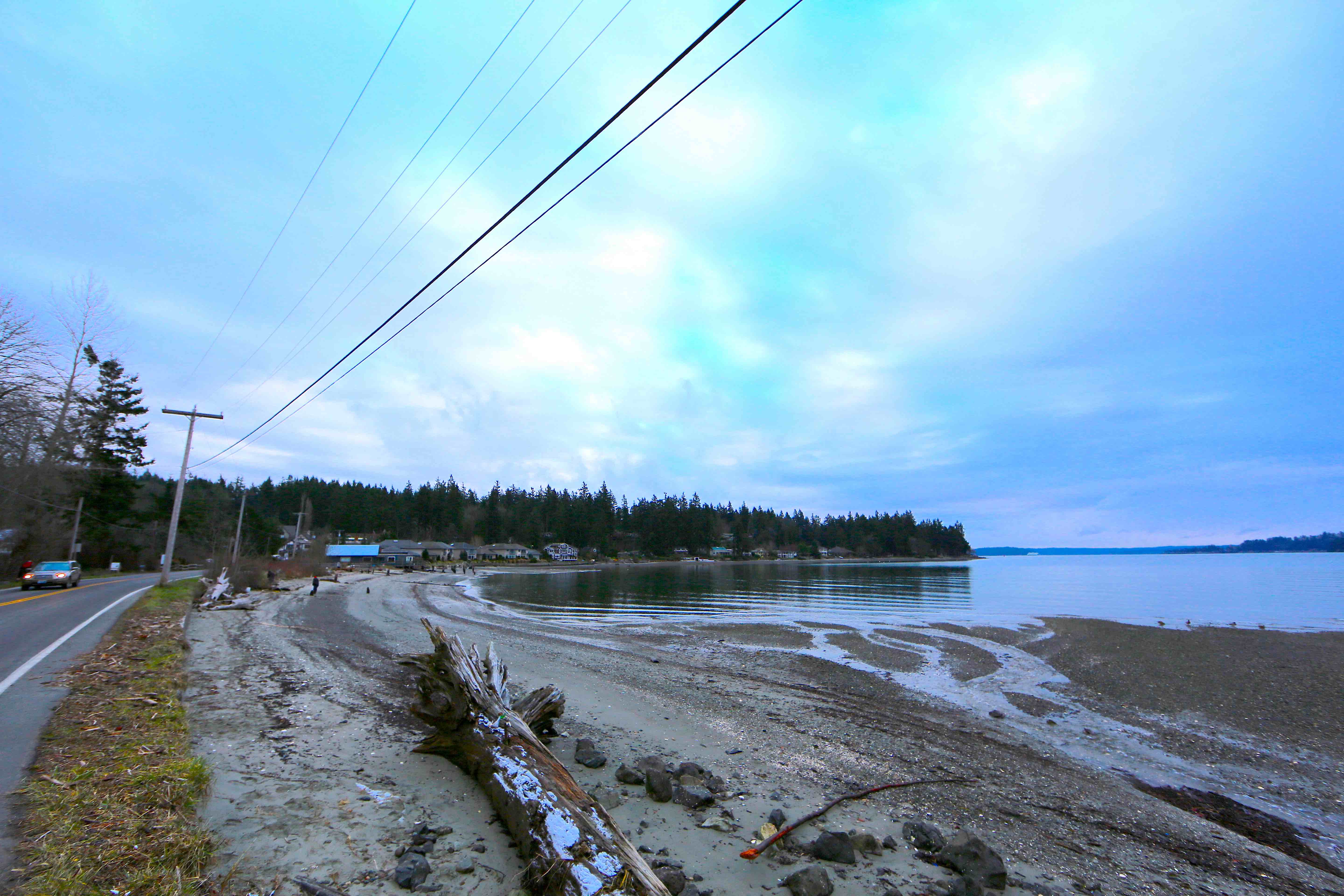
No shots had been heard, so it hadn’t been shot at. We looked up and found the answer some 50 feet above. Power lines etched their impression upon a clear blue sky. This little duck met its demise with a fine line suspended between its nesting area and food source, just across the road.

We were at one of our favorite beaches, Bainbridge Island’s Pleasant Beach. Across a little causeway from the beach is an estuary, known as Schel Chelb, where waterfowl thrive and raise their young. It was a bright winter day and this little critter’s flock had taken off from the wetlands to fly over the road to the bay just beyond, in search of food. Sadly, the small duck never saw the power lines that separate home from fodder for these feathered friends. It was flying right into the sun, and likely never saw what it hit.

The Power Lines That Separate The Nesting Grounds From the Bay © Liesl Clark

The Power Lines That Separate The Nesting Grounds From the Bay © Liesl Clark

According to a 2014 article published at the NIH, an estimated 8 and 57 million birds in the U.S. are killed by such collisions. Globally, collisions with power lines may cause more than one billion annual bird deaths.

In 2012, the U.S. Fish and Wildlife Service came out with a manual for best practices in preventing bird deaths due to collisions with power lines. I’ve tried to find it online but have not had any success as all links to it are broken. An April 2005 report, available through the U.S. Fish and Wildlife Service, provides some guidance for reducing the risk of deadly bird collisions with power lines:

“Marking wires and conductors with white wire spirals and black crossed bands in one study reduced mortality by up to 75 percent. Other potentially helpful devices include bird flappers and diverters, such as the Firefly and the BirdMark, which swivel in the wind, glow in the dark, and use fluorescent colors designed specifically for bird vision.”

Why isn’t this location a priority for our utilities to install such preventative measures? I find it ironic that a protected wildlife area, this man-made restored wetlands, is situated next to power lines that are bringing about avian deaths. Surely this isn’t the only case of duck-meets-powerline at this popular duck breeding ground.

Shel Chelb Estuary: Where The Ducks Are © Liesl Clark

Schel Chelb Estuary: Where The Ducks Are © Liesl Clark

My daughter described the incident: “We heard a big thud. So we didn’t know what it was. I looked over and the duck was on the ground on its side. It was breathing really deeply, its sides going up and down. It closed its eyes and then opened them again several seconds later. After a minute it flipped itself over and stood upright and walked a little bit. But then it just sat still.”

Screen Shot 2016-01-03 at 11.46.31 AM

When I arrived, we could see the blood on the mallard’s beak. It was clearly stunned and taking stock of what to do next, like a hummingbird having just hit a windowpane. This little one plummeted 50-60 feet to the beach below, but it was still alive. I was able to capture this one image before the duck flew low, with difficulty, back across the road to the estuary. We followed it to the estuary side and believe it may survive amongst its little flock of mallards and other waterfowl.

IMG_0788

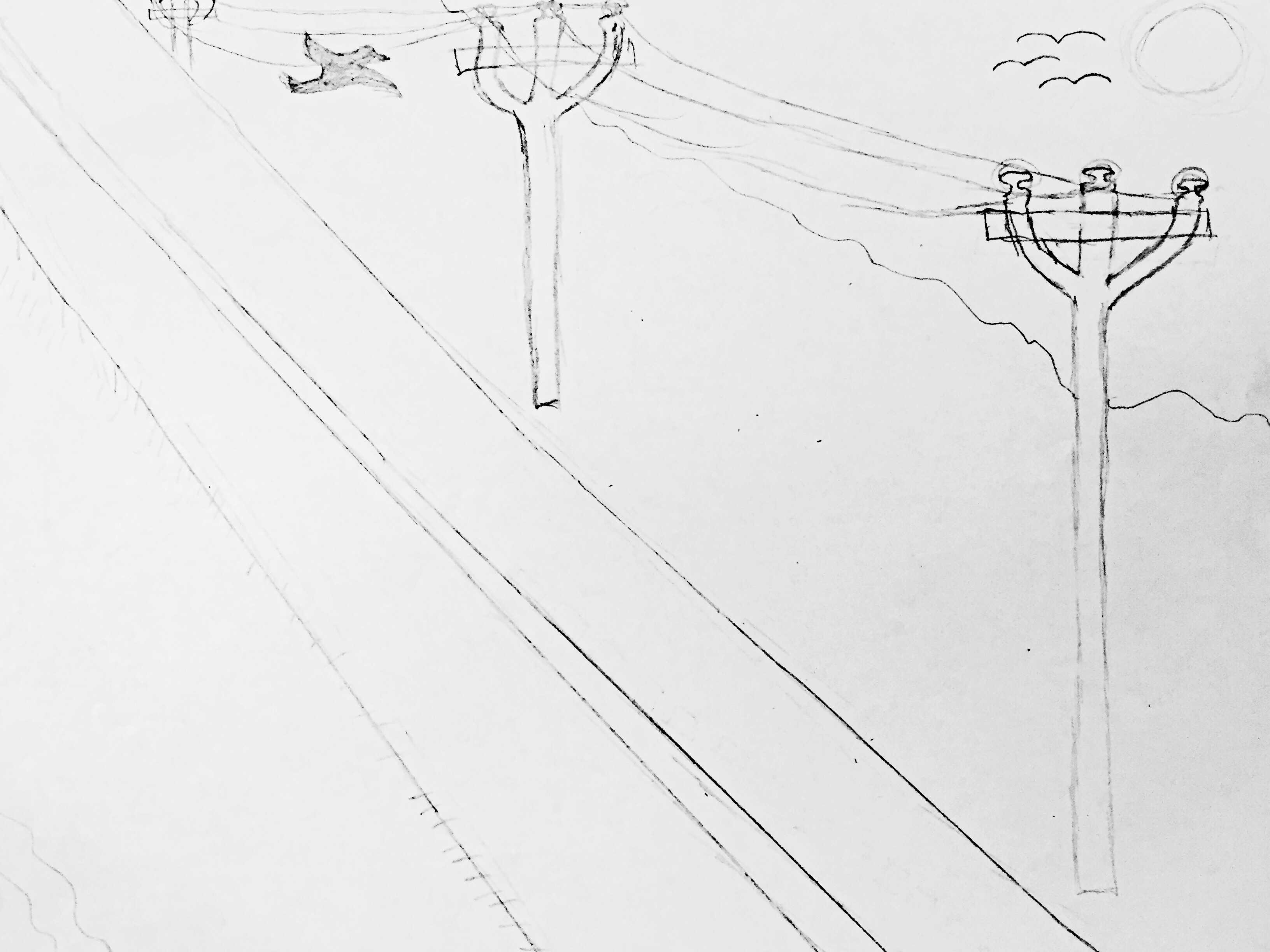
That Fine Line (Drawing By Our 10 Year Old) © Cleo Clark-Athans

We didn’t know why we wanted to go the beach yesterday, other than to feel the warmth of the sun on our faces. But it was no ordinary day for us at the shore. A silently suffering young mallard brought us the bittersweet gift of awareness of a hazard to her species. Have you witnessed such an event? How hard do you think it will be to raise this issue with our utility company and ask them to take the necessary measures to help our friend?