Week 1: Month Less Plastic

One Week's-worth of Plastic to the Landfill

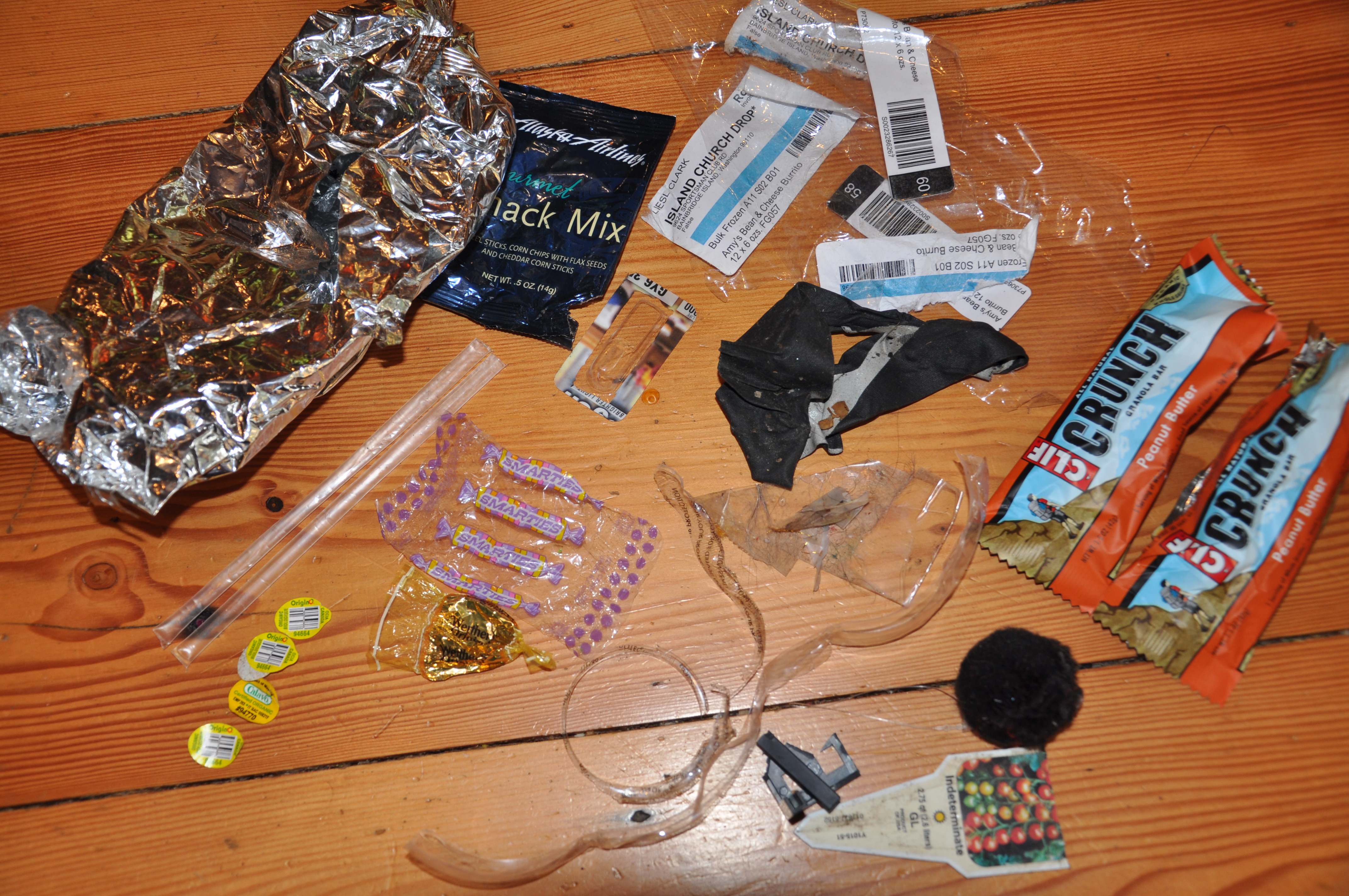
I never thought I’d be taking pictures of my trash for the public to see. But there it is: one week’s-worth of plastic from our household that will go to the landfill.

Now here are my excuses and explanations: First, we’ve had 5 people living in this household, 1 guest visiting from Nepal and decidedly perplexed by our hoarding of all bits plastic that are going into our dust bin. The other general excuse is that more than half of these items were acquired in our household before our month less plastic began. I’m tracking the plastics that are to go to the landfill this month. So, those are my general excuses. The others are related to each item:

Tin-foil-looking stuff that crackers were wrapped in: no specific excuse. Crackers bought before month less plastic and we finished them this past week. Since then, we’ve found some zero waste crackers (that is, if you count recycling in the zero waste mix.)

Paper stickers attached to our bulk order polyethylene bags: What can I say? They need to be cut off the bags and the bags are then put into polyethylene recycling.

Honey straws: I couldn’t say no to the kids the week before our month less plastic, this is the result one week later — to the landfill.

Tape: Scotch tape and gaffer tape do end up in the landfill unfortunately. Haven’t come up with an alternative so far for specific needs (like film needs with gaffer tape and kids projects with clear tape)

Broken black plastic toy: It broke into several pieces no superglue is going to heal.

Clif Bars: Clif Bar sent them to us as part of their support for our hungry team members taking part in educational projects on zero waste in Nepal. We pack all our plastics out of remote areas and these were leftovers that the kids consume as emergency food. Clif Bar is currently researching better alternatives to the plastics in their packaging. And, they’re supporting projects like ours in Nepal, working to reduce plastics trickling down the world’s highest watersheds. They’re a great company.

Black ball thing: That’s a puffball that was used in a child’s art project and it has a ton of glue on one side. Don’t think it’ll be re-used in this lifetime. Surely it’s made of some petroleum product.

Safety Seals: Visiting acupuncturist family member brought herbs for my appendectomy recovery. The herbs come in bottles that have safety seals on their necks and under the lid. UGGH.

Nursery plant label: This one broke. Others, I’ve been trying to send back to the nurseries that generate them.

Alaska Air Snack Packaging: Guests who knew nothing about our month less plastic.

Specialty light bulb packaging: These sorts of plastics in packaging are probably our biggest challenge in a zero waste home. There are NO alternatives.

Organic Stickers: During the week before month less plastic we purchased some organic bananas (see previous post) and tomatoes. Oddly, if they aren’t organic, the sticker’s made of paper. We love the paradox of purchasing organic veggies packaged in nonorganic materials. Was worthy of a film by our garbage spies, but our favorite local store didn’t like that idea so you’ll have to come see it in person to learn how to shop zero waste.

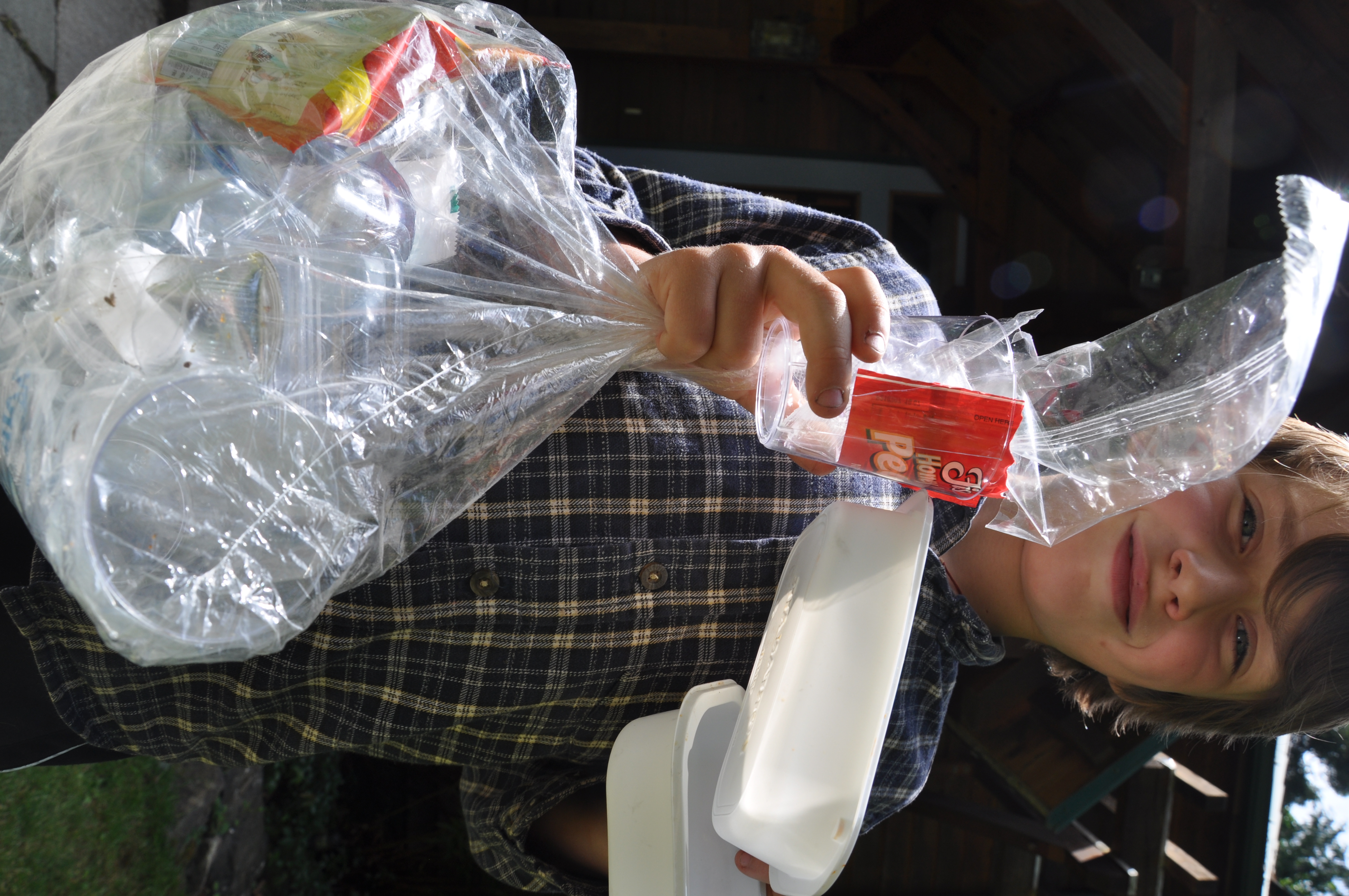
Final excuse: If you compare our plastic landfill waste for 5 people in a week to the plastic landfill waste generated by one passenger on Korean Air on a 15-hour flight between Seoul and Seattle, we win hands down!
Plastic for 1: Seoul to Seattle

Month Less Plastic

Plastic-free for a month

Today is the beginning of a new adventure my family and a few other friends’ families have signed up for: a month less plastic. What?

Essentially, the challenge is to reduce our plastic intake, and share what we learn with each other. If you’re interested in this endeavor, please join us, and write in to share your experiences in curbing our toxic love affair with plastic. It permeates parts of our lives well beyond our kitchens and children’s playrooms, and that’s what this adventure is meant to highlight. What will we learn from trying to use less plastic, whether it’s a focus on simply not allowing new plastics to enter our homes or a study on which plastics we use each day and how we can keep them useful so they never end up in a landfill? Will this exercise complicate our everyday rituals or simplify them? We’re looking for more clarity in defining our relationships with the materials we use each day. Are they healthy? Will the things I throw away or recycle end up part of a new plastic item or will they land in a landfill, or the ocean? What impact will they have in the long run?

All solutions to the problem of persistence of plastics in our environment point to less dependence on plastic. So, we’re going to give it a try. A month less plastic.

But first, I need to rewind to the day before the start of our month. Yesterday. I promise, we didn’t head to the store to stock up on all the things made of or packaged in plastic we’ll need for a month. In fact, we went to a local store to purchase much-needed toilet paper and bananas. Bananas don’t grow here so I’m violating the local motif, but we’re known to do that with a few of our staples: bananas, rice, flours, nuts, avocados, coconuts.

Organic Bananas?

Bananas came in two varieties: organic and non-organic. We aimed for the organic bananas and, to our dismay, found they not only had a couple of organic stickers on them fashioned in the shape of a leaf with a drop of dew on them (made of plastic) but they also had a large strap of plastic tape around the bunch. Adding insult to injury, a ‘sock’ of clear polyethylene plastic was stuck to the stem connecting the bunch together. One plastic over-glued sticker claimed the bananas were “raised by mother nature.” How lovely it will be to see that sticker mushed together with all the other discarded plastics, decidedly not raised by mother nature, in our local landfill in about a week.

Organic/Non-organic, Plastic/no-plastic

Organic/Non-organic, Plastic/no-plastic

On the other side of the produce island, we could see the non-organic “regular” bananas had only a single paper sticker on each bunch. The decision was a no-brainer. Based on our month less plastic agenda, the non-organic bananas ruled out. The organic specimens were a paradox per bunch staring us banana-loving monkeys in the face.

Raised by Mother Nature

We leave you with a short film dedicated to the launch of our month less plastic. It was produced, shot, written, directed, composed and performed by our up-and-coming one-boy film-making machine. I’ll qualify this introspective film by simply saying that it was made entirely without my knowledge. While I was attempting to make a film about how easy it is to shop at your local store and generate zero waste, this film was being made. Sadly, after shooting, editing, and completing our very upbeat film about how one can succeed in zero waste shopping, I was contacted by an executive of the local store and discouraged from pursuing the film any further. We hope you enjoy the film that will have to take its place:

Rag Pickers of the Rotary Auction

They raise hundreds of thousands of dollars in a matter of days, all to the credit of local volunteers and dedicated rotarians. Bainbridge Island’s Rotary Club puts on a rummage sale and auction each year that’s so big it can be seen from Google Earth’s satellites. What’s their secret? Our stuff. Our unwanted mountains of household items we don’t need anymore, but still have a long life in them for others to use. Thousands of home/kitchen/garden things are dropped off each day for 5 days, and all are shopping-carted over to the various departments of the sale: housewares, arts & crafts, sporting goods, children’s books, lawn mowers. It’s a shabby chic department store for a day with prices you can’t beat anywhere in the northwest.

I’m writing this post because we just spent the last week volunteering at the Auction, creating a special job for ourselves: dumpster duty. We attempted to divert as much recyclable and reusable items from that 40-yarder as we could. It was a race to keep up with the myriad trash bins that were being thrown in without our editorial input. The end result: we made a huge dent on the amount of waste to be shipped and dumped in Bremerton, but we’re troubled by the amount of usable and recyclable materials that still made it in. Perhaps a whole shipping container-full.

We need more rag pickers. The effort is exhilarating, a modern archaeological peek into our material culture and the resources we find of little use that would be a boon to another culture or even your neighbor down the street. There are lessons to be learned, but we’re still learning them. Please watch our movie and give us your ideas, your thoughts on how we can stop the daily flow of resources into our landfills.